
La Rosa Holdings Corp's Share Resale and Its Implications for Investor Sentiment and Liquidity
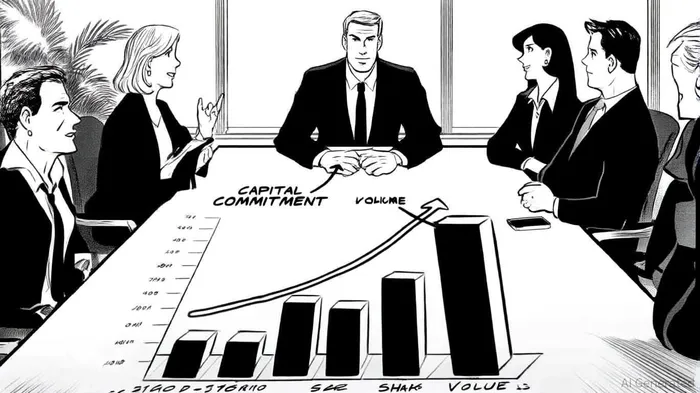
La Rosa Holdings Corp. (LRHC) has embarked on a high-stakes capital-raising strategy that underscores both ambition and risk. In August 2025, the company amended its Equity Purchase Facility Agreement to increase its capital commitment from $150 million to $1.0 billion, a 600% leap[1]. This move, coupled with a concurrent $500,000 stock buyback program[5], reveals a dual-edged approach to shareholder value creation. While the buyback signals short-term confidence in the stock's intrinsic worth, the massive equity facility raises critical questions about long-term dilution and market perception.
Strategic Motives: Growth or Overreach?
The expanded equity facility, which allows La RosaLRHC-- to issue up to 283,333,333 shares under a resale registration statement[1], is framed as a tool to fund "growth initiatives, acquisitions, technological investments, or geographic expansion"[2]. For a company with a market capitalization of approximately $10 million[1], such a large-scale capital infusion suggests an aggressive pivot toward scaling operations. However, the strategic logic hinges on unproven assumptions. As noted by Bloomberg in its analysis of similar transactions, "equity facilities of this magnitude often reflect a company's desperation to access liquidity rather than a calculated growth strategy"[3].
The timing of these moves is equally telling. La Rosa redeemed all outstanding warrants in January 2025, extinguishing 2.4 million shares[3], a step that streamlined its capital structure. Yet the subsequent $1.0 billion equity facility—requiring shareholder approval by October 17, 2025[1]—risks undoing that progress. The company's reliance on institutional investors, with A.G.P./Alliance Global Partners and Curvature Securities collecting 1.665% of proceeds as fees[2], further complicates the calculus.
Market Impact: Liquidity vs. Dilution
The immediate market reaction to La Rosa's announcements has been muted, but the long-term implications are stark. A $1.0 billion equity facility at an implied price of $3.53 per share (based on the 283 million share resale volume[1]) would dilute existing shareholders by over 9,000% relative to the company's $10 million market cap. Such dilution typically depresses investor sentiment, as seen in comparable cases where equity overhangs led to prolonged stock underperformance.
Meanwhile, the $500,000 buyback program—while symbolically positive—pales in comparison to the scale of the resale. This dichotomy creates a credibility challenge: Is La Rosa prioritizing shareholder returns, or is the buyback merely a public relations gesture to offset the negative optics of massive dilution? As one Wall Street analyst observed, "The juxtaposition of a token buyback and a billion-dollar equity facility reads more like a liquidity crisis play than a growth strategy"[5].
Investor Sentiment: A Fragile Balancing Act
Investor sentiment toward La Rosa is likely to remain volatile until the October 17 shareholder vote[1]. The company's controlled structure—led by founder Joseph La Rosa, who holds significant voting power[3]—reduces the likelihood of shareholder pushback but does not eliminate concerns about governance. Retail investors, in particular, may view the resale as a red flag, given the potential for share price erosion.
The resale's execution method also introduces uncertainty. While the SEC-approved registration statement allows for flexible resale methods[1], a flood of shares entering the market could trigger a liquidity crunch. Historical data from the SEC suggests that companies with market caps below $50 million often see price declines of 15-30% following large-scale resales.
Conclusion: A High-Risk Bet on Growth
La Rosa Holdings' capital strategy represents a high-stakes gamble. The $1.0 billion equity facility could provide the firepower needed for transformative growth, but the risks of dilution, governance concerns, and market skepticism are formidable. For investors, the key variables will be the outcome of the October shareholder vote and the pace at which the company deploys the capital. Until then, the stock remains a speculative play with asymmetric risks.





Comentarios
Aún no hay comentarios