
L3Harris' Strategic Divestiture and Expansion in Defense Propulsion: Assessing Long-Term Growth and Shareholder Implications
L3Harris Technologies has emerged as a pivotal player in the defense propulsion sector, leveraging a dual strategy of strategic divestitures and targeted expansions to align with evolving national security demands. For shareholders, the company's recent moves-ranging from a $200 million GMLRS propulsion contract to a near-completed $500 million stake sale in its space propulsion portfolio-signal a recalibration of priorities that could shape its long-term growth trajectory.
Defense Propulsion Expansion: A Foundation for Sustained Revenue
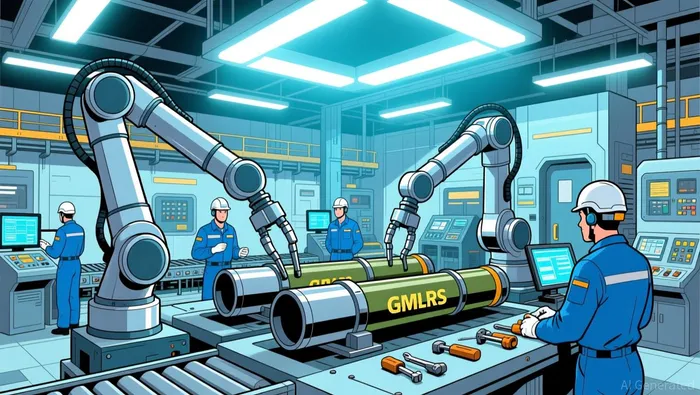
L3Harris' terrestrial defense propulsion efforts are anchored in its partnership with Lockheed MartinLMT-- to supply insensitive munition propulsion units for the Guided Multiple Launch Rocket System (GMLRS). A report by highlights a $200 million follow-on contract secured in 2023, marking the first production order processed through the company's newly completed energetics facility in Camden, Arkansas. This facility, constructed under a Defense Production Act Title III cooperative agreement, is projected to boost annual GMLRS motor output by over 30 percent.
The company's commitment to automation and facility modernization further underscores its focus on efficiency. A $215.6 million cooperative agreement awarded in 2023 has already enhanced GMLRS motor production by nearly 80 percent. Such investments not only position L3HarrisLHX-- to meet surging demand for precision-guided artillery systems but also reinforce its role as a critical supplier in the U.S. military's modernization push.
Strategic Divestiture: Refocusing on Core National Security Priorities
While L3Harris is doubling down on terrestrial defense propulsion, it is simultaneously divesting non-core assets to sharpen its focus. A near-$500 million stake sale of its space propulsion portfolio to AE Industrial Partners-a private equity firm-has been reported by SatNews. Under this transaction, L3Harris retains a 40% minority stake in businesses producing RL-10 rocket engines and in-space propulsion systems.
 This move aligns with the company's broader strategic pivot toward national security initiatives, such as the "Golden Dome" missile defense architecture. By monetizing a portion of its space propulsion assets, L3Harris can redirect capital toward high-priority defense programs while maintaining exposure to the space sector through its retained stake. For shareholders, this balance between liquidity and strategic continuity could mitigate risks associated with overexposure to volatile space markets.
Long-Term Implications for Shareholders
The interplay between expansion and divestiture suggests a calculated approach to capital allocation. L3Harris' increased production capacity for solid rocket motors-driven by a reported surge in demand for rapid-delivery propulsion solutions-positions it to capitalize on defense budgets prioritizing readiness and agility. Meanwhile, the stake sale provides a financial buffer without entirely exiting the space propulsion market, preserving upside potential in a sector projected to grow as governments and private firms invest in satellite and deep-space technologies.
However, shareholders must weigh these benefits against potential trade-offs. The divestiture of space propulsion assets may reduce recurring revenue streams, though the retained 40% stake ensures continued participation in high-margin contracts. Additionally, the company's emphasis on defense propulsion aligns with U.S. policy trends, including the Indo-Pacific strategy and enhanced missile defense spending, which could drive sustained demand for L3Harris' products.
Conclusion
L3Harris' strategic realignment reflects a pragmatic response to shifting defense priorities and market dynamics. By expanding its terrestrial propulsion capabilities while selectively divesting space assets, the company is positioning itself to deliver consistent growth in a sector where U.S. defense spending remains robust. For shareholders, the key will be monitoring how effectively L3Harris balances near-term profitability with long-term innovation, particularly as it navigates the dual pressures of geopolitical volatility and technological disruption.





Comentarios
Aún no hay comentarios