
The L2 Security Debate: Are Ethereum's Scaling Solutions Undermining Its Value Proposition?
The ZKZK-- vs. Optimistic Rollup Dilemma
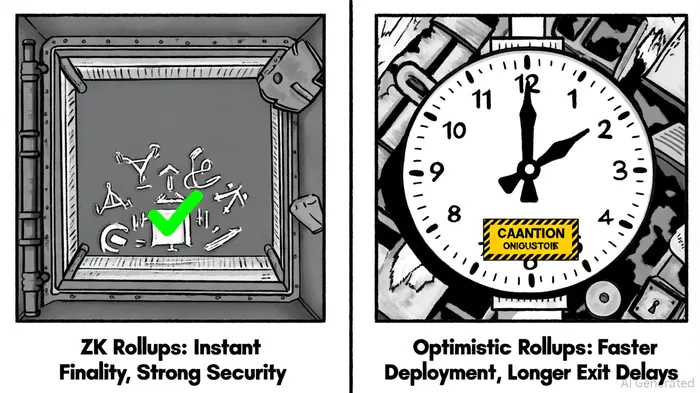
The EthereumETH-- L2 landscape is split between two dominant architectures: ZK rollups and Optimistic rollups. ZK rollups, which use cryptographic proofs to validate transactions, offer near-instant finality and stronger security guarantees. For instance, ZK rollups like StarkNetSTRK-- and zkSyncZK-- Era achieve mainnet finality in 20–30 minutes, compared to the 7-day withdrawal periods of Optimistic rollups like Arbitrum and Optimism, according to a Mitosis analysis. This makes ZK rollups ideal for high-value transactions and privacy-centric applications. However, their computational complexity and EVM incompatibility pose development challenges.
Optimistic rollups, by contrast, prioritize speed and EVM compatibility, allowing developers to deploy existing smart contracts with minimal modifications. Yet, their reliance on a 7-day fraud-proof challenge period introduces operational risks. The Coinbase Base freeze in early 2025, caused by a sequencer outage, highlighted the centralization risks inherent in these models, according to The Currency Analytics. While ZK rollups are gaining traction for their security, Optimistic rollups remain popular for their developer-friendly ecosystems.
Security Incidents and Capital Reallocation
Security breaches have forced institutions to reassess their L2 exposure. The Wormhole hack in 2023, which exploited cross-chain bridge vulnerabilities, triggered a $9.4 billion inflow into Ethereum ETFs in Q2 2025-far outpacing Bitcoin's $552 million-driven by Ethereum's proof-of-stake model and regulatory clarity, according to a Bitget report. Similarly, the Coinbase Base freeze underscored the fragility of sequencer-centric architectures, prompting firms like BlackRock and Apollo to prioritize Ethereum-based cross-chain solutions with institutional-grade security, as detailed in a CryptoNewsTop piece.
Post-incident, institutional capital has reallocated toward Ethereum L1 and ZK rollups. By 2025, over 19 publicly traded companies reclassified Ethereum as a strategic asset, staking 4.1 million ETH ($17.6 billion) to create self-sustaining price cycles, the Bitget report found. Meanwhile, ZK rollups' cryptographic guarantees have attracted $223 billion in DeFi TVL, dwarfing Bitcoin's limited utility, the same Bitget analysis noted. This shift reflects a broader trend: institutions are prioritizing security and regulatory alignment over pure scalability.
The Institutional Investment Playbook
Institutional adoption of Ethereum is accelerating, with U.S. spot Ethereum ETFs reaching $26.5 billion in value and 35.7 million ETH staked ($138 billion) by 2025, according to Coinotag. These trends are bolstered by Ethereum's roadmap, including EIP-4844 (Proto-Danksharding), which enhances L2 scalability while preserving decentralization - a point also highlighted by The Currency Analytics. Regulatory frameworks like the U.S. CLARITY Act and Europe's MiCA further solidify Ethereum's appeal, reclassifying it as a utility token and enabling SEC-compliant staking, the Bitget report observed.
However, challenges persist. Liquidity fragmentation across L2s and bridge vulnerabilities remain pain points. For example, the Wormhole hack exposed flaws in multi-signature custody models, leading to stricter audit requirements and decentralized guardian networks, as CryptoNewsTop documented. Institutions are now conducting "Layer 2 readiness assessments," evaluating factors like sequencer decentralization and bridge audit history, according to Kenson Investments.
The Path Forward: Balancing Security and Scalability
Vitalik Buterin has emphasized that Ethereum's L2s must preserve decentralization to maintain institutional trust. While ZK rollups offer superior security, their complexity and EVM incompatibility hinder adoption. Conversely, Optimistic rollups' centralization risks-exacerbated by sequencer outages-demand urgent solutions. The Ethereum community is exploring hybrid models, such as optimistic rollups with validity proofs, to merge the strengths of both architectures, according to a TokenMinds deep dive.
For institutions, the key lies in diversifying exposure. While ZK rollups are ideal for high-security use cases, Optimistic rollups remain viable for EVM-compatible applications. Meanwhile, Ethereum L1's role as a settlement layer ensures that even in the event of a 51% attack, invalid blocks cannot validate transactions - a resilience noted by Coinotag. This resilience has reinforced confidence, with over $35 billion locked in L2 ecosystems despite ongoing debates, as The Currency Analytics observed.
Conclusion
Ethereum's L2 solutions are not undermining its value proposition-they are evolving it. By addressing security gaps and centralization risks, these scaling solutions are enabling Ethereum to scale without compromising its foundational principles. For institutions, the path forward involves strategic capital allocation, favoring ZK rollups for security-critical applications and Optimistic rollups for developer-friendly ecosystems. As regulatory clarity and technological advancements converge, Ethereum's L2s will remain pivotal in bridging the gap between blockchain's promise and institutional reality.





Comentarios
Aún no hay comentarios