
Kymera Therapeutics: Strategic Momentum and Pipeline Potential Post-Morgan Stanley 2025 Conference
Kymera Therapeutics (NASDAQ: KYMR) has emerged as a focal point in the biotech sector following its presentation at the Morgan StanleyMS-- 23rd Annual Global Healthcare Conference on September 9, 2025. The company's advancements in targeted protein degradation (TPD) and its robust clinical-stage pipeline have drawn significant investor and analyst attention, particularly around its lead candidate, KT-621, a first-in-class oral STAT6 degrader. This article evaluates Kymera's strategic momentum, pipeline differentiation, and market potential, drawing on insights from the conference and third-party validation.
Strategic Momentum: A Pipeline in Motion
Kymera's STAT6 degrader, KT-621, has become the cornerstone of its immunology strategy. The Phase 1 trial results, announced in Q2 2025, demonstrated robust target engagement across all dosages above 1.5 mg, with no serious adverse events reported[1]. This safety profile, combined with the drug's ability to degrade STAT6—a key driver of Th2-mediated inflammation—positions KT-621 as a potential oral alternative to injectable biologics like dupilumab (Dupixent) in treating atopic dermatitis and asthma[2].
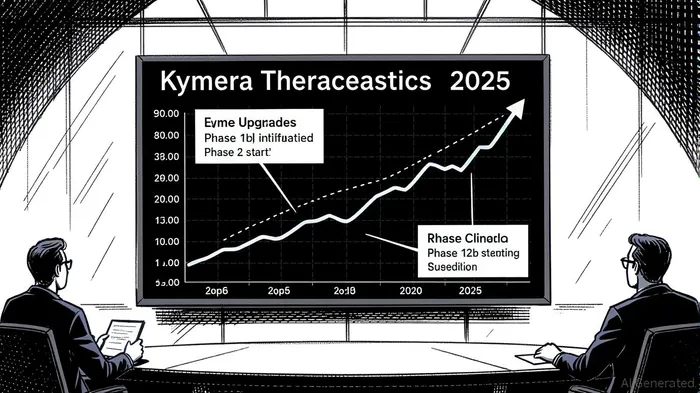
The company is now advancing KT-621 into Phase 1b trials in patients with moderate-to-severe atopic dermatitis, with data expected by Q4 2025[3]. Simultaneously, KymeraKYMR-- plans to initiate Phase 2b trials in both atopic dermatitis and asthma by early 2026[4]. These trials represent a critical inflection point, as they will test the drug's efficacy in real-world patient populations and validate its potential to disrupt a $12 billion Th2 disease market[5].
Kymera's financial strength further underpins its momentum. As of July 31, 2025, the company held $1 billion in cash, providing a runway through mid-2028[6]. This capitalization allows for aggressive clinical development without immediate reliance on dilutive financing, a key concern for biotech investors.
Differentiation and Market Opportunity
The Th2 disease market remains underserved, with only 3% of patients receiving advanced systemic therapies[7]. KT-621's oral formulation addresses a major unmet need: the inconvenience and cost of injectable biologics. Analysts have highlighted its “biologics-like efficacy with oral convenience” as a key differentiator[8]. Preclinical data in non-human primates and rodents further support its safety and potency, with degradation of STAT6 observed even at high doses[9].
Beyond KT-621, Kymera's pipeline includes IRAK4 degraders in collaboration with SanofiSNY--, targeting autoimmune diseases[10]. This partnership not only diversifies Kymera's therapeutic focus but also leverages Sanofi's expertise in clinical development, reducing risk for Kymera.
Analyst Validation and Investor Sentiment
Post-conference, Kymera's stock received a boost from major analysts. Morgan Stanley upgraded the stock to “Overweight” from “Equal Weight,” raising its price target from $49 to $79[11]. CitiC-- and Bank of AmericaBAC-- followed suit, citing KT-621's “potent efficacy, clean safety, and promising biomarker data”. These upgrades reflect growing confidence in Kymera's ability to execute on its clinical roadmap and capture market share in Th2 diseases.
However, challenges remain. Kymera's Q2 2025 earnings report showed a wider-than-expected loss (EPS of -$0.95 vs. forecast of -$0.83) and revenue of $11.5 million, below the projected $20 million[13]. While this raises questions about near-term profitability, the company's extended cash runway and focus on high-impact programs suggest a long-term play rather than a short-term trade.
Risks and Competitive Landscape
Despite its strengths, Kymera faces risks inherent to biotech innovation. The uncertainty of clinical trials—particularly in Phase 2b—remains a wildcard. If KT-621 fails to demonstrate superior efficacy or safety in later-stage trials, its market potential could be constrained. Additionally, competition from established biologics and emerging small-molecule therapies (e.g., JAK inhibitors) could limit adoption.
Another risk lies in the novelty of TPD technology. While Kymera's approach has shown promise, the broader acceptance of degraders in immunology is still evolving. Regulatory hurdles or unforeseen toxicities could delay approvals.
Conclusion: A High-Stakes Bet with High Rewards
Kymera Therapeutics is navigating a pivotal phase in its development. The successful Phase 1 data for KT-621, coupled with analyst upgrades and a strong balance sheet, positions the company as a compelling long-term investment. However, the path to commercialization hinges on the success of upcoming Phase 2b trials and the ability to differentiate its oral degraders in a competitive market.
For investors, Kymera represents a high-risk, high-reward opportunity. The potential to redefine Th2 disease treatment with an oral degrader is significant, but execution will be key. As the company moves into 2026, all eyes will be on the Phase 2b readouts and the broader adoption of TPD in immunology.





Comentarios
Aún no hay comentarios