
KuCoin's Strategic Fee Adjustments and Their Impact on Crypto Liquidity and Trader Incentives
Tiered Rebates and KCS-Based Discounts: A Structured Incentive Framework
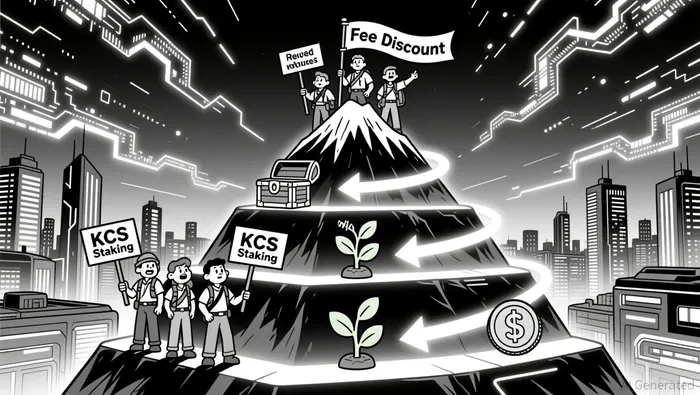
KuCoin's fee structure is now segmented into four loyalty tiers-Explorer, Navigator, Voyager, and Pioneer-each unlocking progressively higher rewards for KCS stakers. For instance, the Explorer tier requires as little as 1 KCS staked, granting access to basic benefits like withdrawal fee rebates and KuCard cashback. At the top tier, Pioneer participants, who hold 150,000 KCS and maintain a 30-day trading volume of 20,000 BTC, enjoy 0.0125% maker fees and 0.03% taker fees-a stark contrast to the base 0.1% rate for Tier 1 users according to KuCoin's announcement. This tiered system incentivizes both KCS accumulation and sustained trading activity, effectively aligning user behavior with the exchange's liquidity goals.
The Tiered Trading Fee Discount Program further reinforces this dynamic. By recalculating user tiers daily at 00:00 AM (UTC+8), KuCoin ensures a fluid and competitive environment where traders can optimize their fee rates by adjusting their KCS holdings and trading volumes according to the exchange's policy. This real-time recalibration not only rewards active participation but also encourages strategic trading patterns that enhance market depth.
Liquidity Provision and Market Depth: A Win for Institutional and Retail Participants
KuCoin's Market Making Incentive Scheme directly targets liquidity providers, offering fee discounts and cash rewards for maintaining balanced order books. Professional market makers can apply for the MM+1 tier, which grants access to lower fees and additional incentives for meeting volume thresholds according to KuCoin's institutional program. This program is particularly impactful in volatile crypto markets, where liquidity gaps can destabilize price discovery. By reducing the cost of providing liquidity, KuCoin attracts both institutional and retail participants to deepen its order books.
Retail traders also benefit indirectly. For example, the Market Maker Referral Program allows existing liquidity providers to refer new clients, earning fee discounts and cash rewards for both parties according to the exchange's referral policy. This creates a flywheel effect: as more liquidity providers join, market depth improves, which in turn attracts more traders seeking tighter spreads and reduced slippage.
Trader Behavior and Regional Impacts: KCS as a Behavioral Catalyst
The integration of KCS into fee discounts has a profound effect on trader behavior. According to a report by CoinLaw, KCS holders are 30% more likely to engage in high-frequency trading compared to non-holders, as the token's utility directly reduces their cost of entry according to CoinLaw's statistics. This behavioral shift is particularly evident in high-growth regions like the Middle East and Latin America, where spot trading volumes on KuCoin grew by double digits in H1 2025.
Moreover, KCS's tokenomics play a role in sustaining these incentives. Monthly token burns, such as the 62,386 KCS burned in September 2025, have reduced the circulating supply by over 5% year-to-date according to CoinLaw's data. This deflationary mechanism not only supports KCS's price but also reinforces its value proposition as a utility token. As of July 2025, KCS traded at $10.91, with a 2.21% daily gain, reflecting renewed investor confidence in its ecosystem according to CoinLaw's market analysis.
Strategic Implications for Traders and Liquidity Providers
For active traders, KuCoin's fee structure creates a self-reinforcing cycle: higher KCS holdings lead to lower fees, which in turn enable more frequent trading and higher potential returns. This is especially advantageous for algorithmic traders and arbitrageurs who rely on low-cost execution.
Liquidity providers, meanwhile, benefit from a dual incentive system. The Market Making Incentive Scheme rewards them for maintaining balanced order books, while the KCS Loyalty Program offers additional discounts on their trading fees. This combination reduces the risk-adjusted returns of liquidity provision, making it an attractive option for capital-efficient strategies.
Conclusion: A New Paradigm for Crypto Exchange Economics
KuCoin's strategic fee adjustments represent a paradigm shift in how exchanges monetize liquidity and incentivize user participation. By tying KCS utility to trading activity and liquidity provision, the platform is not only deepening its markets but also fostering a community of engaged users who benefit from its ecosystem. For investors and traders, this creates a compelling opportunity to leverage KuCoin's fee structure for cost optimization and alpha generation. As the crypto market evolves, exchanges that prioritize liquidity and user incentives-like KuCoin-are likely to emerge as key players in shaping the next phase of decentralized finance.







Comentarios
Aún no hay comentarios