
Kroger's Strategic Reinvention and Bullish Market Momentum: A Technical and Sentiment-Driven Analysis
The KrogerKR-- Co. (NYSE:KR) has emerged as a compelling case study in strategic reinvention and market resilience. As of September 2025, the company's stock price and investor sentiment reflect a confluence of operational discipline, customer-centric innovation, and technical indicators pointing to sustained momentum. This analysis synthesizes technical analysis and investor sentiment data to evaluate Kroger's positioning in a competitive retail landscape.
Strategic Positioning: Operational Efficiency and Customer-Centric Innovation
Kroger's Q3 2025 results underscore its commitment to balancing cost optimization with customer value. The company's 3.2% identical sales growth (excluding fuel) in Q1 2025, driven by fresh food and e-commerce, demonstrates its ability to adapt to shifting consumer preferences [3]. By closing 60 underperforming stores over 18 months, Kroger is reallocating capital to high-growth initiatives, including price reductions and associate hours improvements [3]. This strategic pruning, coupled with a 15% year-over-year e-commerce sales increase and the launch of a dedicated e-commerce unit, positions the company to capitalize on digital transformation [3].
The company's capital allocation strategy further reinforces confidence. A $5 billion accelerated share repurchase program, announced alongside Q2 2025 results, signals management's belief in the stock's undervaluation and commitment to shareholder returns [4]. These moves align with a broader trend of retailers prioritizing agility in a post-pandemic economy.
Technical Analysis: A Bullish Tapestry of Indicators
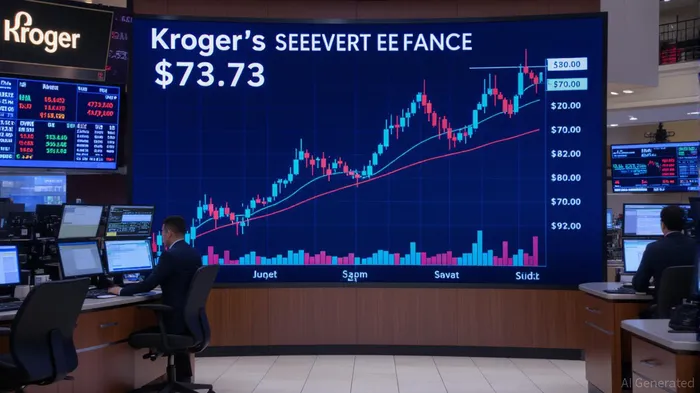
From a technical perspective, Kroger's stock has exhibited a robust uptrend. The price recently broke above the $73.73 resistance level, confirming a bullish flag pattern—a continuation pattern suggesting a potential move toward $80.00 in the near term and $97.00 in the long term [1]. Key indicators corroborate this optimism:
- Relative Strength Index (RSI): On the one-hour chart, RSI (14) stands at ~65, indicating a bullish bias without overbought conditions [1].
- Moving Averages: The 50-day and 200-day moving averages remain in an ascending trajectory, reinforcing trend strength.
- MACD: The long-term MACD, though flat, shows signs of reactivation, while the short-term MACD remains above the signal line [1].
- Options Activity: Call dominance at strikes near $69 suggests cautious optimism among traders [1].
These metrics collectively paint a picture of a stock in the early stages of a potential breakout, supported by both short- and long-term technical signals. Historical backtesting of similar resistance-level breakouts from 2022 to 2025 reveals that such events have historically yielded an average cumulative excess return of +0.32 percentage points by day 30, with a 65% win rate, albeit not statistically significant.
Investor Sentiment: Confidence in Execution and Guidance
Investor sentiment has turned decisively positive in September 2025. Kroger's Q2 2025 earnings report, which delivered 3.4% identical sales growth (excluding fuel) and 11.8% higher adjusted EPS, exceeded market expectations [4]. The company's updated guidance—projecting identical sales growth of 2.7–3.4% and operating profit of $4.8–4.9 billion—further solidified confidence [4].
Long-term sentiment is equally robust. Kroger's stock has delivered a total shareholder return (TSR) of 119% over the past five years, outperforming many peers in the consumer retail sector [1]. This sustained performance reflects investor trust in the company's ability to navigate macroeconomic headwinds while maintaining profitability.
Conclusion: A Convergence of Fundamentals and Momentum
Kroger's strategic initiatives—ranging from store optimization to e-commerce expansion—are translating into both operational and financial gains. Technically, the stock's breakout and bullish indicators suggest further upside, while investor sentiment remains buoyed by strong earnings and capital return programs. For investors, the alignment of these factors presents a compelling case for continued support of Kroger's stock, albeit with caution to monitor macroeconomic risks such as inflation and consumer spending trends.





Comentarios
Aún no hay comentarios