
Kroger's Store Closures Signal a Strategic Pivot—Is This a Contrarian Opportunity?
Kroger's announcement of 60 store closures over the next 18 months marks a pivotal shift in its strategy: shedding underperforming locations to focus on high-margin, customer-centric initiatives like e-commerce, pharmacy services, and fresh foods. While the move carries short-term costs—a $100 million impairment charge—the company's financial discipline and growth metrics suggest this could be a calculated step toward long-term profitability. For investors, the question is whether the risks of execution outweigh the potential rewards of a leaner, more agile retail giant.
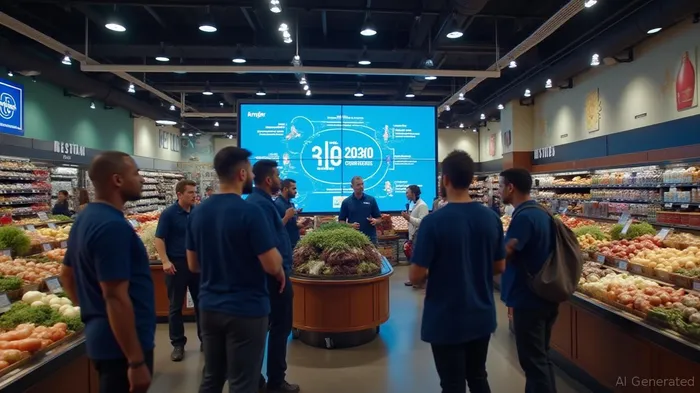
The Rationale: Closing to Reopen
Kroger's decision is rooted in a stark reality: not all stores contribute equally to profitability. By targeting underperforming or overlapping locations, the company aims to reallocate capital to areas with higher growth potential. E-commerce sales, for instance, grew 15% in Q1 2025, yet remain unprofitable—a gap KrogerKR-- is now prioritizing. Meanwhile, identical-store sales (excluding fuel) rose 3.2%, signaling underlying demand for its core grocery offerings.
The closures also reflect a broader trend in retail: strategic contraction to fuel expansion. Walmart and Target have followed similar paths, closing low-traffic stores while investing in urban locations and digital infrastructure. For Kroger, this pivot aligns with its post-merger reset after its $24.6 billion Albertsons deal collapsed in December 2024. With $3.6–$3.8 billion earmarked for 2025 capital expenditures—including 30 new stores and remodels—the company is doubling down on its physical and digital footprints.
Financial Metrics: A Mixed Near-Term Picture, But Steady Guidance
While Kroger's net income fell 8.6% in Q1 2025 to $866 million—due largely to the impairment charge—its adjusted operating profit rose 1.3% to $1.52 billion. Gross margin improved to 23% of sales, driven by cost reductions and the sale of its Specialty Pharmacy division. Management reaffirmed full-year guidance for adjusted operating profit ($4.7–$4.9 billion) and earnings per share ($4.60–$4.80), suggesting the closures are already factored into expectations.
The $100 million impairment is a one-time hit, but the savings from shuttered stores could free up capital for e-commerce scaling, supply chain optimization, and store-level upgrades. Kroger's 3.7% sales growth and 2.25%–3.25% full-year identical-store sales forecast further indicate confidence in its strategy.
Risks and Opportunities for Investors
Risks:
1. Execution Complexity: Closing stores without disrupting supply chains or employee morale is a tightrope walk. Kroger's pledge to rehouse affected workers is a positive step, but operational hiccups could strain resources.
2. E-Commerce Profitability: Despite growth, online sales remain unprofitable. Kroger must prove it can scale fulfillment networks without eating into margins.
3. Competitive Pressure: Walmart and Amazon are aggressively expanding in groceries, leaving little room for error.
Opportunities:
1. Valuation Attraction: Kroger's stock trades at ~10x forward earnings—below its five-year average and far cheaper than Amazon (AMZN) or Instacart-backed rivals. This discount reflects skepticism about its turnaround, but the closures could narrow the gap.
2. Market Share Defense: By focusing on high-traffic areas and fresh foods (a category with 12% margin potential), Kroger could strengthen its position against dollar stores and online rivals.
3. Balance Sheet Resilience: With $1.2 billion in cash and manageable debt, Kroger has flexibility to weather short-term headwinds.
Comparable Precedents: When Closures Paid Off
Retailers like Sears and J.C. Penney failed to pivot quickly, but others succeeded. Walmart's shuttering of 118 stores in 2016–2018 coincided with a 40% rise in its e-commerce sales. Target's 2018–2020 store closures freed capital for its “ownable advantages”—a strategy that boosted its stock by 80% over five years. Kroger's move mirrors these lessons: retail survival hinges on ruthless prioritization.
Investment Thesis: Contrarian Buy or Cautious Hold?
The contrarian case hinges on Kroger's long-term positioning:
- Valuation: At current levels, the stock prices in the risk but not the upside. A 10–15% pullback could make it compelling.
- Dividend: Kroger's 2.2% yield, supported by a 50% payout ratio, offers a buffer against volatility.
- Sector Tailwinds: Groceries are recession-resistant, and Kroger's scale in fresh foods and pharmacy gives it an edge.
However, investors should remain cautious until e-commerce profitability improves. A “hold” stance is prudent until Kroger reports margin expansion in 2026. For contrarians, a gradual position-building approach—averaging into dips—could yield rewards as Kroger's strategic bets mature.
Final Take
Kroger's store closures are not a retreat but a strategic realignment. By focusing resources on high-growth areas and pruning weaker assets, the company is setting the stage for a leaner, more profitable future. While risks remain, the financial discipline and valuation suggest this could be a retail play worth watching—especially for investors willing to look beyond the near-term noise.
Actionable Insight: Consider a small position in Kroger (KR) at current prices, with a focus on dollar-cost averaging. Monitor Q3 2025 updates for e-commerce margins and store closure execution. A catalyst like improved e-commerce profitability or share gains in fresh foods could spark a re-rating.
This analysis is for informational purposes only and should not be considered financial advice.





Comentarios
Aún no hay comentarios