
Kroger's Automation Overhaul: A Strategic Reassessment and What It Means for E-Commerce Profitability
The grocery delivery sector is undergoing a seismic shift, driven by technological innovation and evolving consumer expectations. At the center of this transformation is The Kroger Co.KR--, which has embarked on a bold strategic overhaul of its automation and e-commerce operations. This move, marked by the closure of underperforming automated fulfillment centers and a pivot toward third-party delivery partnerships, has significant implications for capital efficiency and competitive positioning. As KrogerKR-- navigates this transition, investors must assess whether its recalibrated strategy can bridge the gap between its current challenges and the profitability benchmarks set by industry leaders like Walmart and AmazonAMZN--.
Strategic Shifts in Automation: From Overinvestment to Streamlined Execution
Kroger's 2025 automation strategy has been defined by a painful but necessary recalibration. The company announced the closure of three automated fulfillment facilities in January 2025, resulting in a $2.6 billion impairment charge in Q3 2025. This decision reflects a recognition that its initial investments in Ocado-powered automation-while ambitious-failed to deliver the expected returns. However, the company is not retreating from automation entirely. Instead, it is pivoting to a "capital-light" model, leveraging automated customer fulfillment in high-density urban areas while expanding store-based operations.
This shift is designed to address two critical pain points: operational complexity and cost inefficiency. By partnering with third-party delivery platforms like Instacart, DoorDash, and Uber Eats, Kroger aims to reduce infrastructure costs and accelerate delivery times as low as 30 minutes in select markets. These changes are expected to yield a $400 million boost in e-commerce operating profit by 2026, a figure that underscores the potential for profitability through streamlined execution.
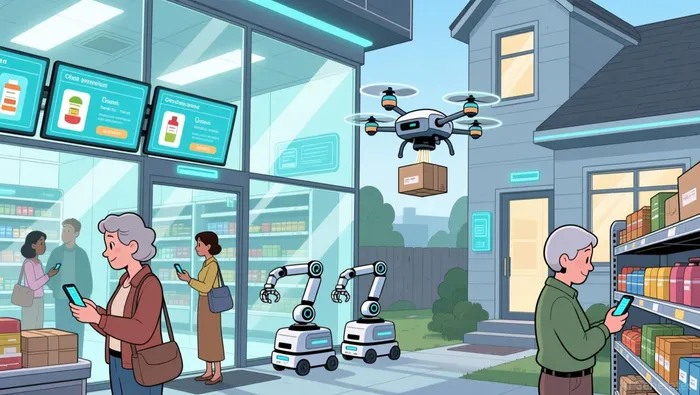
Capital Efficiency: Kroger's ROIC and the Path to Profitability
Return on invested capital (ROIC) is a key metric for evaluating capital efficiency, and Kroger's Q3 2025 results reveal a mixed picture. The company reported an ROIC of 8.12% for the quarter, exceeding its weighted average cost of capital of 5%. While this suggests that Kroger is generating returns above its cost of capital, it lags behind Walmart's ROIC of 12.47% and Amazon's projected 14% as reported by financial analysts. These disparities highlight the challenges Kroger faces in competing with rivals that have already optimized their fulfillment networks.
The impairment charge from its automated facilities, while a short-term drag on profitability, may ultimately enhance long-term capital efficiency. By reallocating resources to high-impact initiatives-such as store-based automation and digital personalization-Kroger aims to improve productivity and reduce underutilized asset costs as detailed in its latest earnings report. This strategy hinges on the assumption that its revised fulfillment model will generate higher returns than its previous capital-intensive approach.
Competitive Positioning: Navigating a Crowded Market
Kroger's competitive positioning in 2025 remains strong but precarious. The company operates 2,722 stores across 35 states, maintaining a 10.2% market share in the U.S. grocery sector. However, its e-commerce business, while growing at 17% year-over-year in Q3 2025, trails Walmart (31.6% market share) and Amazon (22.6%) in digital grocery sales as per market research. Walmart's omnichannel strategy-leveraging its vast store network for local fulfillment-has proven particularly effective, enabling it to achieve profitability in e-commerce while maintaining a 21% annual growth rate according to industry reports.
Kroger's regional delivery strategy, which combines Ocado-powered warehouses in urban areas with hyper-local partnerships in rural markets, offers a nuanced approach as outlined in its digital strategy. However, its ability to scale this model profitably remains unproven. The company's focus on predictive personalization and dynamic pricing is a strength, but it must contend with Amazon's Prime ecosystem and Walmart's price competitiveness, both of which are formidable barriers to entry according to market analysts.
Implications for Investors: Balancing Risks and Opportunities
For investors, Kroger's automation overhaul presents a high-stakes bet. The $2.6 billion impairment charge in Q3 2025 as reported in the earnings release is a stark reminder of the financial risks associated with overambitious capital expenditures. However, the anticipated $400 million boost in e-commerce operating profit by 2026 as projected in the company's guidance suggests that the company's strategic adjustments could yield meaningful returns.
The key question is whether Kroger can close the capital efficiency gap with Walmart and Amazon. While its ROIC of 8.12% as tracked by financial data providers is a positive sign, it remains below industry leaders. Success will depend on the effectiveness of its third-party delivery partnerships and its ability to leverage store-based automation without repeating past missteps. Additionally, Kroger's retail media platform and data-driven inventory adjustments as reported in industry analysis could provide a differentiator in an increasingly competitive landscape.
Conclusion
Kroger's 2025 automation overhaul represents a pivotal moment in its e-commerce journey. By shedding underperforming assets and embracing a more agile fulfillment model, the company is positioning itself to compete in a market dominated by Walmart and Amazon. While the path to profitability is fraught with challenges, the strategic reallocation of capital and focus on customer-centric innovation offer a compelling case for long-term value creation. For investors, the coming years will be critical in determining whether Kroger can transform its e-commerce operations into a sustainable competitive advantage.





Comentarios
Aún no hay comentarios