
Kroger's $2.6 Billion Impairment Charge: A Strategic Buying Opportunity or a Warning Signal?
Strategic Rationale: A Shift Toward Efficiency and Partnerships
According to a report by , Kroger's decision to shutter three automated fulfillment centers in Florida, Maryland, and Wisconsin stems from the underperformance of its in-house automation infrastructure. The company is pivoting to a hybrid model that prioritizes store-centric fulfillment and third-party delivery partnerships with platforms like Instacart, DoorDash, and UberEats. This shift aims to reduce capital intensity, accelerate delivery times, and improve customer experience-a move that aligns with broader retail trends toward flexible, cost-effective logistics.
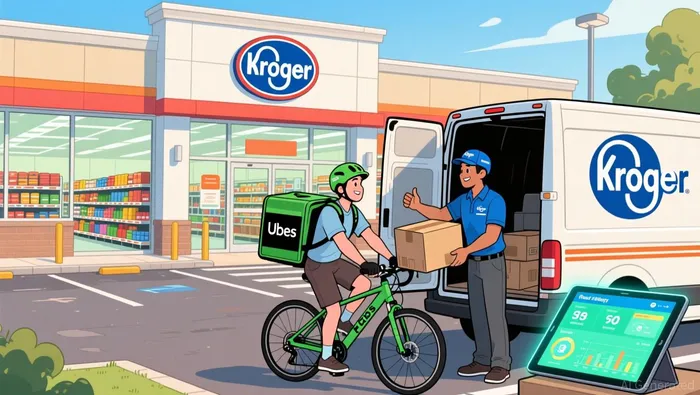
The strategic logic is compelling. By outsourcing delivery to third-party platforms, KrogerKR-- avoids the high fixed costs of maintaining automated facilities while leveraging the scalability of established delivery networks. CEO Ron Sargent emphasized that this approach will simplify the customer experience and free up resources to enhance store conditions and lower prices. For value investors, the key metric is whether these operational changes translate into sustainable profitability.
Financial Impact: Short-Term Pain for Long-Term Gain
The $2.6 billion impairment charge is a significant short-term hit, but Kroger projects a $400 million improvement in e-commerce operating profit by 2026. This suggests the company is willing to absorb near-term costs to restructure its fulfillment network for long-term efficiency. However, the transition carries risks. Execution hinges on the reliability of third-party partners and the ability to maintain customer satisfaction amid reduced control over delivery timelines.
From a valuation perspective, Kroger's P/E ratio of 17.1x and debt-to-equity ratio of 302.7% as of 2025 highlight its high leverage, which could amplify losses during economic downturns. Yet, the retail sector's defensive nature-driven by inelastic demand for groceries-mitigates some of these risks. Kroger's 2.0% dividend yield and 26.6% return on equity further position it as a candidate for patient, long-term investors seeking income and moderate growth.
Sector Resilience: Automation and Collaboration in Balance
The retail sector's response to automation challenges is nuanced. While Kroger is scaling back its in-house automation, other companies are advancing it. For instance, Brightpick's AI-powered warehouse robots enable "lights-out" operations, reducing staffing costs and increasing throughput. This duality underscores a sector-wide recalibration: some firms are doubling down on automation for efficiency, while others, like Kroger, are adopting hybrid models to balance cost and flexibility.
For value investors, this divergence is instructive. Kroger's strategic shift reflects a pragmatic acknowledgment that not all automation initiatives yield returns, particularly in capital-intensive sectors. By redirecting resources to partnerships and store-centric operations, the company is aligning with consumer preferences for speed and convenience without overextending its balance sheet.
Is This a Buying Opportunity?
The answer depends on the investor's time horizon and risk tolerance. Kroger's impairment charge is a warning signal in the short term, but it also signals a strategic recalibration that could enhance profitability. Analysts' "Buy" consensus rating and 11.3% fair value upside suggest confidence in the company's ability to navigate these challenges. However, the high debt load remains a concern, particularly if interest rates rise or consumer spending falters.
In a resilient sector like grocery retail, where demand is relatively inelastic, Kroger's pivot to third-party delivery and store-centric fulfillment could position it to outperform peers. The key will be executing the transition smoothly and maintaining customer loyalty. For value investors, the $2.6 billion charge is less a red flag than a test of management's ability to adapt-a test that, if passed, could unlock significant upside.







Comentarios
Aún no hay comentarios