
Krispy Kreme's Capital-Light Turnaround: A High-Conviction Play for 2026?
In an era where quick-service brands grapple with margin pressures and shifting consumer preferences, Krispy Kreme's strategic pivot toward a capital-light model has emerged as a compelling case study. The company's 2025 initiatives-centered on refranchising, logistics outsourcing, and targeted retail expansion-signal a deliberate shift from asset-heavy operations to a leaner, more agile framework. These moves, if executed effectively, could position Krispy KremeDNUT-- as a high-conviction investment opportunity in 2026.
Refranchising: Trimming the Fat for Profitability
Krispy Kreme's refranchising strategy has been a cornerstone of its turnaround plan. By reducing global Points of Access by 960 locations (6.1%) to 14,851 as of Q3 2025, the company has prioritized profitability over scale. This rationalization has directly contributed to a 17% year-over-year increase in adjusted EBITDA to $40.6 million, driven by cost reductions and the termination of unprofitable ventures like the McDonald's USA partnership.
The refranchising agenda extends beyond the U.S., with international markets such as Australia, New Zealand, and the UK being transitioned to franchise models. This approach not only enhances financial flexibility but also aligns with the company's capital-light philosophy, allowing it to focus on high-growth opportunities without overextending its balance sheet.
Logistics Outsourcing: A Path to Operational Efficiency
Krispy Kreme's decision to outsource U.S. logistics is another critical lever in its cost-cutting strategy. As of Q3 2025, 54% of U.S. logistics operations were already managed by third-party partners, with full outsourcing slated for 2026. This shift is expected to reduce delivery costs and create a more variable cost structure, mitigating operational risks associated with in-house logistics.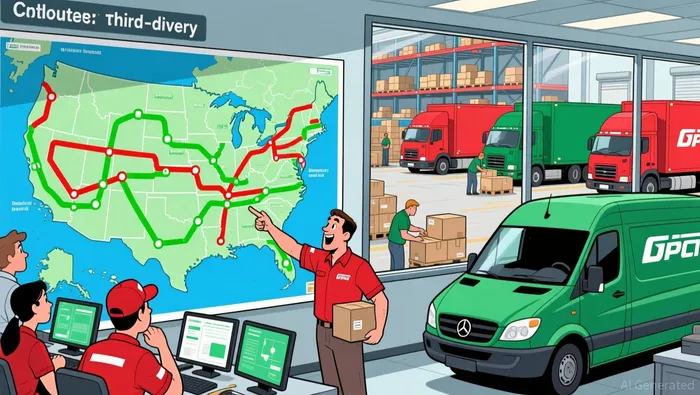 The financial implications are clear: a more predictable expense base and improved margin stability. By leveraging specialized carriers, Krispy Kreme can redirect capital toward growth initiatives while benefiting from the scalability and expertise of logistics providers. This move also aligns with broader industry trends, where companies increasingly outsource non-core functions to enhance agility.
Retail Expansion: Strategic Partnerships for Scalable Growth
Krispy Kreme's U.S. expansion strategy hinges on high-traffic retail partnerships with Walmart, Costco, and Target. These collaborations are designed to maximize visibility and foot traffic, with only a third of Walmart locations currently offering Krispy Kreme products-a gap the company aims to fill. The capital-light nature of these partnerships allows for rapid scaling without the upfront costs of new store construction.
Financial Metrics and Forward-Looking Outlook
While Q3 2025 revenue declined by 1.2% to $375.3 million, the company's adjusted EBITDA growth of 17% highlights the effectiveness of its cost-cutting measures. The sequential increase in average weekly sales per door following the closure of underperforming locations further reinforces the potential for margin expansion.
Looking ahead, the success of Krispy Kreme's turnaround will depend on the execution of its 2026 roadmap. Full logistics outsourcing, the acceleration of retail partnerships, and disciplined international expansion could drive revenue growth and restore investor confidence. However, risks remain, including the performance of retail partners like Walmart and Costco, whose own e-commerce strategies and market dynamics could influence Krispy Kreme's outcomes.
Conclusion: A High-Conviction Play?
Krispy Kreme's capital-light turnaround strategy is a bold repositioning that addresses both operational inefficiencies and financial constraints. By refranchising underperforming locations, outsourcing logistics, and strategically expanding through retail partnerships, the company is laying the groundwork for sustainable growth. While challenges persist, the alignment of these initiatives with industry trends and the demonstrated progress in Q3 2025 suggest that Krispy Kreme could indeed be a high-conviction play for 2026-provided its execution remains as disciplined as its planning.





Comentarios
Aún no hay comentarios