
Is Kratos Defense (KTOS) a Buy Despite Overvaluation Concerns?
The question of whether Kratos DefenseKTOS-- (KTOS) is a compelling investment hinges on a delicate balance between its sky-high valuation metrics and its robust long-term growth prospects. While the company's trailing P/E ratio of 600.54 and EV/EBITDA of 180.28 as of December 2025 according to financial analysis scream overvaluation, its strategic positioning in high-growth defense sectors and aggressive revenue expansion warrant closer scrutiny. This analysis evaluates whether KTOS's near-term margin pressures and valuation extremes are justified by its long-term catalysts.
The Overvaluation Dilemma
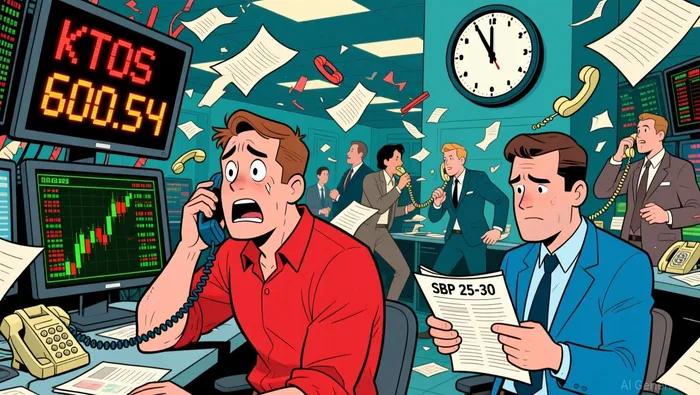
KTOS's valuation metrics are staggering. Its trailing P/E ratio of 600.54 dwarfs its historical average, while the forward P/E of 107.46 suggests the market is pricing in aggressive earnings growth. For context, the S&P 500's average P/E is typically around 25–30. Even more striking is the recent quarterly P/E of 569.46, which exceeds the four-quarter average of 399.8. These figures imply that investors are paying a premium for KTOS's earnings, betting heavily on future profitability. However, the company's financials tell a mixed story: while third-quarter 2025 revenue hit $1.28 billion with a 22.9% gross margin, net income was a modest $20 million, and free cash flow turned negative at -$93.3 million according to financial data. This disconnect between revenue growth and profitability raises concerns about whether the valuation is sustainable.
Long-Term Growth Catalysts: A Defense Sector Powerhouse
Despite the valuation headwinds, KTOS's long-term fundamentals are undeniably strong. The company's Unmanned Systems segment, a key driver of growth, delivered 35.8% organic revenue growth in Q3 2025, fueled by international shipments of tactical Valkyrie drones. Meanwhile, the Government Solutions (KGS) segment reported 20% organic growth, driven by Defense Rocket Systems and Cyber capabilities. These segments align with global defense trends, including the surge in demand for unmanned systems and hypersonic technology.
Management has also raised its full-year 2026 guidance, projecting 15–20% organic revenue growth and a 100 basis point increase in adjusted EBITDA margins. This optimism is grounded in strategic investments: KTOSKTOS-- is expanding manufacturing capacity and securing contracts in high-margin areas like satellite systems and hypersonic propulsion. Analysts further note that profit margins could expand from 1.2% to 5.2% over three years as the company transitions to more profitable contracts. For investors with a multi-year horizon, these catalysts suggest that KTOS's current valuation could be justified if the company executes its growth plan.
Near-Term Margin Pressures: A Necessary Evil?
The path to long-term profitability, however, is not without hurdles. KTOS's Q3 2025 results highlight near-term margin pressures: R&D expenses reached $10 million, and material costs on fixed-price contracts have eroded profitability. Free cash flow used in operations hit $41.3 million, driven by facility expansions and working capital demands. CFO Deanna Lund acknowledged that these investments are "necessary for scaling production" but will weigh on margins in the short term according to financial reports.
The company's negative free cash flow and low net income also raise questions about its ability to fund operations without external financing. Yet, KTOS's balance sheet remains resilient, supported by its $12.5 billion market cap and strong revenue growth. The key risk lies in whether the company can convert its R&D and capital expenditures into scalable, high-margin products before cash flow turns positive.
Balancing the Equation: Is KTOS a Buy?
The decision to invest in KTOS ultimately depends on an investor's risk tolerance and time horizon. For long-term buyers, the company's dominance in defense innovation-particularly in unmanned systems and hypersonic technology-offers a compelling narrative. Its 2026 growth guidance and margin expansion projections suggest that the market may eventually reward patience. However, the current valuation assumes near-miraculous execution: earnings would need to grow at a blistering pace to justify a P/E of 600.
Conversely, short-term investors face a minefield. The company's free cash flow challenges and margin pressures could lead to volatility, especially if defense budgets or contract awards fall short of expectations. The PEG ratio's historical volatility also underscores the market's uncertainty about whether KTOS's growth justifies its price.
Conclusion
Kratos Defense is a stock of extremes: a sky-high valuation paired with explosive growth in critical defense sectors. While the current P/E and EV/EBITDA ratios appear unsustainable in the near term, the company's long-term catalysts-driven by international demand for drones, hypersonic systems, and cyber solutions-could validate the premium over time. Investors willing to stomach near-term margin pressures and cash flow challenges may find KTOS appealing, but they must do so with a clear understanding of the risks. For now, the stock is a speculative bet on the future of defense technology, not a conservative play.







Comentarios
Aún no hay comentarios