
Kraken's Tydro and the Future of DeFi: How Ethereum L2 Scalability is Reshaping Exchange Competitiveness
The launch of Kraken's Tydro on Ethereum's Layer 2 (L2) represents a pivotal moment in the evolution of decentralized finance (DeFi). By deploying a custom-tailored, white-label instance of AaveAAVE-- v3 on its Ink L2 solution, Kraken is notNOT-- just entering the DeFi lending and borrowing space-it is redefining how centralized exchanges (CEXs) can integrate with decentralized infrastructure to capture market share in a rapidly scaling crypto ecosystem.
The Strategic Logic of Tydro
Tydro's design is a masterclass in leveraging existing DeFi primitives while embedding Kraken's proprietary incentives. Built on Aave v3, the protocol supports assets like wETH, kBTC, and stablecoins (USDG, USDT0, GHO) and introduces an $INK-based incentive structure to bootstrap liquidity. This approach allows Kraken to tap into Aave's battle-tested lending engine while aligning capital flows with its native token, creating a flywheel effect for liquidity provision and user adoption. According to the Ink Foundation, Tydro is intended to serve as "core infrastructure for DeFi on Ink" and will be integrated into Kraken's centralized exchange, enabling clients to access DeFi opportunities without leaving the CEX environment, as noted in the RZLT blog.
This integration is critical. Phemex reports that Tydro's total value locked (TVL) has already surpassed $140 million, a figure that underscores the immediate appeal of Kraken's hybrid model. By reducing friction between centralized and decentralized finance, Kraken is addressing a key pain point for retail and institutional users: the complexity of navigating multiple platforms for custody, trading, and DeFi participation.
Ethereum L2 Scalability: The Catalyst for DeFi Adoption
The broader success of Tydro-and Kraken's strategic positioning-cannot be understood without examining Ethereum's L2 landscape. The March 2024 Dencun upgrade, which introduced blob transactions, has been a game-changer. By reducing data storage costs on the base layer, the upgrade has enabled L2 solutions to process transactions at near-zero fees while maintaining Ethereum's security guarantees, a point also highlighted in the RZLT blog. This has created a fertile ground for DeFi protocols to scale, with platforms like ArbitrumARB-- and OptimismOP-- achieving transaction speeds exceeding 40,000 per second, according to a Medium post.
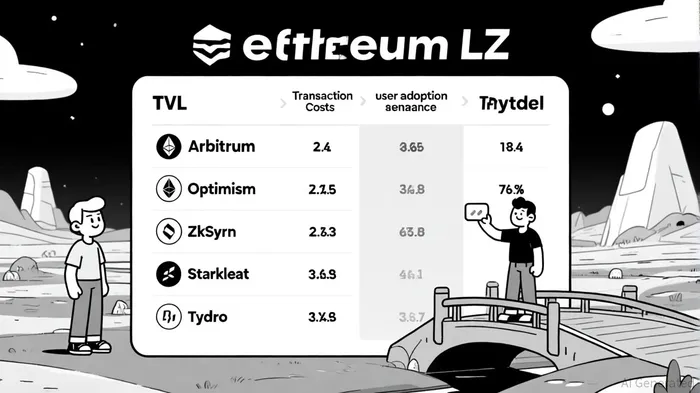
However, the L2 race is far from settled. Optimistic rollups (Arbitrum, Optimism) dominate in TVL and user base, but ZK-rollups (zkSync, Starknet) are gaining traction due to their instant finality and cryptographic efficiency. For instance, zkSyncZK-- Era processes 10,000 transactions per second at a cost of $0.01 per transaction, while Starknet's Cairo-based architecture is optimized for compute-intensive applications, as noted in a Mitosis analysis. The strategic shift toward ZK-rollups is accelerating, with Arbitrum and Optimism planning transitions to ZK-proofs within 24 months to stay competitive, a prediction that has been discussed widely in industry commentary.
Kraken's Market Positioning: A Hybrid Play
Kraken's Tydro sits at the intersection of these trends. Unlike pure-play L2s like Arbitrum or zkSync, Tydro is a CEX-driven initiative that leverages Ethereum's scalability while retaining the trust and user base of a regulated exchange. This hybrid model offers several advantages:
- User Onboarding: Kraken's 4.4 million funded accounts (as of Q2 2025) provide a ready-made audience for Tydro, according to Kraken's Q2 report. By integrating DeFi features directly into its exchange, Kraken eliminates the need for users to navigate external wallets or dApps.
- Liquidity Incentives: The $INK token-based rewards system is designed to attract early liquidity providers, a strategy that mirrors Aave's own incentive structures but is tailored to Kraken's ecosystem, as the RZLT blog observes.
- Regulatory Alignment: As a regulated exchange, Kraken can navigate compliance challenges more effectively than decentralized L2s, making Tydro an attractive option for institutional investors wary of regulatory uncertainty.
Yet, Kraken faces stiff competition. Arbitrum's $19 billion TVL and Base's $15 billion TVL (as of mid-2025) highlight the dominance of established L2s in capturing DeFi liquidity, a point made in the RZLT blog. ZK-rollups, while less mature, are closing the gap with their technical superiority in finality and security. For Tydro to succeed, it must differentiate itself not just through integration with Kraken's exchange but by offering unique value propositions-such as lower fees, faster execution, or novel asset offerings.
Strategic Implications for Exchange Competitiveness
The Tydro launch underscores a broader trend: the blurring of lines between CEXs and DeFi. As Ethereum's L2s mature, exchanges that can seamlessly integrate decentralized infrastructure into their centralized platforms will gain a significant edge. Coinbase's Base network, for example, has leveraged its fiat on-ramps and retail user base to become a top L2 for consumer-facing dApps, as observed in the RZLT blog. Similarly, Kraken's Tydro could become a gateway for its users to participate in DeFi without sacrificing the convenience of centralized custody.
However, the long-term viability of Tydro will depend on Kraken's ability to adapt to the ZK-rollup transition. While optimistic rollups currently dominate in TVL, the industry is shifting toward ZK-based solutions for their stronger security and instant finality. If Kraken delays its pivot to ZK-proofs, it risks falling behind competitors like Arbitrum and StarknetSTRK--, which are already planning their transitions, as the Medium post discussed above argued.
Conclusion: A Calculated Bet on Hybrid Infrastructure
Kraken's Tydro is more than a lending protocol-it is a strategic bet on the future of hybrid blockchain infrastructure. By combining the scalability of EthereumETH-- L2s with the trust and reach of a leading CEX, Kraken is positioning itself to capture a significant share of the DeFi market. Yet, the path to dominance is fraught with challenges, from competing with established L2s to navigating the technical complexities of ZK-rollups.
For investors, the key question is whether Kraken can sustain its momentum. The $140 million TVL is a promising start, but scaling to a position where Tydro rivals Arbitrum or Base will require continuous innovation, aggressive liquidity incentives, and a clear roadmap for ZK integration. If Kraken succeeds, it could redefine the role of CEXs in the DeFi era-not as competitors to decentralized protocols, but as their most powerful enablers.






Comentarios
Aún no hay comentarios