
Kraken's Custody System Disruptions and Their Implications for Crypto Investors
The Operational Risks of Crypto Custody: A Closer Look at Kraken’s Challenges
Kraken, one of the largest cryptocurrency exchanges globally, has faced a series of custody system disruptions in 2025, raising critical questions about operational risk in the crypto industry. These issues, ranging from Monero (XMR) withdrawal delays to Etana Custody funding outages, underscore the fragility of even the most established custodial infrastructures. For investors, understanding these risks is essential to navigating a market where trust and technical reliability are paramount.
Technical Disruptions and Service Reliability
Kraken’s custody system disruptions in late July and August 2025 highlight the operational vulnerabilities inherent in managing digital assets. Specifically, Monero (XMR) withdrawals faced delays from September 3 to September 8, 2025, due to a malfunction in the XMR funding gateway, while deposits remained unaffected [1]. Separately, Etana Custody funding became unavailable on August 26, 2025, impacting users reliant on this third-party integration [1]. These incidents, though temporary, exposed gaps in redundancy and scalability within Kraken’s custody operations.
The company’s Terms of Service explicitly reserves the right to suspend services for technical difficulties, a clause that, while legally sound, erodes user confidence during outages [4]. For institutional clients, such disruptions can translate into liquidity constraints and reputational damage, particularly in a market where speed and reliability are non-negotiable.
Regulatory and Market Volatility Risks
The broader regulatory landscape further complicates Kraken’s operational risks. In July 2025, the U.S. Senate passed the GENIUS Act, setting the stage for federal stablecoin regulations that could reshape custodial requirements [3]. While Kraken’s cold storage model—97% of user funds stored offline—remains a security benchmark [3], regulatory shifts may necessitate costly infrastructure upgrades. Additionally, the DOJ’s closure of its investigation into co-founder Jesse Powell on July 22, 2025, [4] signals a potential easing of regulatory scrutiny, but uncertainty remains about how future enforcement actions might impact custody operations.
Market Confidence and Investor Psychology
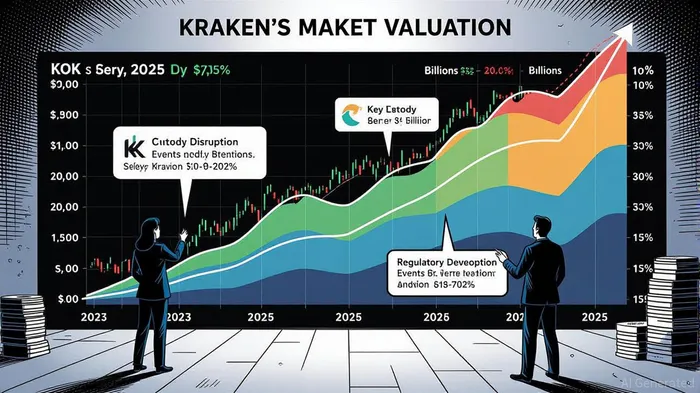
Investor reactions to custody disruptions are deeply influenced by emotional decision-making. A 2025 survey revealed that 84% of crypto holders act on FOMO (fear of missing out), while 81% respond to FUD (fear, uncertainty, and doubt) [4]. Kraken’s recent issues, though technical in nature, could amplify FUD-driven sell-offs, particularly among retail investors. However, the company’s ability to raise $500 million at a $15 billion valuation in 2025 [4] suggests that institutional confidence remains strong, likely due to its robust security measures and expansion into institutional-grade services like EthereumETH-- validator management [2].
That said, the crypto market’s history of volatility means even minor disruptions can trigger disproportionate reactions. For example, the Monero withdrawal delays coincided with a broader market correction in September 2025, compounding investor anxiety [1]. This interplay between technical issues and macroeconomic factors underscores the need for investors to distinguish between operational hiccups and systemic risks.
Implications for Investors: Preparing for the Unpredictable
For crypto investors, Kraken’s custody disruptions serve as a case study in operational risk management. First, diversification remains key: spreading custodial assets across multiple platforms can mitigate the impact of single-point failures. Second, investors should scrutinize custodians’ transparency practices, such as Kraken’s third-party audits and cold storage disclosures [3], which build trust during crises.
Third, the upcoming Kraken IPO—anticipated in late 2025 or 2026 [1]—presents both opportunities and risks. A successful listing could validate the company’s resilience, but ongoing custody issues may delay or devalue the offering. Investors must weigh Kraken’s technical capabilities against its regulatory exposure and market sentiment.
Conclusion: Navigating the New Normal
Kraken’s custody system disruptions in 2025 are a microcosm of the broader challenges facing the crypto industry. While the company’s security infrastructure and institutional partnerships remain robust, technical and regulatory risks are inevitable in a rapidly evolving market. For investors, the lesson is clear: operational risk is not a theoretical concern but a lived reality. By prioritizing transparency, diversification, and regulatory awareness, crypto investors can better navigate the turbulence ahead.
**Source:[1] Kraken Status
https://status.kraken.com/[2] Republic Technologies Integrates Kraken for Ethereum Operations
https://thepaypers.com/crypto-web3-and-cbdc/news/republic-technologies-integrates-kraken-for-ethereum-operations[3] State of Public Crypto-Equities (July 2025)
https://insights4vc.substack.com/p/state-of-public-crypto-equities-july[4] Kraken Raises $500M as Valuation Climbs to $15B
https://www.linkedin.com/pulse/kraken-raises-500m-valuation-climbs-15b-marcel-van-oost-cg9kf






Comentarios
Aún no hay comentarios