
Kraken's $500M Funding and Path to IPO: Liquidity Acceleration and Valuation Dynamics in a Maturing Crypto Market
Kraken's recent $500 million funding round at a $15 billion valuation[1] marks a pivotal moment in the crypto exchange's journey toward a 2026 IPO. The round, executed without a lead investor and on Kraken's terms, underscores the company's strategic positioning in a maturing market where liquidity and regulatory clarity are becoming critical differentiators. For investors, the move raises key questions: How does Kraken's valuation stack up against industry benchmarks? What role does liquidity acceleration play in its growth strategy? And how does its path to public markets reflect broader trends in crypto exchange valuations?
Valuation Dynamics: A $15B Bet on Institutional Adoption and Regulatory Clarity
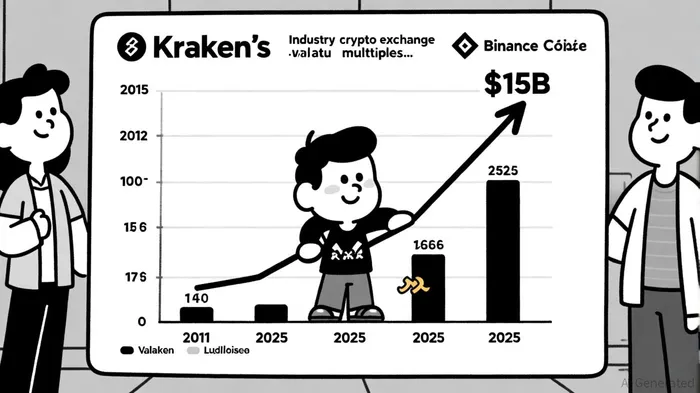
Kraken's $15 billion valuation, achieved in September 2025, places it among the most valuable private crypto firms, trailing only Binance and CoinbaseCOIN-- but outpacing peers like Gemini and Circle[3]. This valuation is anchored in two pillars: institutional adoption and regulatory progress.
Institutional demand for crypto infrastructure has surged, driven by $14.8 billion in BitcoinBTC-- ETF inflows and over 850,000 BTC held in corporate treasuries[6]. Kraken's Q2 2025 financials—$411 million in revenue and $80 million in post-EBITDA earnings[1]—reflect this trend. The exchange's acquisition of NinjaTrader, a $1.5 billion deal that added 2 million users and expanded into U.S. futures trading[5], further solidifies its institutional footprint.
From a valuation perspective, Kraken's 15.2x EV/Revenue multiple[2] (compared to fintech's average 4.2x) highlights the premium investors are willing to pay for crypto firms with clear regulatory pathways. This premium is justified by Kraken's focus on tokenized assets (e.g., xStocks) and its compliance-first approach, which aligns with the EU's MiCA framework and U.S. SEC rule changes easing spot-ETF listings[1].
Liquidity Acceleration: The Engine Behind Kraken's Growth
Liquidity remains the lifeblood of crypto exchanges, and Kraken's post-funding strategy is laser-focused on deepening it. In Q2 2025, the exchange reported $186.8 billion in total volume—a 19% year-over-year increase—and captured 68% of stable-fiat spot trading volume[6]. These metrics are critical in a market where order-book depth determines execution efficiency and volatility.
Kraken's tools for liquidity enhancement are industry-leading. Its Level 2 (L2) order book API[1] and Pro Analytics suite[4] provide institutional traders with real-time insights into slippage, aggressor differentials, and volatility. For tokenized assets like xStocks, Kraken's liquidity strategies include monitoring bid-ask spreads and cumulative volume at price levels[2], ensuring seamless 24/7 trading of equities on blockchain networks.
The $500 million funding round will accelerate these efforts. A portion of the capital will fund international expansion, particularly in Latin America and Europe, where Kraken's MiFID-regulated futures suite is already gaining traction[5]. Another focus area is institutional prime brokerage, a high-margin segment that leverages Kraken's existing custody and trading infrastructure[2].
Risks and Regulatory Realities
Despite its strengths, Kraken faces headwinds. The crypto market's Q1 2025 correction—dropping to $2.8 trillion from $3.8 trillion—exposed vulnerabilities in speculative assets[6], though Bitcoin's dominance rose to 59.1%, signaling a shift toward blue-chip liquidity. For Kraken, the risk lies in balancing innovation (e.g., tokenized stocks) with regulatory scrutiny, particularly in the U.S., where enforcement actions against unregistered offerings remain a concern[3].
Internally, leadership stability is a factor. Co-CEO Arjun Sethi's aggressive product roadmap has been accompanied by executive turnover[1], raising questions about operational continuity. However, Sethi's track record—launching xStocks and securing strategic acquisitions—suggests a long-term vision aligned with public market expectations.
The IPO Timeline: A 2026 Play on Macro and Market Conditions
Kraken's decision to delay its IPO until 2026 is strategic. The company aims to avoid the volatility of 2025's market cycles and capitalize on a more favorable regulatory environment. By 2026, the U.S. and EU are expected to finalize frameworks for tokenized assets and stablecoins, reducing uncertainty for public investors[5].
Macro conditions also favor a 2026 IPO. The U.S. fiscal deficit of $1.9 trillion and China's $4.3 trillion spending plan[6] are injecting liquidity into risk assets, with crypto ETFs and institutional inflows amplifying this effect. Kraken's $15 billion valuation assumes a 2026 IPO price that reflects these dynamics, potentially valuing the company at 1.5x its 2025 revenue run rate.
Conclusion: A High-Conviction Play in a Transformative Sector
Kraken's $500 million funding round is more than a valuation milestone—it's a statement of intent. By prioritizing liquidity acceleration, institutional adoption, and regulatory compliance, the exchange is positioning itself as a bridge between traditional finance and crypto. For investors, the key risks lie in macro volatility and regulatory shifts, but the rewards are substantial: a company poised to dominate a $71.94 billion crypto exchange market by 2029[1].
As the 2026 IPO window approaches, Kraken's ability to execute its liquidity and product strategies will determine whether its $15 billion valuation becomes a baseline or a ceiling.





Comentarios
Aún no hay comentarios