
Kraken's $500M Funding Round: A Barometer for Crypto's Institutionalization and Long-Term Investment Potential
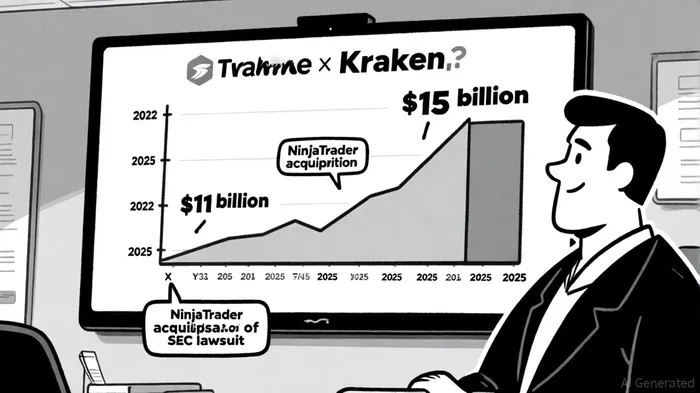
The crypto market's transition from speculative frenzy to institutional legitimacy has been a long and arduous journey. Yet, Kraken's recent $500 million funding round—valuing the exchange at $15 billion—marks a pivotal inflection point. This surge in valuation, coupled with strategic moves like the $1.5 billion acquisition of NinjaTrader and a clear roadmap for a 2026 IPO, underscores how institutional capital is increasingly treating digital assets as a core asset class. For investors, the implications are profound: Kraken's success is not just a story of one exchange but a microcosm of broader trends reshaping the crypto landscape.
Institutional Adoption: From Skepticism to Strategic Integration
Kraken's funding round, led by a mix of institutional investors, venture capital firms, and co-CEO Arjun Sethi's Tribe Capital, reflects a shift in risk appetite. Notably, the absence of a lead investor—a departure from traditional venture capital norms—suggests that Kraken set its own terms, signaling confidence in its market position[1]. This aligns with broader data: a Coinbase-EY-Parthenon survey revealed that 86% of institutional investors either have existing crypto exposure or plan to increase allocations in 2025[3].
The exchange's financials further validate this trend. Kraken reported $411 million in Q2 2025 revenue and $80 million in post-Ebitda earnings, demonstrating profitability in a sector long criticized for burn rates[2]. These metrics, combined with the NinjaTrader acquisition—which added 2 million customers—position Kraken as a hybrid platform bridging traditional finance (TradFi) and crypto. Products like tokenized stocks and cross-border fiat-digital transaction tools (via the Krak App) are not just incremental improvements; they are strategic bets on a future where crypto is seamlessly integrated into global finance[1].
Regulatory Clarity: A Tailwind for Institutional Confidence
Regulatory uncertainty has historically stifled institutional participation in crypto. However, 2025 has seen a paradigm shift. In the U.S., the Trump administration's passage of the GENIUS Act and the SEC's approval of in-kind creation/redemption mechanisms for BitcoinBTC-- and EthereumETH-- ETFs have provided much-needed clarity[3]. Kraken's dismissal of the SEC lawsuit in March 2025 further solidified its legal standing, removing a major overhang for the company and the industry[1].
Globally, the EU's Markets in Crypto-Assets (MiCA) framework, fully effective by late 2024, has created a harmonized regulatory environment, encouraging cross-border operations[3]. Kraken's compliance with MiCA and its alignment with the CLARITY Act demonstrate how exchanges are adapting to a fragmented but increasingly structured regulatory landscape. For investors, this means reduced counterparty risk and greater transparency—key prerequisites for institutional capital.
Strategic Positioning for an IPO: A New Era for Crypto Exchanges
Kraken's 2026 IPO ambitions are not just a fundraising play; they represent a structural shift in how crypto companies access capital. Unlike traditional venture-backed exits, an IPO would subject Kraken to public market scrutiny, forcing it to balance growth with profitability. Yet, the company's $1.5 billion revenue in 2024 and $424 million in adjusted EBITDA suggest it is primed for this transition[1].
The IPO also aligns with the broader tokenization wave. As JPMorgan and Goldman Sachs tokenize assets and BlackRock pilots tokenized funds, Kraken's role as a bridge between TradFi and crypto becomes critical. Its investment in tokenized equities and real estate fractionalization positions it to capture a slice of the $10 trillion tokenization market by 2030[3].
Implications for Long-Term Investors
For long-term investors, Kraken's funding round and valuation surge highlight three key themes:
1. Institutional Legitimacy: The participation of venture capital and institutional investors in Kraken's round signals a shift from speculative bets to strategic allocations.
2. Regulatory Resilience: Kraken's legal victories and compliance with global frameworks (MiCA, GENIUS Act) demonstrate how crypto firms can navigate regulatory complexity—a critical factor for sustained growth.
3. Hybrid Innovation: Kraken's focus on tokenized assets and cross-border tools reflects a broader industry trend toward convergence between digital and traditional finance.
However, risks remain. The crypto market's volatility, geopolitical tensions, and potential regulatory reversals could disrupt this trajectory. Yet, for investors with a multi-year horizon, Kraken's strategic positioning—coupled with the broader institutionalization of crypto—offers a compelling case for inclusion in diversified portfolios.
Conclusion
Kraken's $500 million funding round is more than a headline; it is a bellwether for crypto's maturation. As institutional capital flows into the sector and regulatory frameworks solidify, the lines between traditional and digital finance will blur. For investors, the challenge lies not in predicting the next speculative bubble but in identifying platforms like Kraken that are building the infrastructure for a tokenized future.





Comentarios
Aún no hay comentarios