
Kraft Heinz’s Strategic Split: A Catalyst for Value Unlocking in a Fragmented Consumer Staples Landscape
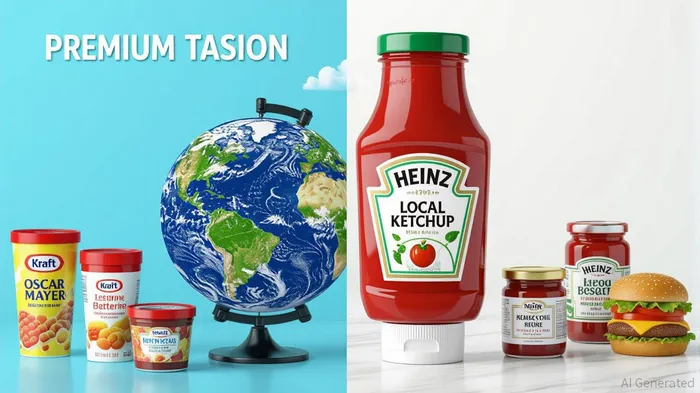
Kraft Heinz’s impending strategic split into two distinct entities—focusing on global brands and local condiments—represents a bold attempt to reverse a decade of underperformance and reposition itself in a shifting consumer staples landscape. The separation, which unwinds the 2015 merger between KraftKHC-- Foods and HeinzKHC--, aims to address structural challenges that have eroded value despite the company’s iconic brand portfolio. With a market capitalization of $33 billion and a recent EBITDA margin plunge to -23.58% in Q2 2025 due to a $9.3 billion impairment loss [1], the split is not just a strategic pivot but a survival play.
Financial Underperformance and the Case for Unbundling
Kraft Heinz’s financials tell a story of declining margins and operational strain. For the second quarter of 2025, net sales fell 1.9% year-over-year to $6.4 billion, with organic sales dropping 2.0% amid volume/mix declines in North America and developed international markets [2]. Adjusted operating income contracted 7.5% to $1.3 billion, while the adjusted gross profit margin fell 140 basis points to 34.1% [2]. These metrics underscore a company struggling to adapt to rising input costs and shifting consumer preferences.
The proposed split seeks to address these issues by isolating high-margin, premiumized segments (e.g., Heinz ketchup, Grey Poupon) from underperforming processed foods. This bifurcation could unlock value in two ways:
1. Deleveraging: By spinning off lower-margin assets, the company could reduce its net debt-to-EBITDA ratio, which has been a drag on credit ratings and cost of capital.
2. Focus on Growth: The condiments and sauces segment, which benefits from global premiumization trends, could trade at a higher multiple than the conglomerate’s current 1.3x price-to-sales ratio (vs. 1.8x peer average) [3]. Analysts project free cash flow to grow from $1.5 billion in H1 2025 to $4.71 billion by 2035, suggesting a path to intrinsic value appreciation [3].
Market Sentiment and Industry Trends: A Mixed Outlook
The market’s reaction to the split has been cautious. As of late August 2025, KHCKHC-- trades near $32.50, reflecting skepticism about the company’s ability to execute the separation and reverse its earnings decline [4]. Analysts are divided: the Zacks Consensus Estimate forecasts a 15.7% drop in 2025 EPS but a 2.9% rebound in 2026 [5]. This duality highlights the tension between short-term pain (impairment charges, margin compression) and long-term potential (premium brand growth, capital efficiency).
Industry trends, however, favor the split. The consumer staples sector is increasingly polarized between premium, health-conscious brands and commoditized processed foods. Kraft Heinz’s condiments division aligns with global demand for clean-label products and global flavor trends, while its processed foods segment faces headwinds from plant-based alternatives and cost inflation [6]. By separating these units, the company can tailor strategies to each market’s dynamics—a move that mirrors successful splits in the sector, such as Mondelez’s 2012 spinoff of its snacks business.
Risks and the Path Forward
Critics argue the split may not address deeper issues, such as brand erosion and operational inefficiencies. The $9.3 billion impairment charge in Q2 2025—driven by declining demand for processed foods—signals that the company’s core assets are already losing value [1]. Additionally, the split’s success hinges on effective execution, including managing transition costs and maintaining brand equity during the separation.
Yet, the financials suggest a compelling case for investors. Kraft Heinz’s discounted cash flow model implies a $81.86 intrinsic value per share, a 65.8% premium to its current price [3]. This gap reflects undervaluation but also the risks of execution failure. For the split to work, the company must demonstrate that the combined value of the two entities exceeds the whole—a classic “synergy” argument that has historically justified conglomerate breaks.
Conclusion: A Turnaround Candidate with Conditional Potential
Kraft Heinz’s strategic split is a high-stakes gamble, but one that aligns with both financial logic and industry trends. By focusing on premium, high-margin segments and shedding underperforming assets, the company can reduce debt, improve capital allocation, and capitalize on global demand for premiumized staples. While the path to value unlocking is fraught with risks, the current valuation and projected cash flow growth make KHC a compelling candidate for investors willing to bet on a successful transformation.
Source:
[1] Kraft HeinzKHC-- Reports Second Quarter 2025 Results [https://news.kraftheinzcompany.com/press-releases-details/2025/Kraft-Heinz-Reports-Second-Quarter-2025-Results-Maintains-Full-Year-2025-Outlook/default.aspx]
[2] Kraft Heinz Q2 Earnings Beat Estimates, Organic Sales Down 2% Y/Y [https://www.nasdaq.com/articles/kraft-heinz-q2-earnings-beat-estimates-organic-sales-down-2-y-y]
[3] Does Kraft Heinz's Share Price Offer Opportunity After 16 ... [https://finance.yahoo.com/news/does-kraft-heinz-share-price-101056951.html]
[4] Kraft Heinz (KHC) Breakup Into Two Companies Nears, WSJ Reports [https://blockchain.news/flashnews/kraft-heinz-khc-breakup-into-two-companies-nears-wsj-reports]
[5] Can Kraft Heinz's Strategic Moves & Innovations Drive Growth in 2025? [https://www.nasdaq.com/articles/can-kraft-heinzs-strategic-moves-innovations-drive-growth-2025]
[6] Kraft Heinz's Strategic Breakup: A Recipe for Unlocking Value in the Consumer Staples Industry [https://www.ainvest.com/news/kraft-heinz-strategic-breakup-recipe-unlocking-consumer-staples-2507/]





Comentarios
Aún no hay comentarios