
The Kraft Heinz Split: A Strategic Move to Unlock Shareholder Value in the Food Industry
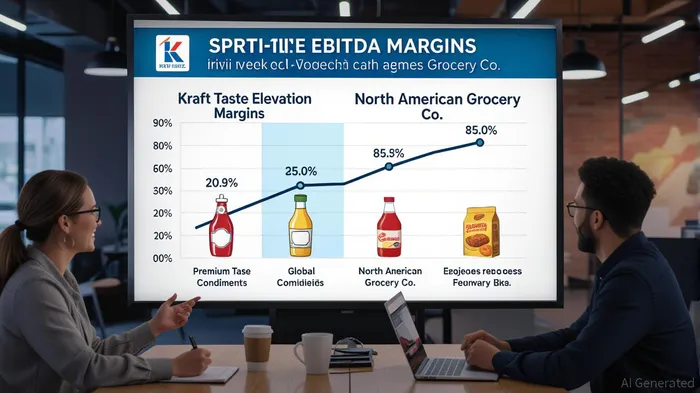
The Kraft HeinzKHC-- Company’s decision to split into two publicly traded entities—Global Taste Elevation Co. and North American Grocery Co.—represents a bold attempt to address decades of operational complexity and stagnant growth. By separating high-margin premium brands (e.g., Heinz ketchup, Philadelphia cream cheese) from commoditized staples (e.g., Oscar Mayer, Lunchables), the company aims to unlock long-term shareholder value through tailored strategies and improved governance. This move, expected to finalize in late 2026, mirrors the 2023 Kellogg’s spin-off but with distinct structural and financial implications [1].
Strategic Rationale and Financial Logic
The split is rooted in the divergent performance of KraftKHC-- Heinz’s segments. In 2024, the premium condiments division achieved a 190 basis point EBITDA margin expansion, while the broader company’s operating income fell to $1.68 billion, hampered by cost overruns and brand erosion [5]. By isolating the high-growth “taste elevation” business, Kraft Heinz hopes to prioritize innovation and premiumization, a strategy that has historically driven value in food sectors [4]. Meanwhile, the grocery division will focus on cost efficiency to counter private-label competition, a critical factor in maintaining margins [1].
This approach aligns with historical precedents. For example, the 2023 Kellogg’s split into KellanovaK-- and WK KelloggKLG-- Co. initially saw a $1.3 billion market value drop due to investor skepticism over brand names and snack demand [4]. However, WK KelloggKLG-- Co. later rebounded, with shares rising from $10.50 to $24.02 by mid-2024, demonstrating that spin-offs can succeed if executed with clear strategic focus [3]. Kraft Heinz’s separation, however, benefits from a more distinct segmentation of premium vs. commodity assets, potentially reducing the risk of brand dilution.
Governance and Leadership Reorganization
Governance structures post-split are designed to enhance decision-making agility. Carlos Abrams-Rivera, the current CEO of Kraft Heinz, will lead North American Grocery Co., while a new CEO will be appointed for Global Taste Elevation Co. This dual leadership model mirrors Kellogg’s post-split governance, where each entity operates independently [1]. The separation committee overseeing the Kraft HeinzKHC-- spin-off has also emphasized maintaining investment-grade credit ratings and dividend stability, addressing investor concerns about debt (7.18x net debt-to-EBITDA) and capital returns [5].
A critical test will be the ability of each entity to allocate capital effectively. For instance, Global Taste Elevation Co. could reinvest in R&D for premium products, while North American Grocery Co. may prioritize supply chain optimization. This tailored approach contrasts with Kraft Heinz’s previous struggles to balance competing priorities under a single governance structure [2].
Risks and Market Realities
Despite the strategic logic, risks persist. The spin-off’s success hinges on brand revitalization, particularly for the grocery division, which has faced declining sales due to shifting consumer preferences [5]. Additionally, transition costs and operational disruptions could temporarily impact performance, as seen in Kellogg’s initial post-split volatility [4]. Analysts estimate that the combined valuation of the two new entities could exceed Kraft Heinz’s current $33 billion market cap, but this depends on execution and market confidence [1].
Conclusion
The Kraft Heinz split is a calculated bet on operational clarity and strategic focus. By addressing the inherent challenges of a merged entity—such as conflicting growth trajectories and governance inefficiencies—the company aims to create two entities better positioned to navigate the evolving food landscape. While historical spin-offs like Kellogg’s show that short-term volatility is inevitable, the long-term potential for value creation remains strong, provided each new entity executes its tailored strategy effectively. For investors, the key will be monitoring post-split performance metrics, particularly EBITDA expansion and brand differentiation, to gauge whether the separation delivers on its promises.
Source:
[1] Kraft Heinz Breakup Plan Promises Sharper Focus And Bigger Growth [https://finance.yahoo.com/news/kraft-heinz-breakup-plan-promises-115129615.html]
[2] Kraft Heinz to Split Into Two Companies [https://www.foodengineeringmag.com/articles/103231-kraft-heinz-to-split-into-two-companies]
[3] WK Kellogg Co Spin-Off and Possible Acquisition [https://www.etalon-capital.com/insights/wk-kellogg-co-spin-off-and-possible-acquisition-event-driven-investment-strategy/]
[4] Kellogg loses $1.3 billion in value after spinoff of snacks biz [https://www.axios.com/2023/10/03/kellogg-stock-spinoff-kellanova]
[5] Kraft Heinz Company (KHC) Financial Analysis and Spin [https://www.monexa.ai/blog/the-kraft-heinz-company-khc-market-analysis-spin-o-KHC-2025-07-28]





Comentarios
Aún no hay comentarios