
Korean Exchange Listings as Catalysts for Altcoin Rallies: The ZKP Phenomenon and Broader Implications
The Korean cryptocurrency market has long been a bellwether for global altcoin dynamics, with its exchanges serving as both launchpads and accelerants for speculative and institutional capital. In late 2025, this role was amplified by the listing of Zero-Knowledge Proof (ZKP)-related altcoins, which triggered liquidity surges and retail-driven momentum across Asian markets. This analysis explores how ZKP's unique development model, coupled with regulatory shifts and retail investor behavior, created a perfect storm for altcoin rallies-and what this means for the future of crypto liquidity in Asia.
ZKP's Unique Value Proposition: A New Paradigm in Altcoin Development
ZKP's approach to blockchain infrastructure diverges sharply from traditional altcoin projects. Unlike most projects that prioritize fundraising before development, ZKP allocated $100 million to build a fully operational network before opening its presale. This "build-first" model, combined with a modular architecture featuring private smart contracts and encrypted storage, positioned ZKP as a solution for secure AI and financial workloads. The project further innovated with hardware called "Proof Pods," priced at $249 each, which enable users to earn ZKP tokens by validating AI tasks. Early buyers, incentivized by daily on-chain auctions, released 200 million tokens per cycle, secured the asset at discounted rates, creating immediate upside potential as exchanges determined listing prices.
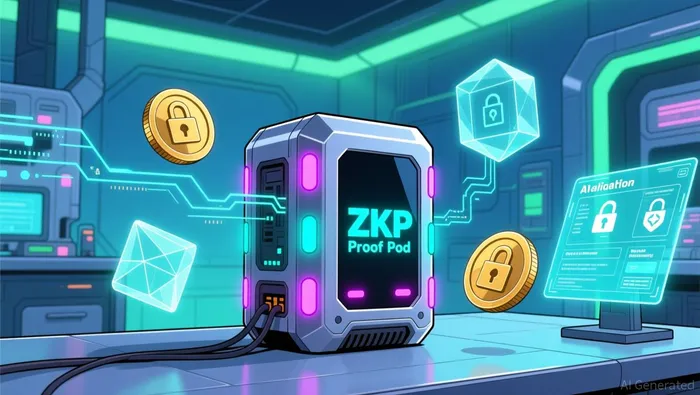 This utility-driven narrative resonated with Korean investors, who historically favor projects with tangible applications. By late 2025, ZKP's listing on Upbit and Bithumb catalyzed a 53.1% price surge within an hour, with trading volumes exceeding $103 million. The token's integration of zkTLS technology as a decentralized oracleADA-- further solidified its appeal, attracting both retail and institutional attention.
Liquidity Surges and Retail-Driven Momentum
The ZKP phenomenon exemplifies the liquidity amplification effect of Korean exchange listings. When ZKP debuted on Upbit, its price spike was mirrored by broader market optimism, with tokens like Midnight's NIGHT surging 35% in the same period. This momentum was fueled by South Korea's historically high crypto turnover rate of 156.8% in 2025, far above the global average of 111.6%. However, this retail-driven frenzy coincided with a broader shift in investor behavior. By November 2025, Korean crypto trading volumes had plummeted by over 80% compared to 2024 levels, as investors redirected capital to domestic equities like Samsung and SK Hynix, buoyed by President Lee Jae-myung's market-friendly policies.
This duality-sharp altcoin rallies amid declining overall crypto volumes-highlights the role of Korean exchanges as price discovery engines. While ZKP and similar tokens attracted speculative inflows, the broader market's retreat to equities underscored a maturing retail investor base prioritizing short-term gains over long-term crypto accumulation.
Regulatory Tailwinds and Institutional Legitimacy
Regulatory developments in 2025 further amplified ZKP's impact. Hong Kong's move to allow insurers to allocate capital to crypto assets under strict risk charges marked a pivotal step toward institutional legitimacy. Meanwhile, South Korea's proposed Digital Asset Basic Act, which includes legalizing won-pegged stablecoins and spot crypto ETFs, signaled a regulatory environment increasingly open to innovation. These frameworks not only legitimized ZKP's utility but also created pathways for institutional capital to enter Asian crypto markets.
Singapore's proactive stance, including a S$5 billion Equity Market Development Programme and stricter licensing for digital asset firms, further stabilized the region's crypto ecosystem. Together, these regulatory shifts created a "compliant speculation" environment, where retail investors could engage with ZKP and similar tokens without sacrificing legal clarity.
Broader Implications for Asian Crypto Markets
The ZKP phenomenon reveals a broader trend: Asian markets are evolving from retail-driven volatility to a hybrid model incorporating institutional participation. While Q3 2025 saw a 30.56% global spot trading volume increase, South Korean volumes contracted by 30% from August to November 2025, reflecting profit-taking behavior. This shift aligns with the Bank of Korea's observation that retail investors had moved from accumulation to harvesting gains.
However, ZKP's success also demonstrated the enduring power of Korean exchanges in shaping global altcoin narratives. Despite declining volumes, the country's regulatory advancements and exchange-driven liquidity ensured that ZKP and other ZKP-related tokens maintained cross-border relevance. This dynamic suggests that while Korean retail participation may wane, its role as a catalyst for altcoin innovation and liquidity will persist.
Conclusion: A New Era for Altcoin Investment
The ZKP phenomenon underscores the interplay between innovative project design, regulatory tailwinds, and retail investor behavior in Asian crypto markets. For investors, the key takeaway is clear: Korean exchange listings remain critical catalysts for altcoin rallies, particularly for projects with real-world utility and institutional-grade infrastructure. However, the broader market's shift toward profit-taking and equity allocation signals a need for caution. As ZKP's Proof Pods and auction model demonstrate, the future of altcoin investment will likely hinge on projects that balance speculative appeal with tangible value creation-a challenge that ZKP has met with remarkable success.







Comentarios
Aún no hay comentarios