
Korea's Market Volatility Amid Global Rally: Strategic Positioning for Long-Term Investors
Regulatory Overhaul: Strengthening Market Integrity
The Korea Financial Services Commission (FSC) has implemented a series of regulatory updates aimed at enhancing market transparency and deterring unfair trading practices. Effective October 28, 2025, the Korea Exchange (KRX) transitioned from an account-based surveillance system to an individual-centered model, leveraging pseudonymized personal data (e.g., resident registration numbers) to track suspicious activities more effectively. This reform is projected to reduce surveillance targets by 39%, enabling regulators to focus on high-risk behaviors such as market manipulation and cross-trading.
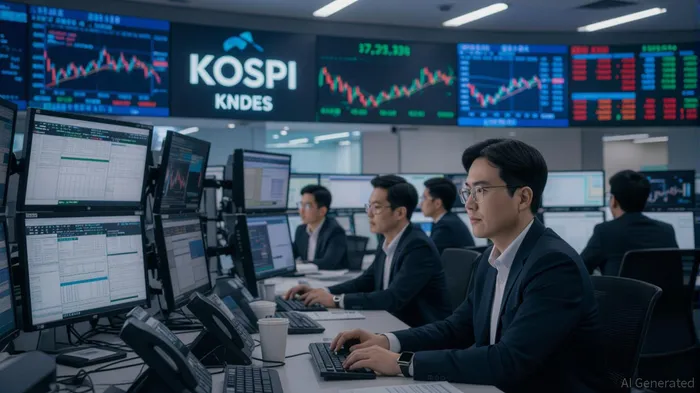 Complementing this is a sharp increase in penalty surcharges for violations, including price manipulation and illegal short-selling. Employees of financial institutions found engaging in such activities now face aggravated sanctions, including extended professional restrictions. These measures signal a commitment to fostering a fairer market environment, which could bolster investor confidence and attract foreign capital.
Market Sentiment and Structural Reforms: A New Era
The KOSPI's outperformance is underpinned by a confluence of factors, including corporate governance reforms and a surge in retail investor participation. Recent legislation mandates boards to act in the interest of all shareholders, not just controlling families, while introducing measures to limit insider control and promote board independence. These changes are addressing the long-standing "Korea discount," with companies increasingly adopting self-driven reforms such as share buybacks and dividend increases.
Retail investor participation has also surged, with stock ownership among South Koreans rising from 12% in 2019 to nearly 30% in 2025. This shift has created a more vocal and engaged investor base, pressuring companies to prioritize transparency and value creation. Meanwhile, the March 2025 lifting of the short-selling ban has enhanced liquidity and price discovery, attracting foreign investors who previously shied away from the market.
Emerging Opportunities and Challenges
South Korea's structural reforms have positioned it as a compelling destination for long-term capital. The country's equities still trade at a significant discount (around 10× forward earnings), suggesting potential for further appreciation if governance improvements continue. Additionally, the prospect of an MSCI Developed Market upgrade-a potential catalyst for $30 billion in passive inflows-has added to investor optimism.
However, challenges persist. The government's 20% increase in EV subsidies for 2026, while aimed at stimulating domestic demand, highlights ongoing trade tensions with the U.S., where delayed tariff reductions and unresolved nuclear negotiations create uncertainty. Hyundai Motors, for instance, faces financial strain due to U.S. tariffs accounting for 40% of its revenue, underscoring the vulnerability of export-dependent sectors.
Strategic Positioning for Long-Term Investors
For investors seeking to capitalize on Korea's evolving landscape, strategic positioning is critical. First, prioritizing companies with strong governance practices and transparent capital allocation can mitigate risks associated with lingering corporate inefficiencies. Johan Koo, a noted analyst, emphasizes that firms demonstrating self-driven reforms-such as disciplined capital returns-are better positioned to close the valuation gap with global peers.
Second, leveraging tools like Direct Market Access (DMA) through synthetic equities and futures products allows global investors to navigate Korea's market without an onshore presence. This is particularly valuable given the country's complex regulatory environment and liquidity constraints in certain sectors.
Finally, hedging against macroeconomic risks-such as trade tensions and housing market imbalances-is essential. While the stock market has rallied, housing supply constraints and strict redevelopment rules remain a drag on sustainable growth. Investors should consider diversifying across sectors, including technology and green energy, which are central to South Korea's long-term economic strategy.
Conclusion
South Korea's financial markets are at a pivotal juncture, driven by regulatory reforms, structural upgrades, and shifting investor dynamics. While the KOSPI's rally reflects progress, long-term investors must remain vigilant against macroeconomic headwinds and sector-specific vulnerabilities. By focusing on governance-driven equities, leveraging advanced market access tools, and hedging against geopolitical risks, investors can strategically position themselves to capitalize on Korea's transformation.







Comentarios
Aún no hay comentarios