
Kodak's Pension Surplus Strategy: A Model for Unlocking Value in Distressed Industrial Firms
In the annals of corporate restructuring, few stories are as instructive as Eastman Kodak's post-bankruptcy transformation. Once a symbol of industrial decline, KodakKODK-- has emerged as a case study in strategic financial engineering, particularly through its innovative use of pension fund monetization to strengthen its balance sheet and reduce debt. For investors and corporate leaders navigating the challenges of distressed industrial firms, Kodak's approach offers a blueprint for unlocking value through disciplined asset management and long-term planning.
Pension Reversion: A Strategic Reclamation
Kodak's journey began with the reversion of its overfunded Kodak Retirement Income Plan (KRIP), a move that unlocked approximately $767 million in excess assets-$609 million in cash and $158 million in non-cash holdings-by the end of 2025. This reversion process, completed after a multi-year transition plan, allowed the company to reclaim capital that had been tied up in a pension system no longer aligned with its operational needs. By terminating the KRIP and purchasing an annuity contract from MetLife to cover 27,000 retirees, Kodak fulfilled its obligations without disrupting retiree benefits while freeing up liquidity.
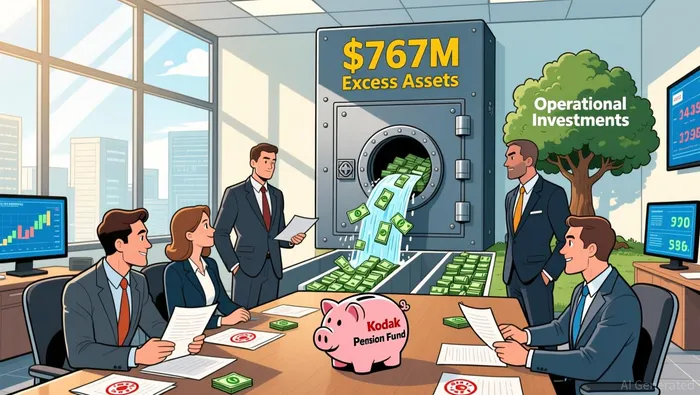 The significance of this maneuver lies in its precision. Unlike traditional debt refinancing or asset sales, which often come with high costs or operational disruptions, Kodak's pension reversion was a low-cost, high-impact strategy. According to a report by , the company used $312 million of the reclaimed cash to pre-pay term loans, reducing its outstanding debt to $200 million and achieving a net-positive cash position of over $300 million after excise taxes. This not only slashed Kodak's interest expenses but also improved its liquidity, positioning the firm for future growth.
Debt Reduction and Balance Sheet Strengthening
The debt reduction strategy was a critical step in Kodak's broader financial restructuring. By 2025, the company had effectively halved its loan balance, a feat that significantly reduced its leverage and improved credit metrics. As stated by Kodak in a press release, this action "positions the company to pursue strategic opportunities with greater flexibility." The freed-up capital also allowed Kodak to invest in its core operations, including digital imaging and commercial printing, sectors where the firm has shown renewed competitiveness.
Moreover, the pension reversion enabled Kodak to avoid the costly obligations of maintaining an underfunded pension plan. For distressed firms, underfunded pensions often act as a drag on cash flow and credit ratings. By contrast, Kodak's overfunded KRIP provided a unique opportunity to convert a liability into an asset. This approach aligns with broader trends in corporate finance, where firms are increasingly viewing pension funds not as fixed costs but as strategic resources.
A New Pension Plan: Balancing Employee Benefits and Cost Efficiency
Kodak's restructuring was not solely about debt reduction-it also prioritized employee welfare. The company established the Kodak Cash Balance Plan (KCBP), a fully funded defined benefit plan for current U.S.-based employees, with $251 million in investment assets and $5 million in cash. This plan replicates the benefits of the previous KRIP while minimizing ongoing costs. By fully funding the KCBP upfront, Kodak ensured continuity for employees without exposing itself to future pension liabilities.
This dual focus on employee retention and cost control is a hallmark of Kodak's strategy. As noted in a blog post by the company, the KCBP "delivers the same retirement security for employees while eliminating the financial risks associated with the old plan." For industrial firms facing similar challenges, this model demonstrates how pension reform can be both equitable and economically prudent.
Broader Implications for Distressed Firms
Kodak's experience underscores a broader lesson: pension monetization can be a powerful tool for balance sheet optimization. For firms in sectors like manufacturing, energy, or aerospace-where pension obligations often loom large-Kodak's approach offers a replicable framework. Key elements include:
1. Identifying Overfunded Plans: Firms with surplus pension assets can explore reversion or partial reversion to generate liquidity.
2. Strategic Debt Allocation: Using reclaimed funds to pre-pay high-interest debt or invest in growth areas can accelerate recovery.
3. Employee-Centric Reform: Transitioning to a new, fully funded plan ensures workforce stability while reducing long-term liabilities.
Critically, Kodak's success was underpinned by meticulous planning and a long-term perspective. The reversion process took years to execute, but the payoff-a debt-free balance sheet and a stronger competitive position-justifies the patience. For investors, this signals that firms willing to undertake such structural reforms can transform from liabilities into opportunities.
Conclusion
Kodak's pension surplus strategy is more than a financial maneuver-it is a testament to the power of creative capital allocation in distressed environments. By reimagining its pension obligations as a source of value, the company has not only stabilized its finances but also laid the groundwork for sustainable growth. For industrial firms facing similar challenges, Kodak's playbook offers a compelling case for how pension monetization can be a strategic lever, not just a last resort.







Comentarios
Aún no hay comentarios