
Zero Knowledge Proof (ZKP): Is This the First Truly ZK-Native Network with 500x Potential?
The ZK-Native Landscape: A New Era of Scalability
Zero-knowledge rollups (ZK-Rollups) have redefined blockchain infrastructure by bundling thousands of off-chain transactions into a single on-chain proof, slashing gas fees and congestion. According to a report by Rumblefish, zkSync Era, StarkNet, and Polygon zkEVM dominate the 2025 landscape, each offering distinct advantages.
- zkSync Era processes over 27 million transactions monthly, leveraging a custom zkEVM with LLVM compiler support for Ethereum-compatible smart contracts. Its integration with DeFi protocols like SyncSwap has reduced transaction costs by 90%, while native account abstraction features attract developers.
- StarkNet employs STARK proofs, achieving industrial-scale throughput with Cairo, a language optimized for zero-knowledge computation. The platform's adoption by dYdXDYDX-- v3 for high-frequency trading has demonstrated its ability to handle thousands of trades per second with near-zero latency.
- Polygon zkEVM boasts $1 billion in funding for ZKP development, offering bytecode-level EthereumETH-- compatibility. Gaming studios have reported in-game transaction costs dropping from $2-3 to under $0.05, underscoring its cost-efficiency.
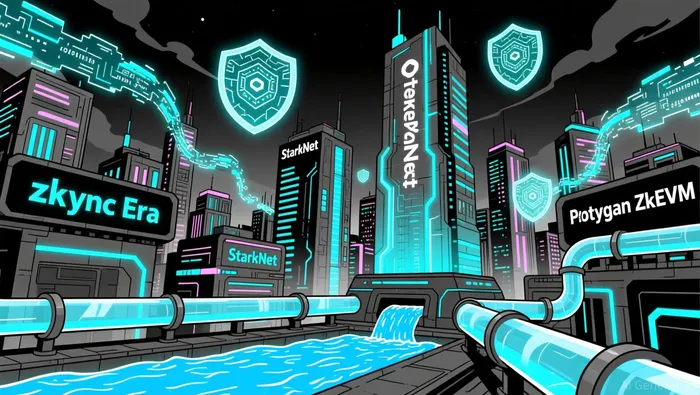
Meanwhile, Scroll and Linea focus on seamless EVM compatibility, with Linea's $2 billion TVL and MetaMask integration making it a developer-friendly hub according to industry analysis. Privacy-first solutions like Aztec Network combine encryption and ZKPs to enable confidential DeFi transactions, addressing niche but critical use cases as research shows.
Growth Drivers: Partnerships, TVL, and Institutional Adoption
The ZK ecosystem's explosive growth is fueled by three pillars: institutional partnerships, TVL expansion, and transaction volume metrics.
- Institutional Partnerships:
- Polygon has committed $1 billion to ZKP development, while global brands like Nike and Sony are deploying ZK-based systems for NFT compliance.
- Deutsche Bank's Project Dama 2 leverages zkSyncZK-- for real-world asset tokenization, ensuring regulatory compliance across jurisdictions as per industry reports.
Inovia Capital has expanded into Abu Dhabi to deepen partnerships in the GCC, signaling institutional confidence in ZK's enterprise potential according to market analysis.
TVL and Transaction Volume:
- ZK-based TVL has surpassed $28 billion, with StarkNet seeing a 200% TVL increase in Q4 2025.
- Lighter, a ZK-powered derivatives platform, reported a 30-day trading volume of $279.5 billion and $1.15 billion TVL according to financial reports, highlighting the scalability of ZK-native derivatives.
Curve Finance achieved $29 billion in Q3 2025 trading volume and $2.3 billion TVL, driven by stablecoin liquidity demand as per official filings.
Technological Advancements:
- Ethereum's EIP-4844 upgrade reduced data posting costs by 95%, making ZK-Rollups economically viable for mass adoption according to industry analysis.
- Hardware acceleration and decentralized proving markets are addressing computational bottlenecks, democratizing access to ZK infrastructure as market reports indicate.
The 500x Question: Who Stands Out?
While no ZK-native network explicitly projects 500x growth, zkSync Era and StarkNet exhibit the most compelling trajectories.
- zkSync Era's 27 million monthly transactions and 90% cost reductions for DeFi protocols position it as a critical Layer 2 for Ethereum. Its Buenos Aires digital identity system, serving 3.6 million citizens, demonstrates government-scale adoption.
- StarkNet's Cairo language and STARK proofs enable unparalleled optimization, with dYdX v3 processing thousands of trades per second. Its TVL growth and institutional use cases (e.g., Project Dama 2) suggest long-term dominance in high-frequency trading.
- Polygon zkEVM's $1 billion funding and gaming partnerships highlight its potential to capture Web3's next billion users.
However, Scroll and Linea's EVM compatibility and developer tooling (e.g., MetaMask integration) could accelerate mass adoption, particularly for Ethereum-based dApps.
Conclusion: A ZK-Driven Future
The ZKP market is projected to grow at a 22.1% CAGR, reaching $7.59 billion by 2033. While 500x growth remains speculative, the convergence of EIP-4844, institutional partnerships, and TVL expansion creates a fertile ground for ZK-native networks to dominate. zkSync Era and StarkNet are the most likely candidates, but investors must monitor TVL trends, transaction volume, and enterprise adoption to identify the next breakout project.
For early-stage investors, the ZK-native space offers a rare combination of technological innovation, scalability, and privacy-a trinity that could redefine blockchain's role in finance, identity, and beyond.






Comentarios
Aún no hay comentarios