
Zero Knowledge Proof (ZKP) Whitelist Launch in 2025: Early Access as a Catalyst for Exponential Token Value
The Zero Knowledge Proof (ZKP) 2025 whitelist launch is notNOT-- merely a presale event—it is a strategic inflection point for a project poised to redefine decentralized trust, privacy, and scalability. For investors, the early access mechanism embedded in ZKP's design offers a unique opportunity to capitalize on exponential token value growth, driven by a combination of technological innovation, institutional adoption, and a novel validation-based economic model.
The ZKP Ecosystem: A Reputation-Driven Economy
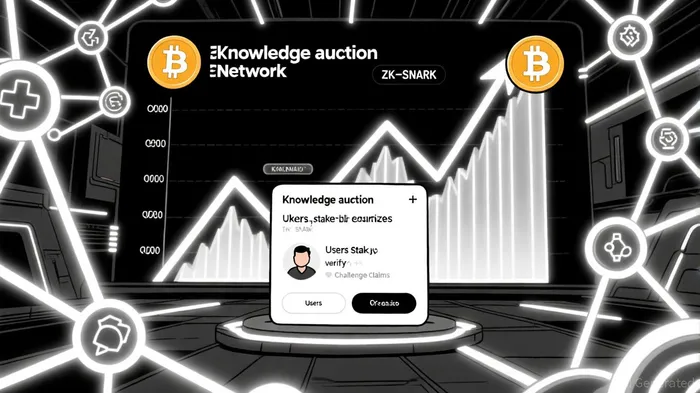
At its core, ZKP introduces a reputation-driven economy where participants earn influence and rewards through verifiable contributions. The protocol's knowledge auction system incentivizes users to stake, verify, and challenge claims, creating a transparent, on-chain record of accuracy and credibility, as outlined in a CoinCentral explainer. This mechanism transforms trust into a measurable asset, with reputational scores directly tied to a participant's ability to contribute factual value. Early adopters who join the 2025 whitelist gain not only discounted token access but also a front-row seat in shaping the network's foundational standards, according to a Blockonomi analysis.
The project's reliance on privacy-preserving cryptography (zk-SNARKs and zk-STARKs) further enhances its appeal. These techniques enable confidential transactions while maintaining transparent verification, addressing critical pain points in enterprise adoption and regulatory compliance, as noted in a FinancialContent article. By solving the scalability-privacy trade-off, ZKP positions itself as a potential Layer 1 infrastructure for Web3, with applications spanning DeFi, AI compute, and data sovereignty, as discussed in an Analytics Insight overview.
Early Access as a Value Multiplier
Historically, early access programs in blockchain projects have acted as catalysts for token price appreciation. The ZKP 2025 whitelist follows this pattern, offering a first-mover advantage to participants who recognize the project's potential before institutional and corporate players enter the space, as Blockonomi notes. This dynamic mirrors Ethereum's 2014 presale, where early buyers reaped outsized gains as the platform matured into a foundational blockchain infrastructure, an outcome highlighted by Blockonomi.
Data from similar ZKP projects like zkSync, StarkNet, and Aztec Network underscores the correlation between early access and token value. These projects saw significant price surges post-presale as institutional demand surged, driven by their compliance-ready features and high transaction throughput, benchmarks that appear in a Gate overview. For ZKP, the 2025 whitelist is expected to trigger a similar trajectory, with early participants securing tokens at a fraction of their future valuation, as Analytics Insight suggests.
Institutional Adoption and the Halo Effect
The ZKP ecosystem is already attracting attention from institutional stakeholders, particularly in sectors requiring privacy-first solutions. For example, DeFi platforms are exploring ZKP-based confidential smart contracts to enhance transactional privacy and regulatory compliance, as CoinCentral reported. Similarly, AI developers are leveraging ZKP's scalable verification mechanisms to address challenges in data integrity and intellectual property protection, according to Analytics Insight. This institutional interest creates a halo effect, potentially boosting trading volumes and prices for existing ZKP-related tokens like zkSyncZK-- and StarkWare, a trend noted in FinancialContent.
Moreover, the anticipated NIST standardization of ZKP protocols in 2025 adds a layer of regulatory credibility, further accelerating enterprise adoption, a point emphasized by FinancialContent. As standards solidify, ZKP's utility in real-world applications—from supply chain management to healthcare data security—will become more tangible, driving demand for its tokens, as Gate's report outlines.
Validation-Based Economics: A New Paradigm
Unlike speculative crypto projects, ZKP's value proposition is rooted in validation-based economics. Participants earn rewards not through market sentiment but by contributing accurate claims and verifying truth, a dynamic highlighted in Gate's analysis. This model fosters a sustainable, engagement-driven economy, where token value is generated through active participation rather than passive holding. For investors, this creates a flywheel effect: increased participation strengthens the network's utility, which in turn drives token demand and price appreciation.
Risks and Considerations
While the ZKP 2025 whitelist presents compelling opportunities, investors must remain cognizant of risks. Regulatory uncertainties, competition from established ZKP projects, and the technical complexity of zero-knowledge proofs could delay adoption. However, the project's focus on modular design and real-world utility mitigates these risks, positioning ZKP as a long-term infrastructure play rather than a speculative asset, as FinancialContent observes.
Conclusion: A Strategic Gateway to the Future of Web3
The ZKP 2025 whitelist is more than a presale—it is a gateway to a decentralized future where privacy, scalability, and trust are programmable. For investors, early access offers a rare chance to secure tokens at a foundational price while aligning with a project that addresses critical gaps in blockchain innovation. As ZKP's ecosystem matures, the interplay of reputation-driven economics, institutional adoption, and cryptographic advancements will likely drive exponential token value, making the 2025 whitelist a pivotal moment in the crypto landscape.






Comentarios
Aún no hay comentarios