
Zero Knowledge Proof (ZKP) and the Impending Whitelist Prelaunch: Assessing Market Potential and Investment Timing
The blockchain industry is on the cusp of a paradigm shift, driven by innovations in zero-knowledge proof (ZKP) technology. As of October 2025, the impending whitelist prelaunch for a groundbreaking ZKP project has ignited significant investor interest, positioning it as a potential cornerstone of the next crypto bull run. This analysis evaluates ZKP's market potential, tokenomics, institutional traction, and strategic advantages, while comparing it to existing ZKP-related tokens like zkSyncZK-- and StarkWare.
The ZKP Knowledge Auction Model: A New Economic Paradigm
The ZKP project introduces a reputation-driven economy where truth is monetized through a novel knowledge auction system. Users stake ZKP tokens to submit claims, which are then verified or challenged by others. Rewards are distributed based on accuracy, while misinformation is penalized, creating a self-regulating trust infrastructure, according to Blockchain Reporter. This mechanism transforms credibility into a measurable on-chain asset, enabling applications in decentralized finance (DeFi), AI, and institutional compliance, as noted by Coinrise.
Unlike traditional blockchain projects, ZKP's dual-consensus model combines Proof of Intelligence (validating claims) and Proof of Space (distributed AI workloads), ensuring scalability without compromising privacy, MEXC reports. The protocol also integrates secure multiparty computation and homomorphic encryption, making it a robust solution for data-sensitive industries like healthcare and supply chain management, as FinancialContent explains.
Institutional Adoption and Real-World Applications
ZKP's institutional partnerships underscore its viability. Deutsche Bank and JPMorgan are exploring its use in tokenized assets and interbank messaging, while Google Cloud has integrated ZKP-based identity verification for compliance with U.S. OFAC sanctions, according to Biometric Update. These collaborations signal growing acceptance of ZKP as a foundational layer for Web3 credibility, where trust is decentralized and verifiable, CoinCentral argues.
In DeFi, ZKP's shielded smart contracts enable confidential transactions and regulatory compliance without exposing user data, as explained in a CoinCentral explainer. For example, the project's Zero-Knowledge Compliance Suite (launched in Q3 2025) allows banks to perform KYC/KYB checks using zk-verifiable credentials, reducing friction in cross-border transactions, as outlined in the zkPass roadmap.
Tokenomics and Investment Timing: A Comparative Analysis
While ZKP's tokenomics remain partially opaque, its economic model shares structural similarities with established ZKP projects like zkSync and StarkWare, yet introduces unique incentives.
- zkSync (ZK): With a total supply of 21 billion tokens, zkSync's allocations are split between team (16.1%), investors (17.2%), and ecosystem initiatives (19.9%), subject to a 3-year vesting schedule, according to Tokentrack. A major token unlock in August 2025 tested market resilience, with the price rising 15% pre-unlock, per CoinMarketCap.
- StarkWare (STRK): STRK's total supply of 10 billion tokens includes a 3.84 billion circulating supply, with institutional interest driving adoption in DeFi, as shown by Crypto.news. However, its price declined by 5.87% in Q3 2025 amid bearish market sentiment, Tokenomist notes.
ZKP's token utility is designed to align with its knowledge auction system. Tokens will power staking, governance, and reputation rewards, with early whitelist participants gaining discounted allocations and influence over protocol norms, as CoinCentral explained. Analysts compare this to Ethereum's 2014 prelaunch, where early adopters shaped the network's trajectory, Analytics Insight observes.
Strategic Entry Points: The Whitelist Advantage
The ZKP whitelist prelaunch offers a rare asymmetric opportunity. Early participants notNOT-- only secure lower token costs but also gain a strategic foothold in a protocol poised to redefine trust in Web3. According to a report by Blockchain Reporter, the whitelist period is expected to close once capacity is reached, creating urgency for investors.
Moreover, ZKP's halo effect could boost existing ZKP-related tokens like zkSync and StarkWare by amplifying institutional interest in zero-knowledge proofs, as highlighted in Gate's list. This network effect positions ZKP as a catalyst for broader adoption, similar to how Ethereum's rise propelled ERC-20 tokens.
Risk Considerations and Price Projections
While ZKP's potential is compelling, risks include regulatory uncertainty and competition from established layer-2 solutions. Price projections for ZKP tokens vary:
- Bullish Scenario: $0.05–$0.10 by end-2025, driven by institutional adoption and AI integration, per Coin Predictions.
- Bearish Scenario: $0.01–$0.04 if regulatory hurdles or market volatility emerge, according to SwapSpace.
Comparatively, zkSync's ZKZK-- token is projected to reach $0.05–$0.08 by 2025, while STRKSTRK-- faces short-term bearish pressure, as outlined by CryptoOfficiel.
Conclusion: A Defining Moment for ZKP
The ZKP project represents a convergence of privacy, scalability, and institutional-grade compliance-a rare trifecta in the crypto space. Its knowledge auction model, coupled with strategic partnerships and a whitelist-driven launch, positions it as a high-conviction investment. For investors seeking exposure to the next phase of blockchain innovation, the impending whitelist prelaunch offers a critical entry point.
As the ZKP ecosystem matures, its success will hinge on execution, adoption, and the ability to maintain its first-mover advantage in the zero-knowledge proof space. 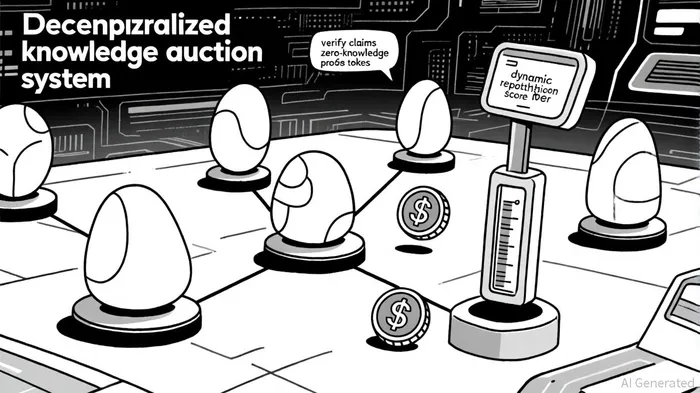






Comentarios
Aún no hay comentarios