
Zero Knowledge Proof (ZKP): A Next-Generation Crypto Alternative to Stagnant Giants Like Solana and Hedera
The cryptocurrency landscape in 2025 is marked by a stark divergence between legacy platforms and emerging innovations. While SolanaSOL-- (SOL) and HederaHBAR-- (HBAR) grapple with stagnation, regulatory uncertainties, and scalability limitations, a new contender-Zero Knowledge Proof (ZKP)-is redefining the paradigm of participation-driven growth and sustainable returns. This article examines ZKP's presale model, Proof Pod infrastructure, and market dynamics, contrasting them with the challenges faced by Solana, Hedera, and UniswapUNI-- (UNI). For investors seeking to capitalize on high-utility blockchain innovation, ZKP presents a compelling case for strategic entry.
ZKP's Presale Model: Structured Participation and Market Engagement
ZKP's presale model is a departure from traditional speculative tokenomics. Instead of a one-time token dump, ZKP employs daily auctions releasing 200 million tokens, creating a predictable supply flow that incentivizes ongoing participation. This model rewards active engagement over short-term speculation, fostering a community-driven ecosystem. By contrast, Solana and Hedera rely on static market conditions, with HBAR's 30.19% annual inflation rate and Solana's bot-driven transaction volume underscoring their struggles to maintain organic growth.
The structured presale also aligns with broader trends in institutional adoption. As noted by , ZKP's approach mirrors the success of enterprise-focused platforms like Hedera, which leveraged governance councils and staking incentives to drive adoption. However, ZKP's emphasis on daily liquidity and participation metrics creates a more dynamic market environment, reducing the risk of price stagnation seen in HBARHBAR-- and SOLSOL--.
Proof Pod Infrastructure: Tangible Utility and ROI Potential
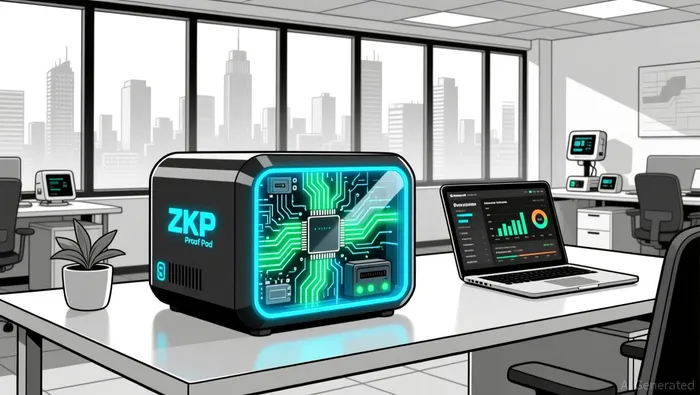
ZKP's Proof Pod infrastructure represents a unique fusion of hardware and blockchain innovation. These AI-driven hardware units validate tasks and generate daily rewards, offering a tangible utility that contrasts with the abstract value propositions of Solana and Hedera. Early data suggests that Proof Pods, priced at $249, can scale to generate up to $300 per day in rewards at Level 300, creating a utility-driven ROI model. Analysts project returns of up to 800x for early participants, a stark contrast to the speculative volatility of Solana's 5.13% inflation-adjusted returns.
This infrastructure also addresses a critical gap in the market. While Hedera's 10,000 TPS and Solana's 65,000 TPS highlight technical prowess, neither offers the physical asset backing that Proof Pods provide. For investors, this translates to a more resilient value proposition, as the hardware component mitigates the risks of purely digital token depreciation.
Market Dynamics: ZKP vs. Solana, Hedera, and UNI
The comparative analysis between ZKP and its peers reveals a clear advantage in both technical and economic metrics. Solana's DeFi ecosystem, while robust (with a TVL 9x higher than HBAR), is plagued by bot-driven transactions and a Nakamoto coefficient of 1, indicating centralization risks. Hedera, despite its enterprise-grade infrastructure and carbon-negative status, faces governance centralization and liquidity constraints.
Uniswap (UNI), meanwhile, is under selling pressure, with governance participation declining to 45 million tokens in 2025-down from earlier years. Proposals often pass with narrow margins, reflecting a fragmented community. ZKP's Proof Pod model, by contrast, incentivizes active participation through daily rewards, creating a more cohesive and engaged user base.
Strategic Timing for Investors: Capitalizing on Early-Stage Innovation
The urgency for investors to act on ZKP lies in its early-stage momentum. With over $100 million self-funded before public auctions, the project has already demonstrated credibility through tangible infrastructure. The first Proof Pod shipment to Australia further validates its operational readiness. For comparison, Solana and Hedera's growth trajectories have been hindered by macroeconomic headwinds and regulatory ambiguities, while UNI's governance struggles highlight the limitations of traditional tokenomics.
ZKP's presale model also offers a unique window for capitalizing on participation-driven growth. Daily auctions ensure liquidity and reduce the risk of market saturation, a challenge faced by stagnant giants like HBAR and SOL. As the ZKP market is projected to grow at a 22.1% CAGR, reaching $7.59 billion by 2033, early adopters stand to benefit from exponential ROI.
Conclusion: A New Era of Sustainable Blockchain Investment
Zero Knowledge Proof (ZKP) is not merely another altcoin-it represents a paradigm shift in how blockchain projects create value. By combining a structured presale model, tangible infrastructure, and participation-driven economics, ZKP addresses the core limitations of Solana, Hedera, and UNIUNI--. For investors seeking sustainable returns in a maturing crypto market, ZKP offers a rare opportunity to align with innovation that bridges the gap between digital and physical utility.
As the 2025-2026 period unfolds, the strategic timing for entry into ZKP's ecosystem is critical. With institutional adoption, regulatory clarity, and enterprise partnerships already in motion, the window for capturing early-stage growth is narrowing. For those willing to embrace the next generation of blockchain innovation, ZKP's Proof Pod infrastructure and participation-driven model may well define the future of decentralized value creation.






Comentarios
Aún no hay comentarios