
Zero Knowledge Proof (ZKP): The 800x ROI Infrastructure Play Outperforming BNB and DOGE in 2026
In 2026, the cryptocurrency market is witnessing a stark divergence between speculative assets and infrastructure-driven projects. While BNBBNB-- and DOGEDOGE-- remain mired in consolidation, Zero Knowledge Proof (ZKP) is emerging as a transformative force, leveraging verifiable computation and privacy-first AI to redefine blockchain utility. With a projected 800x return on investment (ROI), ZKP's infrastructure-centric model is not just outpacing traditional assets but also aligning with the visionary roadmap of Ethereum's co-founder, Vitalik Buterin.
ZKP's Presale Traction: A Transparent, High-Yield Model
ZKP's presale has captured investor attention through its innovative daily auction model, distributing 200 million tokens per cycle with a $50,000 per-wallet cap to ensure equitable participation according to project documentation. This approach has driven consistent demand, with experts forecasting an 800x ROI as the project scales. Unlike traditional presales, ZKP's model ties token pricing to real-time auction results, creating a self-sustaining ecosystem where early adopters benefit from both liquidity and price discovery as reported by MEXC.
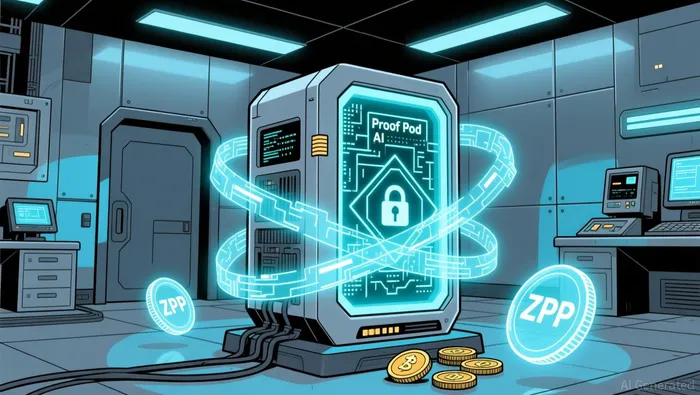
The project's transparency is further reinforced by its on-chain activity, including the deployment of the first Proof Pod hardware unit to Australia. These devices, which perform encrypted AI computations and generate ZKP rewards, signal active development and operational readiness according to Cryptoninjas. ZKP's listing on platforms like CoinMarketCap has amplified its visibility, attracting early adopters drawn to its real-world applications in secure data sharing and privacy-preserving AI as detailed in OpenExo's coverage.
Proof Pod Infrastructure: A Hardware-First Revolution
ZKP's Proof Pod initiative represents a paradigm shift in blockchain infrastructure. Unlike energy-intensive mining or passive staking, Proof Pods are plug-and-play hardware units that validate AI tasks using zero-knowledge proofs. Each device operates on a tiered earning model: a Level 1 Pod generates $1 worth of ZKP daily, while a Level 300 Pod can yield up to $300 per day according to ZKP's blog. This hardware-first approach ensures tangible value creation, with $17 million worth of Proof Pods already manufactured and tested for immediate deployment as reported by MEXC.
The project's $100 million pre-launch investment underscores its commitment to building a functional network from day one, bypassing the speculative fundraising common in crypto according to 2Urbangirls. By early 2027, ZKP plans to transition to a standalone reward system, further solidifying its infrastructure as a self-sustaining ecosystem as predicted by CryptoNews.
Vitalik Buterin's Vision: ZKP as the Future of Scalable Privacy
Vitalik Buterin's advocacy for zero-knowledge (ZK) proofs has positioned them as the cornerstone of scalable, privacy-preserving blockchain infrastructure. In 2025, Buterin emphasized that ZK technology would become "the most viable path" for addressing scalability and privacy challenges, a vision directly embodied by ZKP's native ZK-native architecture according to Phemex. Unlike Ethereum's gradual integration of ZK components, ZKP is designed from the ground up to support zk identity, zk compute, and zk verification as detailed by MEXC.
Buterin's recent calls for removing Ethereum's modular exponentiation (modexp) precompile-citing its inefficiency in proof generation-highlight his alignment with ZKP's focus on optimizing cryptographic efficiency according to Yahoo Finance. This synergy is evident in ZKP's collaboration with Ethereum-based rollups like zkSyncZK-- and StarkNetSTRK--, which have processed over 27 million transactions monthly, achieving 90% lower gas fees as reported by RumbleFish.
Contrasting ZKP with BNB and DOGE: Infrastructure vs. Speculation
While ZKP's infrastructure-driven growth is gaining momentum, BNB and DOGE remain trapped in a cycle of consolidation. BNB's price has been range-bound between $800 and $1,300, with on-chain metrics like MVRV and cost-basis levels indicating a potential 45% downside risk by mid-2026 according to FXEmpire. Despite Binance Smart Chain's 56.4 million weekly active addresses and $2.1 billion in RWA TVL, its deflationary mechanisms and quarterly burns may not offset broader market risks as analyzed by BeInCrypto.
Dogecoin, meanwhile, is stabilizing around $0.12–$0.13, with ROI estimates hinging on social media trends rather than technological advancements according to Weex. Analysts project a bullish range of $0.28–$0.55 for DOGE by 2026, but these forecasts remain speculative, lacking the infrastructure-driven fundamentals that underpin ZKP's growth as reported by CryptoRank.
Real-World Adoption: From Sports to AI
ZKP's real-world applications are accelerating its adoption beyond the crypto sphere. A $10 million partnership with the Dolphins rugby team integrates privacy-first AI for player health monitoring and fan engagement, leveraging ZKP's technology to protect sensitive data as reported by MEXC. Similarly, FC Barcelona has adopted ZKP for global sports analytics, demonstrating the project's scalability and institutional credibility according to Xt. These partnerships validate ZKP's ability to deliver verifiable computation in high-stakes environments, reinforcing its infrastructure narrative.
Conclusion: A Must-Act-On Infrastructure Play
As the crypto market matures, investors are increasingly prioritizing projects with tangible infrastructure and real-world utility. ZKP's 800x ROI projection is not a speculative gamble but a calculated outcome of its hardware-first model, Vitalik-aligned vision, and growing institutional partnerships. While BNB and DOGE remain stuck in consolidation, ZKP is building the next-generation blockchain infrastructure-positioning itself as the must-act-on opportunity for 2026.






Comentarios
Aún no hay comentarios