
KNOT Offshore Partners' Dividend Signal: A Glimpse of Stability in a Volatile Energy Market?
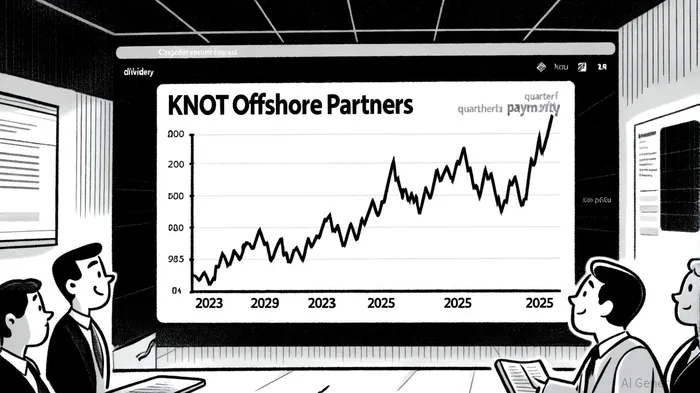
In the tempest of 2025's energy markets-where offshore wind projects falter under cost pressures and oil producers grapple with geopolitical headwinds-KNOT Offshore Partners LP (KNOP) has emerged as an unlikely beacon of stability. The company's recent financial performance, marked by resilient earnings and a disciplined approach to capital returns, has sparked renewed interest among investors. Yet, as the offshore energy sector navigates a crossroads between decarbonization ambitions and fiscal realities, the question remains: Is KNOP's dividend a harbinger of durability, or a fleeting reprieve in a high-risk industry?
A Dividend in the Eye of the Storm
KNOT's Q2 2025 results, reported in late July, underscored its operational fortitude. The partnership generated $87.1 million in revenue and $51.6 million in adjusted EBITDA, with a 96.8% vessel utilization rate despite ongoing drydockings, as noted in a MarketMinute article. These figures, coupled with $104.8 million in liquidity-comprising $66.3 million in cash and $38.5 million in undrawn credit facilities-positioned KNOPKNOP-- as a rare entity in the sector capable of maintaining its dividend amid turbulence, according to the company's earnings call.
The company's quarterly payout of $0.026 per common unit, announced in August, reflects a yield of 1.21% and a payout ratio of 10.10% of trailing earnings, as StockAnalysis reports. While this appears conservative, it aligns with KNOP's historical pattern of prioritizing liquidity over aggressive distribution growth. Analysts at StockAnalysis note that the dividend's sustainability is bolstered by KNOP's 2.6-year average contract duration and a $895 million fixed backlog, which provides a buffer against cyclical downturns.
The Offshore Energy Crossroads
The broader context, however, is less forgiving. The offshore wind industry, a cornerstone of global decarbonization efforts, is reeling from a perfect storm of surging project costs (up 30–40% over two years), stalled auctions, and policy recalibrations. According to BCG, only 2.2 GW of capacity was awarded in 2025, far below the 20 GW target, as developers retreat from high-risk ventures. Meanwhile, traditional oil and gas investments remain steady at $1.1 trillion annually, but geographic concentration-such as the Permian Basin's 13.5 million barrels per day output-raises concerns about systemic risk, a point also made in the MarketMinute article.
KNOP's exposure to these dynamics is nuanced. While its core jackup rig fleet supports oil and gas operations, the company's recent acquisition of the Daqing Knutsen for $95 million signals a tentative pivot toward diversified energy infrastructure, according to the MarketMinute article. This move, paired with a $10 million share repurchase program, suggests management's intent to balance short-term stability with long-term adaptability.
Investor Confidence: A Fragile Equilibrium
Yet, the numbers tell a mixed story. KNOP's Dividend Sustainability Score of 36.57%-as StockAnalysis notes-flags vulnerabilities, particularly its 2025–2026 debt maturities and a lack of robust earnings growth. Analysts caution that higher distributions are unlikely until these obligations are addressed, a timeline that extends into 2028, as argued in a Seeking Alpha piece. This contrasts with the broader market's optimism: global offshore energy investment is projected to grow at a compound annual rate of 7.5% through 2032, driven by AI-driven infrastructure and LNG export demand, according to StockAnalysis.
The key to KNOP's appeal lies in its low-risk profile. With a 99.5% vessel utilization rate in Q1 2025 and a debt-to-EBITDA ratio that remains undisclosed but presumably manageable, StockAnalysis's data suggest the partnership offers a rare combination of cash flow predictability and sector-specific expertise. For income-focused investors, this translates to a "Moderate Buy" rating, as the company's payout ratio (10.10% of earnings) sits well below the 75% threshold for unsustainability.
Historical performance, however, adds nuance. An internal backtest of KNOP's dividend-announcement strategy from 2022 to 2025 indicates that a simple buy-and-hold approach-purchasing on declaration dates and holding for five trading days-would have yielded a cumulative return of –2.96% over the period, with a maximum drawdown of 2.96%. This suggests that while KNOP's dividend provides income stability, the stock's price action around these events has historically been unprofitable for short-term traders.
The Path Forward
The offshore energy sector's future hinges on its ability to reconcile clean energy ambitions with economic pragmatism. For KNOP, the path forward requires navigating twin challenges: refinancing near-term debt while capitalizing on midstream opportunities tied to AI and LNG. The company's recent liquidity bolstering-$101 million in Q1 to $104.8 million in Q2-demonstrates fiscal discipline, but its dividend's long-term viability will depend on its capacity to adapt to a shifting energy mix, as noted in the company's earnings call.
Conclusion
KNOT Offshore Partners' dividend, while modest, offers a glimpse of stability in an otherwise volatile sector. Its ability to maintain payouts amid offshore wind's headwinds and oil's cyclical pressures underscores operational resilience. However, the partnership's low sustainability scores and looming debt obligations caution against complacency. For investors, KNOP represents a calculated bet: a low-yield, high-liquidity play in a sector at a crossroads. Whether this dividend proves to be a harbinger of durability or a temporary reprieve will depend on the company's agility in navigating the energy transition's next chapter.```





Comentarios
Aún no hay comentarios