
Klarna's Post-IPO Decline: A Warning Sign in the Evolving Buy Now, Pay Later (BNPL) Sector?
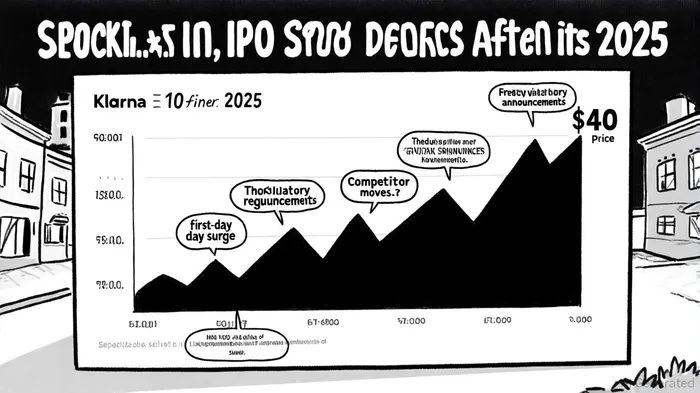
The buy now, pay later (BNPL) sector has long been a darling of fintech innovation, promising to democratize access to credit while sidestepping traditional banking systems. Klarna's September 2025 IPO, however, has cast a shadow over this optimism. Despite an initial valuation of $15.1 billion and a first-day stock surge of 15%, the company's shares have since fallen below their IPO price, trading at $42.74 as of late September 2025[1]. This decline raises critical questions about the sector's sustainability, regulatory risks, and the competitive pressures reshaping its landscape.
A Market at a Crossroads
The BNPL sector's explosive growth—projected to reach $343.52 billion in 2025 at a 48.4% CAGR—has been fueled by consumer demand for flexible payment options and the integration of BNPL into e-commerce platforms[2]. Klarna's IPO was seen as a watershed moment, signaling investor confidence in the sector's potential to mature beyond speculative hype. Yet, the company's post-IPO performance highlights vulnerabilities. While KlarnaKLAR-- reported $823 million in Q3 2025 revenue (up 20.67% year-over-year), it also posted a $52 million net loss, a stark contrast to its pre-IPO profitability narrative[3].
This divergence underscores a broader tension in the BNPL sector: the challenge of balancing rapid expansion with financial discipline. Klarna's foray into higher-risk products like “fair financing” (longer-term installment plans) has boosted interest income but increased credit risk, leading to larger provisions for defaults[4]. Such strategies, while potentially lucrative, expose the sector to macroeconomic headwinds, such as rising interest rates and tightening consumer budgets.
Competitive Pressures Intensify
Klarna's struggles are not isolated. Rivals like Affirm, PayPal, and Afterpay are aggressively defending their market shares. Affirm, for instance, has doubled down on its direct-to-consumer (DTC) channels, including the Affirm Card and App, while forming partnerships with financial infrastructure providers like FIS[5]. PayPal, the largest BNPL player in the U.S., leverages its 300 million-strong user base and “Pay in 4” offering to maintain dominance[6]. Afterpay, meanwhile, targets niche markets like fashion and low-order-value items, expanding its two-sided network to counter Klarna's global ambitions[7].
The competitive landscape is further complicated by regulatory scrutiny. In the U.S. and U.K., regulators are pushing to classify BNPL as credit, requiring affordability checks and credit reporting. Klarna has proactively aligned with these trends, but smaller players like Clearpay have already exited European markets to focus on profitability[8]. This regulatory shift is likely to accelerate market consolidation, favoring firms with robust compliance frameworks and diversified revenue streams.
Demographic and Behavioral Shifts
Consumer behavior also poses long-term risks. BNPL adoption remains heavily skewed toward younger demographics: 73% of users are aged 18–35, with Gen Z and Millennials accounting for 44% and 48% of usage, respectively[9]. While this demographic drives growth, it also creates instability. Younger users often have lower income stability and financial literacy, increasing default risks. For example, 37% of BNPL users missed at least one payment in 2025, with regulatory alerts spiking by 49%[10].
Moreover, BNPL's integration into essential purchases—such as groceries and healthcare—raises ethical concerns. Unlike discretionary spending, these transactions can trap users in cycles of debt, particularly as BNPL data remains largely absent from credit scores[11]. This lack of transparency risks eroding consumer trust and inviting stricter oversight.
Strategic Implications for Investors
Klarna's post-IPO decline serves as a cautionary tale for investors. While the BNPL sector's growth trajectory remains intact, its future hinges on three key factors:
1. Regulatory Adaptation: Companies must navigate evolving credit regulations without stifling innovation. Klarna's proactive engagement with regulators offers a blueprint, but smaller players may struggle.
2. Operational Discipline: Sustained profitability requires balancing growth with risk management. Klarna's shift to higher-margin services like Klarna Card and AI-driven financial tools[12] could mitigate this, but execution remains critical.
3. Diversification: Over-reliance on younger demographics limits scalability. Expanding into B2B markets, as seen with Santander and Allianz Trade's partnerships[13], could unlock new revenue streams.
Conclusion
Klarna's post-IPO volatility is not merely a company-specific issue but a symptom of broader sector dynamics. The BNPL market's maturation is inevitable, but its path will be shaped by regulatory rigor, competitive innovation, and consumer behavior. For investors, the key lies in identifying firms that can adapt to these forces—those that balance growth with prudence, diversify their offerings, and prioritize long-term sustainability over short-term hype.





Comentarios
Aún no hay comentarios