
KKR's Strategic Bet on SupplyHouse and the Future of Trade E-Commerce
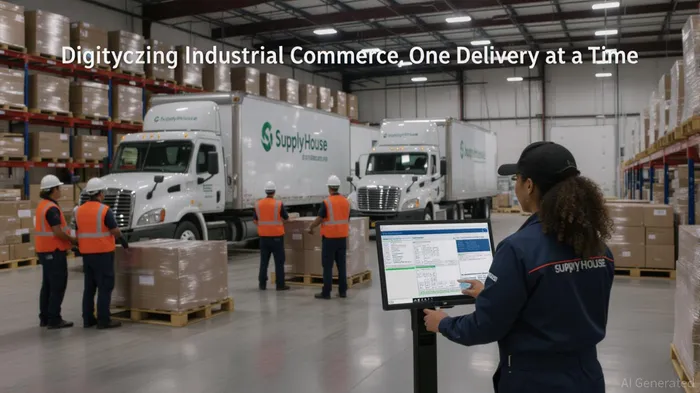
In July 2025, KKR's $20.3 billion investment arm made a bold move into the industrial e-commerce sector by acquiring a stake in SupplyHouse, a high-growth platform specializing in HVAC, plumbing, and electrical products. This partnership, though shrouded in undisclosed financial terms, signals a pivotal shift in the digitization of B2B supply chains—a sector now valued at $32.11 trillion globally and projected to balloon to $36.16 trillion by 2026. For investors, this move is not just about capitalizing on a niche market; it's about aligning with a fundamental reimagining of how goods are bought, sold, and delivered in the industrial world.
The B2B E-Commerce Revolution: A $36 Trillion Opportunity
The industrial B2B sector has long been fragmented, with supply chains plagued by inefficiencies, manual processes, and a lack of digital integration. But 2025 marks a turning point. Digital adoption has surged, with 80% of B2B sales interactions now occurring online—up from 13% in 2019. In the U.S., digital channels are expected to account for 56% of B2B revenue by 2025, driven by millennial buyers who demand self-service portals, mobile-first experiences, and hyper-personalization.
SupplyHouse is positioned at the epicenter of this transformation. The company's proprietary e-commerce platform, TradeMaster loyalty program, and nationwide logistics network enable it to deliver over 250,000 products from 500+ brands to 7 million customers, with 98% of the U.S. population reachable within two days. This is not just e-commerce—it's a scalable, digitized supply chain that mirrors the efficiency of consumer giants like AmazonAMZN-- but tailored for trade professionals.
Why KKR's Ascendant Strategy Targets SupplyHouse
KKR's investment in SupplyHouse is part of its Ascendant Strategy, a $12 billion initiative targeting middle-market companies in North America. This strategy prioritizes businesses with durable cash flows, strong unit economics, and cultures that prioritize employee engagement. SupplyHouse checks all these boxes:
- Operational Excellence: Its logistics network is a competitive moat, with 1,200 employees trained to deliver “white-glove” service.
- Digital Infrastructure: The TradeMaster platform leverages AI for inventory optimization and personalized customer experiences, aligning with trends where 87% of B2B buyers are willing to pay more for tailored solutions.
- Employee-Centric Culture: Both KKRKKR-- and SupplyHouse share a “team first” philosophy. This isn't just altruism—it's a strategic differentiator. Studies show that companies with engaged employees outperform peers by 20% in profitability.
By investing in SupplyHouse, KKR is betting on a company that not only digitizes supply chains but also humanizes them. This dual focus on technology and culture is rare in the industrial sector and positions SupplyHouse to dominate its niche.
The Bigger Picture: KKR's Play in the $36 Trillion B2B Market
The B2B e-commerce boom is being fueled by three megatrends:
1. AI and Automation: Successful e-commerce firms automate 70% of workflows, reducing procurement costs by 15% and boosting efficiency by 30%.
2. Omnichannel Strategies: Companies with seamless web, mobile, and marketplace integrations retain 89% of customers, compared to 33% for laggards.
3. Supply Chain Resilience: With 66% of B2B firms citing fulfillment as their biggest headache, SupplyHouse's two-day delivery model is a game-changer.
For KKR, SupplyHouse is a gateway to these trends. The firm's $127.4 billion market cap and 16-year dividend streak underscore its ability to balance long-term value creation with financial stability. By pairing SupplyHouse's operational depth with KKR's capital and strategic expertise, the partnership could unlock exponential growth.
Investment Implications: A Win-Win for Stakeholders
For investors, the key question is whether this partnership can scale SupplyHouse's model beyond HVAC, plumbing, and electrical. The answer lies in its adaptability. The company's platform is already modular, with APIs that could integrate with other industrial sectors. If KKR leverages its network to replicate this model in adjacent markets (e.g., construction materials, automotive parts), the valuation potential is enormous.
However, risks exist. The B2B e-commerce space is highly competitive, with players like Amazon Business and FastenalFAST-- already vying for market share. SupplyHouse must continue to innovate in AI-driven personalization and logistics efficiency to maintain its edge.
The Bottom Line: A Strategic Bet on the Future
KKR's investment in SupplyHouse is more than a financial transaction—it's a vote of confidence in the digitization of industrial commerce. As the global B2B market hurtles toward $36 trillion, companies that combine cutting-edge technology with a “people-first” culture will lead the charge. For KKR, this partnership aligns perfectly with its Regime Change thesis: investing in businesses that thrive in a world of inflation, volatility, and digital disruption.
Investors should watch this space closely. The next phase of B2B e-commerce isn't about replacing old systems—it's about reimagining them. And in that race, SupplyHouse, backed by KKR, is a formidable contender.





Comentarios
Aún no hay comentarios