
KKR's Managed Credit Strategies: A Hedge Against Rising Rates in a Shifting Market
In today's volatile market, where rising interest rates threaten to erode income portfolios, KKR's managed credit strategies have emerged as a critical tool for diversification and resilience. . . By leveraging private credit, (CLOs), and a reimagined 40/30/30 portfolio framework, KKRKKR-- is positioning itself as a leader in navigating the new normal of higher-for-longer rates.
The Challenge: Rising Rates and Credit Market Volatility
The Federal Reserve's aggressive rate hikes since 2022 have created a perfect storm for credit portfolios. Fixed-rate assets have lost value, while sectors like commercial real estate and non-investment-grade corporate debt face liquidity risks[4]. For KKR, this environment has tested the mettle of its managed credit strategies. , a modest but telling erosion[1]. Yet, even as income streams tightened, , underscoring its commitment to shareholder returns[1].
The Strategy: Diversification Through Private Credit and CLOs
KKR's playbook has always been about balancing risk and reward. In 2025, . According to a report by , . These securities, , provide two key advantages:
1. Carry protection, .
2. Default resilience, .
KKR's portfolio managers have also emphasized credit selection, focusing on high-quality borrowers with durable competitive moats. .
The 40/30/30 Portfolio: A New Blueprint for Diversification
The traditional 60/40 portfolio—40% bonds, 60% stocks—has struggled in the inflationary 2020s. KKR's proposed 40/30/30 framework, however, allocates 30% to alternatives like private credit, real estate, and infrastructure, . This approach has shown historical outperformance during high-inflation periods, .
A key innovation within this framework is the integration of CLOs. As KKR's leveraged credit portfolio manager notes, , . By allocating 10% of the 40/30/30 portfolio to private credit (via CLOs and direct lending), .
The Results: Growth Amidst Uncertainty
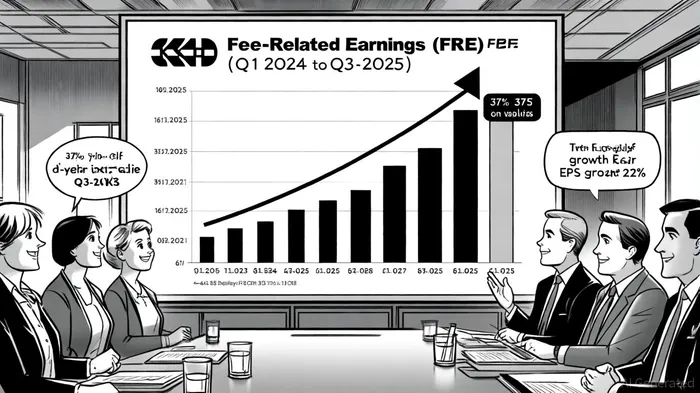
Despite the challenges, KKR's strategic bets are paying off. In Q1 2025, . These gains reflect strong demand for its credit strategies, . The firm's partnership with Capital Group to launch hybrid public/private credit funds in 2025 further democratizes access to these strategies, .
Looking Ahead: Discipline and Flexibility
KKR's success in 2025 hinges on its ability to maintain disciplined underwriting and active risk management. While rising rates have compressed spreads in the leveraged loan market, . Additionally, .
Conclusion: A Strategic Edge in a High-Rate World
For , KKR's managed credit strategies offer a compelling solution to the challenges of 2025. By combining the flexibility of private credit, the hedging power of CLOs, and the diversification of a 40/30/30 portfolio, the firm is not just surviving the rate hike cycle—it's thriving. As the market grapples with inflation and policy uncertainty, KKR's disciplined approach serves as a blueprint for building resilient, high-yield portfolios.







Comentarios
Aún no hay comentarios