
Why Kiyosaki's 2026 Price Targets for Bitcoin and Gold Signal a Paradigm Shift in Asset Allocation
The Case for Hard Assets: Gresham's Law and Scarcity
Kiyosaki's bullish stance on Bitcoin and gold hinges on Gresham's Law, which posits that "bad money drives out good" in a system where fiat currencies are devalued by excessive money printing, as noted in the Economic Times article. The U.S. Federal Reserve's post-pandemic stimulus programs, which expanded the money supply by over 40%, as cited in the Economic Times article, have accelerated this dynamic. As central banks continue to erode purchasing power, investors are increasingly turning to assets that defy inflationary decay.
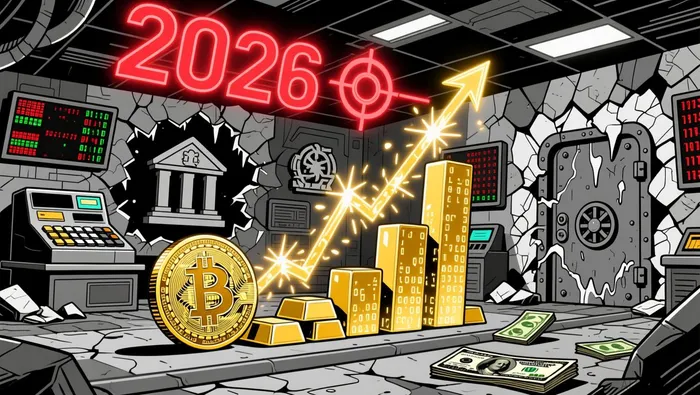
Gold, with its millennia-old role as a store of value, and Bitcoin, the first programmable scarce asset, represent a counter-narrative to fiat-centric portfolios. Kiyosaki's $27,000 gold target aligns with historical patterns: during the 2008 financial crisis, gold prices surged 25% as investors fled equities, as noted in the Economic Times article. His Bitcoin prediction, meanwhile, reflects a belief in its digital scarcity-21 million coins-positioning it as a hedge against the infinite supply of fiat currencies.
Inflationary Policy Critique: The Fed's "Money Printing" Dilemma
Kiyosaki's critique of the U.S. Treasury and Federal Reserve is not isolated. A 2024 report by the International Monetary Fund (IMF) warned that prolonged accommodative monetary policies risk creating "asset inflation" while exacerbating inequality, as noted in the Economic Times article. By betting on Bitcoin and gold, Kiyosaki is essentially advocating for a portfolio realignment that prioritizes assets with intrinsic value over those inflated by central bank interventions.
This shift is already materializing. In 2023, institutional demand for gold-backed ETFs grew by 18%, while Bitcoin's market capitalization surpassed $1 trillion for the first time, as noted in the Economic Times article. These trends suggest that Kiyosaki's 2026 targets may not be outliers but rather the culmination of a long-term reallocation of capital toward hard assets.
The Paradigm Shift in Asset Allocation
Traditional asset allocation models, which historically emphasized 60% equities and 40% bonds, are increasingly obsolete in an era of negative real interest rates and geopolitical instability. Kiyosaki's framework proposes a radical departure: a portfolio weighted toward scarce, non-correlated assets.
Consider the implications of his targets. At $250,000, Bitcoin would represent a 10x increase from its 2023 peak, while gold's $27,000 price would mark a 70% surge from 2024 levels, as noted in the Economic Times article. Such growth would force institutional investors to reclassify these assets from speculative to strategic, much like the shift from cash to real estate during the 2008 crisis, as noted in the Economic Times article.
Conclusion: Preparing for the New Monetary Order
Kiyosaki's 2026 price targets are more than forecasts-they are a call to action for investors to rethink the foundations of wealth. By anchoring their analysis in Gresham's Law and the failures of inflationary policy, his predictions challenge the status quo and highlight the resilience of hard assets in a world of monetary uncertainty. As the Fed's balance sheet continues to expand and global debt levels reach record highs, the case for Bitcoin and gold grows stronger, as noted in the Economic Times article.
For those willing to adapt, the coming years may offer not just financial opportunity but a chance to participate in a redefinition of value itself.






Comentarios
Aún no hay comentarios