
KITE's Post-Listing Price Trajectory: A Study in Valuation Volatility for Emerging Tech Tokens
A Volatile Debut: KITE's Price Fluctuations
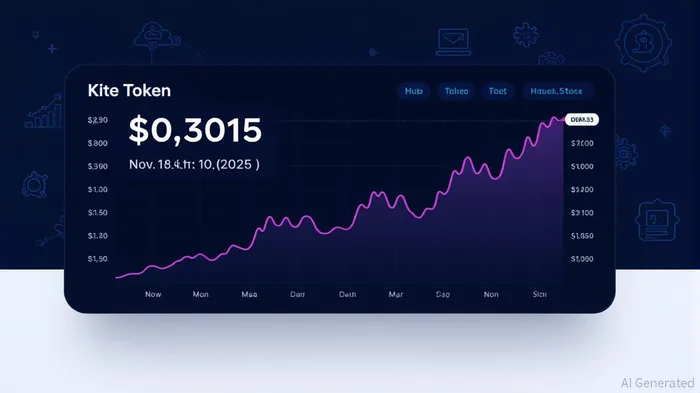
KITE's listing on Binance on November 3, 2025, marked a pivotal moment for the token. It opened at $0.11 but quickly dropped to $0.095, reflecting the typical "buy the rumor, sell the news" dynamic seen in speculative assets, as noted in a LookOnChain report. By the end of the first week, the token's market capitalization stabilized at $167 million, with a fully diluted valuation (FDV) of $929 million, according to the same report. This initial volatility contrasts sharply with the performance of more established tech stocks, such as Nebius GroupNBIS-- (NASDAQ: NBIS), which has seen a 417% surge in 2025 due to its strategic partnership with Microsoft, as reported by The Motley Fool.
The disparity highlights a key distinction: while Nebius benefits from institutional backing and a clear revenue stream, KITE remains an early-stage token with limited analyst coverage. As of mid-November, no major Wall Street firms had issued formal ratings for KITE, unlike Kite Realty Group Trust (KRG), a REIT with a "Hold" consensus despite mixed sentiment, as reported by MarketBeat. This lack of institutional scrutiny amplifies KITE's exposure to retail-driven speculation, a common feature of newly listed tech tokens.
Broader Market Dynamics and Sector Comparisons
KITE's valuation volatility cannot be viewed in isolation. The broader tech sector, particularly AI and blockchain, has experienced extreme swings in 2025. For instance, Corpay (CPAY), a diversified financial services firm, reported robust Q3 results but saw its stock decline 24.5% year-to-date, illustrating how market sentiment can override fundamentals, according to a Simply Wall St report here. Similarly, KITE's price action reflects a tug-of-war between bullish narratives about its "agentic economy" model-where AI agents transact autonomously-and skepticism about its utility and adoption potential, as reported by CoinDesk.
A comparison with Nebius Group further underscores this tension. Nebius's 114.9x sales multiple, while expensive, is justified by its $17.4 billion Microsoft contract and projected 392% revenue growth in 2025, according to The Motley Fool. KITE, by contrast, lacks such concrete revenue drivers, relying instead on speculative demand from crypto-native investors. This divergence raises questions about whether KITE's valuation is a reflection of its intrinsic value or a temporary fad.
Implications for Investors
For investors, KITE's post-listing performance serves as a cautionary tale about the risks of valuation volatility in emerging tech assets. While the token's FDV of $929 million suggests optimism about its long-term potential, its current price of $0.095-well below the $0.11 listing price-highlights the fragility of such optimism. This volatility is exacerbated by the absence of regulatory clarity and the token's concentration in speculative trading platforms like Binance's Alpha section.
However, the token's integration into BingX's Xpool pre-listing platform, which allowed users to stake assets for early access, as reported in a PR Newswire, indicates a strategic effort to build a loyal user base. If Kite's AI-driven payment ecosystem gains traction, this could provide a foundation for sustainable growth. For now, though, investors must weigh the token's speculative allure against its lack of proven utility and the broader market's risk-off sentiment.
Conclusion
KITE's post-listing price trajectory exemplifies the valuation volatility characteristic of newly listed tech tokens. While its initial trading volume and FDV signal strong market interest, the token's subsequent price corrections and limited analyst coverage underscore the challenges of assessing its true value. As the AI and blockchain sectors continue to evolve, investors must remain vigilant, balancing innovation-driven optimism with rigorous due diligence.





Comentarios
Aún no hay comentarios