
The KITE Listing Surge: Decoding Market Sentiment and Institutional Confidence
Strategic Post-Listing Valuation Dynamics
Kite Realty Group Trust (KRG) has navigated a complex landscape in Q3 2025, marked by operational resilience amid macroeconomic headwinds. Despite reporting a $4.82 million revenue shortfall and a negative EPS of -$0.07, the company demonstrated a 2.1% year-over-year increase in same-property net operating income (NOI) and a 12.2% blended cash leasing spread. These metrics underscore KRG's strategic pivot toward grocery-anchored properties, which now account for 79% of its retail weighted average base rent. This shift has driven strong leasing performance, with average new lease spreads of 56% and 20% gross capital returns in the segment.
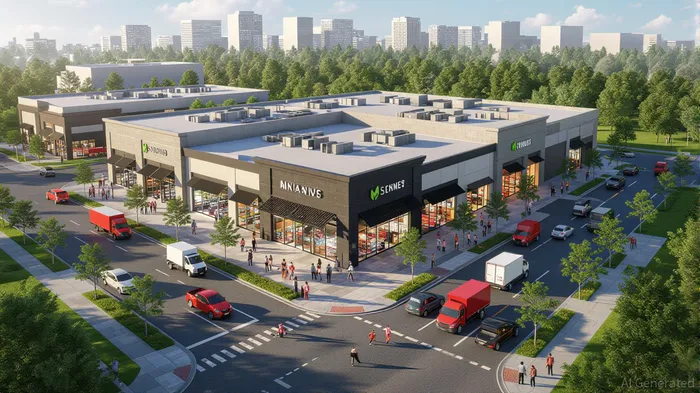
However, KRG's valuation remains under pressure. Analysts have revised price targets downward, with Raymond James and Wells Fargo setting new benchmarks at $26.00 and $23.00, respectively. The company's negative P/E ratio and a 7.4% year-over-year dividend increase to $0.29 per share highlight the tension between operational improvements and broader sector challenges. The retail REIT industry, rated "F" due to macroeconomic uncertainties, further complicates KRG's valuation trajectory.
Institutional Adoption and Ownership Trends
Institutional confidence in KRG reflects a mixed landscape. While major shareholders like Vanguard Group, State Street Corp, and JPMorgan Chase collectively own $1.2 billion in shares, recent trading activity reveals divergent strategies. Intech Investment Management LLC reduced its stake by 16.8%, and CEO John A. Kite sold 48% of his holdings. Conversely, Centersquare Investment Management LLC and Geode Capital Management LLC increased their positions by 133.6% and 0.7%, respectively. This duality suggests cautious optimism among some investors, buoyed by KRG's strong balance sheet-$1.2 billion in liquidity and a net debt-to-adjusted EBITDA ratio of 5.0x.
The approval of U.S. spot crypto ETFs, though not yet including KRG, may catalyze institutional interest in digital assets, potentially spilling over into real estate REITs with hybrid strategies. KRG's dual-listing ambitions, akin to the SGX-Nasdaq bridge model, could further enhance liquidity and attract Asian institutional investors.
Market Sentiment and Long-Term Viability
Market sentiment toward KRG is shaped by both optimism and skepticism. On one hand, the company's strategic focus on industrial real estate-driven by AI-enabled logistics and e-commerce demand-positions it to capitalize on long-term trends. On the other, risks such as anchor tenant bankruptcies, re-leasing challenges, and economic pressures on consumer spending persist. Analysts remain divided: some highlight KRG's grocery-anchored portfolio and 7.4% dividend growth as strengths, while others caution against sector volatility.
The broader IPO market's resurgence in Q3 2025-marked by a 19% increase in deals and 89% growth in proceeds-has also influenced investor behavior. KRG's revised 2025 guidance and operational improvements may attract value-conscious investors, but its performance will ultimately hinge on macroeconomic stability and effective tenant management.
Conclusion: Navigating the KITE Conundrum
The KITE listing surge encapsulates the duality of market dynamics in 2025. For KRG, the path forward requires balancing short-term challenges with long-term strategic gains. Institutional adoption, while mixed, signals underlying confidence in its operational resilience. However, investors must remain vigilant about sector-specific risks and macroeconomic shifts. As the retail REIT industry grapples with uncertainty, KRG's ability to adapt-through industrial real estate diversification and dividend sustainability-will be pivotal in determining its long-term viability.





Comentarios
Aún no hay comentarios