
Kirkland's Q2 2026 Earnings Call: Contradictions Emerge on E-commerce Strategy, Tariff Impacts, and Sourcing Shifts
The above is the analysis of the conflicting points in this earnings call
Date of Call: September 16, 2025
Financials Results
- Revenue: $75.8M, down 12.2% YOY (vs $86.3MMMM-- prior year)
- EPS: Adjusted loss per share of $0.90, improved from $1.11 prior year; GAAP net loss $19.4M vs $14.5M prior year
- Gross Margin: 16.3%, down 410 bps YOY (20.4% prior year) driven by liquidation (130 bps), tornado-related write-offs (100 bps), and tariffs (30 bps)
Guidance:
- Expect continued liquidation of non-go-forward inventory in H2 to fund/store conversions
- No additional significant tornado-related expenses anticipated in H2
- Tariff headwind ~100 bps to gross margin in Q3; limited impact in Q4
- Accelerating Bed BathBBBY-- & Beyond Home conversions; 4 more Nashville-area openings in ~6 weeks
- Plan to convert virtually all stores over 24 months; per-store CapEx < $100k
- Placed buys for 30 conversions in Q1 2026; targeting broad back-to-campus push in 2026
- E-commerce to remain pressured; focus on brick-and-mortar and BOPIS for profitability
- Exploring wholesale for Kirkland’s Home; first buybuy BABY store expected in 2026
Business Commentary:
- Retail Transformation and Partnership:
- Kirkland's Inc. announced a partnership with Bed Bath & Beyond, which included opening its first store in Brentwood and planning for conversions of all existing Kirkland's Home stores.
The partnership aims to leverage the Bed Bath & Beyond name and infrastructure for a capital-light transformation, with each conversion expected to cost less than
$100,000in CapEx.Impact of Disruptions on Financial Performance:
- The company reported
net salesof$75.8million for Q2, down from$86.3million in the prior year quarter, driven by a9.7%decline in comparable sales. The decline was attributed to disruptions at the Jackson, Tennessee distribution center following a tornado and ongoing strategic liquidation of inventory for Bed Bath & Beyond conversions.
E-commerce Challenges:
- Kirkland's experienced a
38.5%decrease in e-commerce comparable sales during Q2. The drop was primarily due to disruptions at the distribution center and purposeful liquidation efforts to optimize inventory for the Bed Bath & Beyond conversion.
Tariff and Inventory Management:
- Kirkland's faced marginal pressure in Q2 due to
30 basis pointsof additional tariff costs, which is expected to increase to100 basis pointsin Q3. The company is strategically managing inventory by liquidating non-go-forward categories and restructuring stores in anticipation of Bed Bath & Beyond conversions.
Leadership and Financial Expertise:
- Andrea Courtois joined as CFO in July, bringing more than
20 yearsof financial expertise in planning, analysis, and inventory management. - Her appointment underscores the company's commitment to long-term growth through strategic financial management and inventory optimization in support of the ongoing transformation.
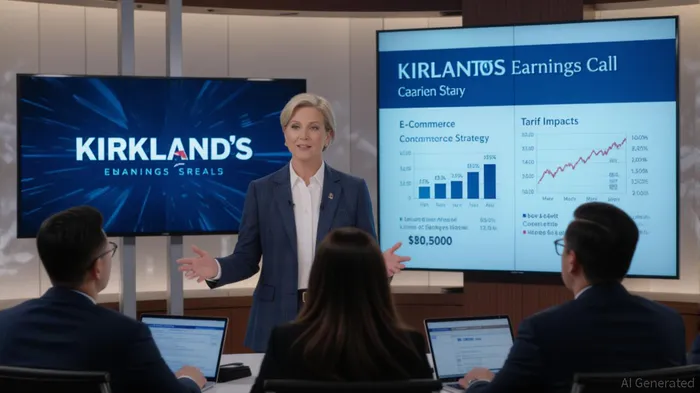
Sentiment Analysis:
- Net sales fell to $75.8M from $86.3M; gross margin declined 410 bps to 16.3% on liquidation, tornado, and tariffs. Management expects continued liquidation and Q3 tariff pressure. However, the first Bed Bath & Beyond Home store exceeded expectations with strong traffic, new customers, and sales, prompting an accelerated conversion plan with low per-store CapEx and 30 conversions bought for Q1 2026.
Q&A:
- Question from Jeremy Hamblin (Craig-Hallum Capital Group): What were actual conversion costs for Brentwood and how are post-opening trends developing?
Response: Brentwood cost ~$30k (well below the <$100k target); traffic, new customer acquisition, and sales are running above a Kirkland’s baseline with strong lifts in bedroom and kitchen.
- Question from Jeremy Hamblin (Craig-Hallum Capital Group): Of the 300+ locations, how many will be converted versus closed over the next 24 months?
Response: About 25 closures at January 2026 lease expirations; expect 250–275 existing stores to remain and convert, with opportunistic additions, particularly in the Northeast.
- Question from Jeremy Hamblin (Craig-Hallum Capital Group): How should we think about store momentum vs. e-commerce and when e-commerce stabilizes?
Response: E-commerce remains challenged and will be deprioritized; focus capital on profitable store and BOPIS transactions. Expect e-commerce declines to normalize to earlier-year levels.
- Question from Jeremy Hamblin (Craig-Hallum Capital Group): Can you confirm current debt/liquidity following the IP sale and financing structure?
Response: Management affirmed figures in line with ABL and Bed Bath & Beyond loan facilities, indicating sufficient availability to support operations and conversions.
- Question from Jeremy Hamblin (Craig-Hallum Capital Group): How will tariffs affect Q3/Q4 and how are you managing sourcing exposure into 2026?
Response: Expect Q3 gross-margin pressure mitigated by vendor negotiations and pricing; Q4 limited impact. Shift mix toward domestic/national brands as stores convert and reduce China exposure; India negotiations ongoing.
- Question from Jeremy Hamblin (Craig-Hallum Capital Group): Can you quantify back-half gross margin impact from tariffs?
Response: ~100 bps GMGM-- headwind in Q3; limited in Q4. Liquidation to prep conversions will likely weigh more on GM than tariffs through year-end.
- Question from Jeremy Hamblin (Craig-Hallum Capital Group): How many conversions can you achieve in 2026 vs. 2027?
Response: Buys placed for 30 conversions in Q1 2026; targeting as many additional conversions as supply allows to capture the 2026 back-to-campus season.





Comentarios
Aún no hay comentarios