
The Kinto Collapse: Lessons for Evaluating Ethereum L2 Viability and Security Risks
The collapse of Kinto, an EthereumETH-- Layer 2 (L2) DeFi project, in July 2025 serves as a stark reminder of the fragility of blockchain ecosystems when security vulnerabilities are exploited. A $1.6–$1.9 million hack, enabled by a flaw in the ERC-1967 Proxy standard, drained liquidity from UniswapUNI-- and Morpho pools, leading to a 81% token price drop and the project’s eventual shutdown [1]. This case study underscores critical lessons for investors evaluating the long-term viability of Ethereum L2 projects in a post-hack environment, particularly when compared to the resilience strategies of larger platforms like Starknet, Arbitrum, and ZKsync.
The Kinto Collapse: A Case of Systemic Vulnerability
Kinto’s downfall was rooted in its reliance on the ERC-1967 Proxy standard, a widely used OpenZeppelin codebase for upgradable smart contracts. Attackers exploited a logic flaw to mint 110,000 fake Kinto tokens on Arbitrum, triggering a liquidity drain and eroding user confidence [1]. The project’s attempt to recover via a $1 million “Phoenix Program” failed to attract further funding, forcing a shutdown by September 30 [1]. This outcome highlights two critical weaknesses: overreliance on unproven smart contract patterns and inadequate governance structures to manage post-hack recovery.
Kinto’s failure mirrors that of its co-founder’s previous project, Babylon Finance, which collapsed after a 2022 hack. Such recurring patterns suggest a lack of institutional learning in the DeFi space, where high-yield staking offers (e.g., 130% APY in USDC) often overshadow security due diligence [1].
Contrasting Kinto with Ethereum L2 Resilience
In contrast to Kinto’s collapse, major Ethereum L2 projects like Starknet, Arbitrum, and ZKsync have demonstrated robust post-hack recovery strategies. For instance:
- Arbitrum mitigated a 2025 outage caused by BitcoinBTC-- Ordinals-inspired inscriptions by decentralizing its sequencer architecture, reducing single points of failure [4].
- Starknet addressed a three-hour network freeze during the Grinta upgrade through phased rollouts and rigorous compatibility testing [3].
- ZKsync recovered from an airdrop vulnerability by strengthening smart contract audits and implementing multi-signature governance for critical contracts [6].
These projects emphasize proactive risk mitigation, including formal verification, decentralized sequencer models, and community-driven governance. For example, Arbitrum’s ARB token enables decentralized decision-making, allowing token holders to vote on upgrades and treasury allocations [1]. This contrasts sharply with Kinto’s centralized recovery efforts, which failed to secure stakeholder buy-in.
Broader Lessons for Ethereum L2 Viability
The Kinto collapse reveals systemic risks in Ethereum L2 ecosystems, particularly in bridge contracts and off-chain components. A 2024 industry report noted that $2.2 billion was stolen in crypto hacks, with 21% of incidents targeting L2 bridges and sequencers [4]. To evaluate L2 viability, investors should prioritize projects with:
1. Zero-knowledge proofs (ZKPs): Platforms like ZKsync and Starknet use ZKPs to validate transactions cryptographically, minimizing attack surfaces [5].
2. Decentralized infrastructure: Arbitrum’s shift to a decentralized sequencer model reduces reliance on centralized nodes [4].
3. Robust governance: Token-based governance (e.g., ARB) ensures community oversight of critical upgrades [1].
The Role of Security Audits and Industry Collaboration
Post-hack resilience also hinges on external audits and bug bounty programs. For example, OpenZeppelin and Trail of Bits provide specialized audits for L2 platforms, securing over $50 billion in value [3]. In contrast, Kinto’s lack of third-party audits left it exposed to well-known vulnerabilities in the ERC-1967 Proxy standard [1].
Investors should also consider security debt—the accumulation of unaddressed vulnerabilities due to rushed deployments or inadequate testing. Tools like Olympix and TraceLLM are emerging to automate vulnerability detection, but adoption remains uneven [2].
Conclusion: A Framework for Evaluating L2 Projects
The Kinto collapse underscores the need for a rigorous evaluation framework for Ethereum L2 projects. Key metrics include:
- Security maturity: Use of ZKPs, formal verification, and third-party audits.
- Governance decentralization: Token-based governance vs. centralized control.
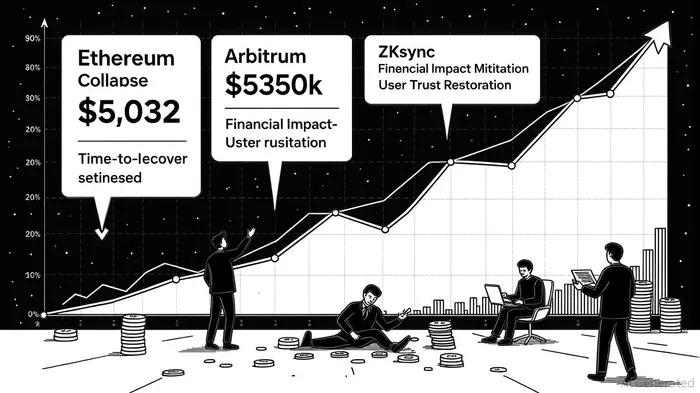
- Post-hack recovery: Time-to-recover, financial impact mitigation, and user trust restoration.
While Kinto’s failure highlights the risks of under-resourced projects, larger L2s like Arbitrum and Starknet demonstrate that resilience is achievable through technical innovation and community-driven governance. For investors, the lesson is clear: prioritize projects with proactive security measures, decentralized infrastructure, and transparent governance to navigate the evolving risks of the Ethereum ecosystem.
Source:
[1] Kinto to Shut Down After Exploit Drains $1.9M From ... [https://web.ourcryptotalk.com/news/kinto-to-shut-down-after-hack]
[2] The Security Debt Crisis: How Hidden Flaws Bankrupt Smart Contracts in Seconds, [https://www.olympix.ai/blog/the-security-debt-crisis-how-hidden-flaws-bankrupt-smart-contracts-in-seconds]
[3] OpenZeppelin, [https://www.datawallet.com/crypto/best-smart-contract-auditing-companies]
[4] Arbitrum Operations “Back to Normal” After Inscriptions Surge Caused Outage [https://www.bitget.com/news/detail/12560604946869]
[5] Security Challenges and Performance Trade-Offs in On- ... [https://www.mdpi.com/2076-3417/15/6/3225]
[6] ZK Collapsed: How Are the Four Kings of Layer 2 Holding Up Now? [https://www.bitget.com/news/detail/12560604946869]






Comentarios
Aún no hay comentarios