
Kinder Morgan's Arizona Expansion: A Pillar of Resilience in Energy Transition and AI-Driven Efficiency
As the energy landscape evolves, Kinder MorganKMI-- (KMI) is positioning itself as a critical player in bridging traditional infrastructure with the demands of the future. The company's Arizona expansion projects—particularly the Copper State Connector pipeline and the proposed Bullet Pipeline—are not merely about moving gas; they represent a strategic pivot toward resilient infrastructure designed to withstand the dual pressures of energy transition and AI-driven operational optimization. Here's why investors should pay attention.
The Arizona Expansion: A Hub of Growth and Transition
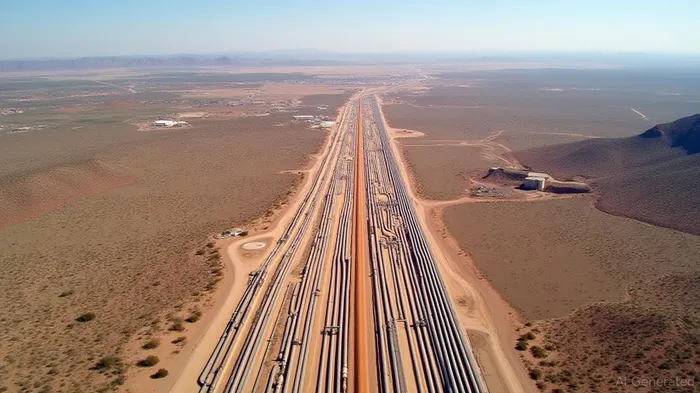
KMI's Arizona projects are anchored by the 630-mile Copper State Connector, a $3.5 billion pipeline system designed to transport 2.1 billion cubic feet (Bcf) of natural gas daily from the Permian Basin to Arizona markets. This pipeline, paired with salt-cavern storage facilities, is set to meet surging demand from data centers, industrial users, and West Coast LNG export terminals. UBS estimates the project could add $750 million to KMI's EBITDA, pushing its project backlog to $14.5 billion—nearly halfway to its $20 billion target by 2026.
The Bullet Pipeline, a 550-mile greenfield project targeting $1.5–1.8 billion in construction costs, further underscores KMI's focus on scalability. This pipeline would twin the South Mainline of the El Paso Natural Gas system, delivering up to 1.1 Bcf/d of Permian gas to Arizona's data centers, including the 2.4 GW Tract Data Center in Maricopa County.
Infrastructure Resilience: The Foundation of KMI's Strategy
KMI's infrastructure is engineered to thrive amid uncertainty. Its 95% fee-based revenue model and 89% take-or-pay contracts ensure stable cash flows, even as energy demand fluctuates. This model is critical in an era where data centers and renewable projects are increasingly gas-dependent. For instance, East Daley Analytics estimates 7 GW of data center load within 50 miles of the El Paso Natural Gas footprint, creating a reliable revenue stream for KMI.
The company's Salt Cavern Storage Facility in Arizona adds another layer of resilience. These facilities can store 24 Bcf of natural gas, providing flexibility to balance supply and demand—key for regions with intermittent renewable energy generation.
AI-Driven Efficiency: The Invisible Edge
KMI's operational excellence is underpinned by AI and predictive analytics, which optimize maintenance, routing, and emissions reduction. Sensors along pipelines feed data into predictive models, enabling proactive repairs and minimizing downtime. Dynamic routing algorithms ensure hydrocarbons flow to the highest-value markets, while emissions monitoring tools help meet methane reduction targets.
These technologies are not just cost savers—they're profit multipliers. By reducing maintenance costs and improving capacity utilization, KMI can allocate capital more efficiently. For example, the Copper State Connector's $750 million EBITDA contribution assumes a 6.0xZRX-- build multiple, a figure bolstered by AI's ability to maximize pipeline throughput.
Financial Fortitude and Risks
KMI's fortress balance sheet—with a target Net Debt/EBITDA ratio of 3.8x—supports its ambitious expansion. A 4.23% dividend yield, backed by 21 years of growth, adds to its appeal. The company's $2.5 billion 2025 investment plan, including renewable natural gas (RNG) projects and the Trident pipeline, signals a commitment to diversification.
Risks remain, however. Permitting delays in Arizona and New Mexico could stall projects like the Bullet Pipeline. Yet KMI's track record—securing approvals for the Trident and Mississippi Crossing pipelines—suggests these risks are manageable.
Investment Thesis: Buy on Dips, Hold for the Transition
KMI is a defensive play in an uncertain energy market. Its Arizona projects, paired with AI-driven efficiency, position it to capitalize on $20–28 Bcf/d of natural gas demand growth by 2030 (driven by LNG exports and power generation). UBS's $38 price target implies a 36% upside from current levels, assuming Copper State's approval.
For investors, KMI offers income stability (4.05% yield) and long-term growth. The company's focus on RNG and scalable infrastructure aligns perfectly with energy transition goals, making it a rare “both/and” investment: resilient today, relevant tomorrow.
Recommendation: Accumulate KMI on dips below $28, with a 12–18 month horizon. Monitor regulatory approvals and data center demand milestones for catalysts.
In a world demanding both reliability and innovation, Kinder Morgan's Arizona expansion is more than a pipeline—it's a blueprint for energy resilience.







Comentarios
Aún no hay comentarios