
The Kimchi Premium: South Korea's Unique Bitcoin Market Dynamics and Speculative Fervor
Bitcoin's Kimchi Premium-the persistent price disparity between South Korean and global markets-has long been a barometer of speculative behavior and regulatory asymmetry. As of October 2025, the premium surged to a three-year high of 12%, defying a global BitcoinBTC-- price slump to $95,000, according to a Bitcoin Newsday report. This divergence underscores South Korea's unique market dynamics, where political instability, retail-driven speculation, and regulatory constraints collide to create a volatile yet lucrative environment for investors.
The Anatomy of the Kimchi Premium
The Kimchi Premium's resurgence in October 2025 was fueled by a confluence of factors. South Korea's strict capital controls, which restrict foreign investment in domestic exchanges, have historically limited arbitrage opportunities, according to a Bitget analysis. Compounding this, the absence of a futures trading market in South Korea means local investors lack hedging tools available to global counterparts, amplifying price swings - a trend Bitcoin Newsday also reported. Meanwhile, the retail-dominated nature of South Korea's crypto market-where individual investors account for over 70% of trading volume-creates a feedback loop of speculative buying during periods of uncertainty, according to a Cryptopolitan analysis.
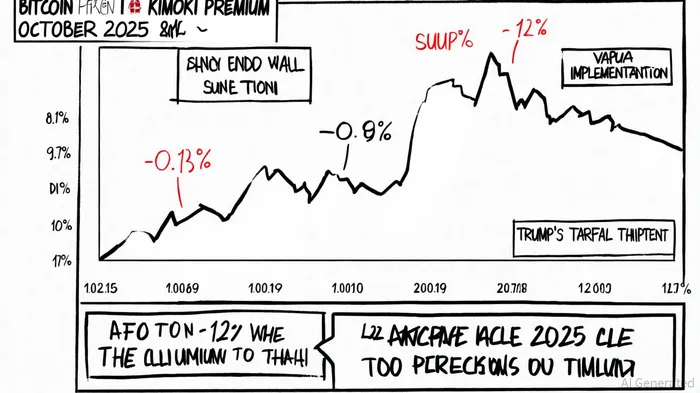
Political instability further exacerbated the premium. The impeachment of President Yoon Suk Yeol in late 2025 weakened the South Korean won and triggered a flight to Bitcoin as a store of value, a pattern discussed in the Cryptopolitan analysis. This trend was compounded by U.S. President Donald Trump's announcement of import tariffs on Asian trade partners, which spiked global market uncertainty and pushed the Kimchi Premium to 12% in early October, as noted by Bitcoin Newsday.
Speculative Behavior and On-Chain Signals
South Korean investors' speculative tendencies are evident in on-chain data. Despite a global bear market, Bitcoin holders in the region maintained long-term positions, with empty blockchain activity levels mirroring those of 2022-a period preceding a major bull run, as reported by Bitcoin Newsday. This behavior suggests a belief in future supply constraints, as retail investors hoard Bitcoin rather than liquidate holdings.
A strategic shift in trading behavior also emerged: investors increasingly converted Bitcoin to USD rather than Korean won, bypassing local liquidity constraints, a pattern highlighted by Cryptopolitan. This trend reflects a growing awareness of global market dynamics and a desire to hedge against domestic currency depreciation. However, it also highlights the limitations of South Korea's regulatory framework, which restricts cross-border arbitrage through high transaction fees and time delays, as the Bitget analysis observed.
Regulatory Tightrope: VAPUA and Market Maturation
The 2024 Virtual Asset User Protection Act (VAPUA) initially curtailed the Kimchi Premium by 22% through KYC/AML protocols and reserve transparency requirements, according to the Bitget analysis. By August 2025, the premium had turned negative (-0.18%), signaling a maturing market. Yet regulatory constraints persist. The VAPUA's delistings and liquidity reductions have not eliminated price gaps-South Korean Bitcoin prices still trade 2–3% above global benchmarks, limited by the same capital controls that once fueled the premium, as Bitget noted.
The rise of XRPXRP-- as a challenger to Bitcoin's dominance in South Korea adds another layer of complexity. On Upbit, XRP's transactional utility and speculative appeal have drawn retail investors away from Bitcoin, fragmenting demand and complicating price convergence, a dynamic discussed by Bitcoin Newsday. This shift suggests a broader realignment in crypto preferences, with altcoins gaining traction as both transactional assets and speculative vehicles.
Future Outlook: Convergence or Chaos?
While the Kimchi Premium's volatility appears here to stay, analysts predict a gradual narrowing of price gaps as regulatory frameworks evolve. The VAPUA's emphasis on transparency has already reduced liquidity asymmetries, and further reforms-such as the potential introduction of futures trading-could accelerate convergence, the Bitget analysis argues. However, political instability and macroeconomic shocks (e.g., Trump's tariffs) will likely continue to widen the premium periodically, creating cyclical arbitrage opportunities for those who can navigate regulatory hurdles, as Bitcoin Newsday observed.
For investors, the Kimchi Premium remains a double-edged sword. South Korea's speculative fervor offers high-reward opportunities, but the risks of regulatory crackdowns, liquidity crunches, and geopolitical shocks cannot be ignored. As one on-chain analyst noted, "The Kimchi Premium is less a bug and more a feature of South Korea's crypto ecosystem-a volatile, retail-driven market where sentiment and speculation reign supreme." - a point also covered in the Bitcoin Newsday report.






Comentarios
Aún no hay comentarios