
The Kimchi Premium and Its Implications for Bitcoin Market Dynamics in 2025
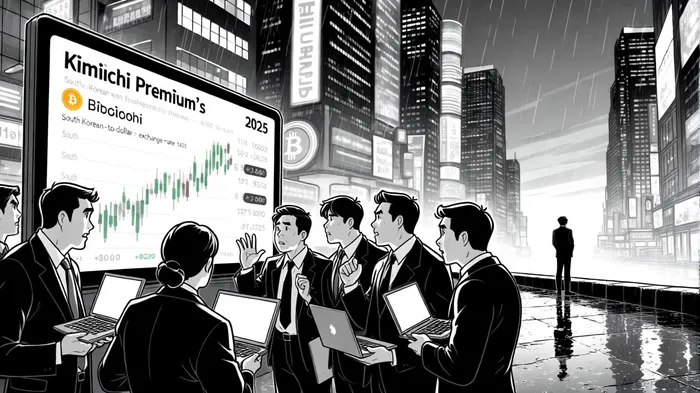
The Kimchi Premium, a persistent anomaly in cryptocurrency markets, has emerged as a critical barometer for Bitcoin's global dynamics in 2025. Defined by the price disparity between South Korean exchanges and international platforms, this phenomenon reflects a unique interplay of regulatory constraints, retail investor behavior, and macroeconomic forces. As the premium surged to 7.47% in Q3 2025-its highest level since February of the same year-the implications for market structure and investor strategy have become increasingly pronounced, according to CoinCentral.
Geographical Arbitrage: A Fractured Market
The Kimchi Premium's persistence is rooted in South Korea's stringent capital controls, which restrict foreign investment in domestic crypto exchanges, according to Finance Facts 101. This creates a two-tiered market: global platforms like Binance and CoinbaseCOIN--, where BitcoinBTC-- trades at a lower price due to broader liquidity, and South Korean exchanges such as Upbit, where retail demand drives prices higher. Arbitrageurs traditionally exploit this gap by purchasing Bitcoin internationally and selling it domestically, but operational hurdles-including transaction delays and regulatory scrutiny-have eroded profit margins, the Finance Facts 101 analysis notes.
In Q3 2025, however, the premium's volatility took on new dimensions. Currency fluctuations and U.S.-Korea trade tensions incentivized South Korean investors to convert Bitcoin into U.S. dollars rather than Korean won, effectively using crypto as a hedge against fiat instability, according to CryptoPotato. This behavior amplified the premium, as domestic demand outpaced supply. Meanwhile, the concurrent surge in the Coinbase Premium (peaking at 0.18 on October 10) underscored divergent investor priorities: U.S. institutional buyers prioritizing accumulation amid a broader market sell-off, and South Korean retail investors seeking refuge from currency risks, as CoinCentral observed.
Retail Investor Behavior: Panic, Resilience, and the "Korean Whale" Effect
South Korean retail investors have long been the Kimchi Premium's most influential drivers. In Q3 2025, their activity intensified amid political uncertainty. President Yoon Suk Yeol's brief declaration of martial law in December 2024 triggered a panic sell-off, causing the premium to plummet to a record low as investors liquidated positions, the Finance Facts 101 analysis reports. Yet, this volatility also revealed the market's resilience: within 24 hours, trading volumes on platforms like Upbit hit $35 billion, dwarfing traditional equity indices like the KOSPI, according to the same analysis.
The "Korean whale" effect further complicates dynamics. Large retail investors, often operating through non-profit organizations now permitted to engage in crypto trading under new FSC guidelines, have amplified demand, CoinCentral noted. These actors, unbound by traditional institutional constraints, often prioritize speculative gains over long-term holding, exacerbating price swings. For instance, XRPXRP-- trading volumes in South Korea surpassed the KOSPI in late 2024, illustrating how retail fervor can distort market fundamentals, the Finance Facts 101 analysis observed.
Regulatory Evolution: A Double-Edged Sword
South Korea's regulatory landscape in 2025 has been both a catalyst and a constraint. The Financial Services Commission (FSC) introduced phased institutional access to crypto markets, beginning with non-profits and exchanges in April 2025 and expanding to public companies by year-end, CoinCentral reported. While these reforms aim to stabilize the market by injecting institutional liquidity, they also risk diluting the Kimchi Premium. By Q1 2025, the premium had normalized to historical levels, suggesting that institutional participation may temper retail-driven volatility, according to NewsBrewery.
However, regulatory tightening has introduced new challenges. Enhanced KYC/AML requirements, including the second phase of the VirtualCYBER-- Asset User Protection Act, have increased compliance costs for exchanges, which NewsBrewery noted has limited arbitrage opportunities as smaller players struggle to navigate stricter transaction reporting standards. Meanwhile, the government's push to create a legal framework for tokenized securities signals a long-term shift toward mainstream adoption-but one that may take years to materialize, CoinCentral suggested.
Implications for Bitcoin's Global Market
The Kimchi Premium's evolution in 2025 offers critical insights into Bitcoin's broader market dynamics. Historically, sharp spikes in the premium have preceded corrections, as seen in March 2024 and February 2025, CoinCentral observed. The Q3 2025 surge, coupled with the Coinbase Premium's record high, suggests a synchronized surge in demand across U.S. and South Korean markets. Yet, this demand is increasingly fragmented: institutional buyers in the U.S. seek accumulation, while South Korean retail investors hedge against currency risks.
For investors, the premium highlights the importance of geographical diversification. Arbitrage strategies must now account for regulatory asymmetries and macroeconomic tailwinds, such as the U.S. dollar's role as a safe-haven asset. Additionally, the FSC's reforms indicate that South Korea may transition from a speculative hub to a more mature market, reducing the premium's magnitude over time.
Conclusion
The Kimchi Premium in 2025 is more than a regional anomaly-it is a microcosm of Bitcoin's global market structure. As South Korea navigates regulatory evolution and retail investor behavior, the interplay between arbitrage opportunities and macroeconomic forces will shape Bitcoin's trajectory. While the Q3 2025 premium surge signals short-term volatility, the long-term outlook hinges on institutional adoption and regulatory harmonization. For now, the premium remains a testament to the resilience-and fragility-of crypto markets in a fragmented world.





Comentarios
Aún no hay comentarios