
Kia's PV5 and the Future of Electric Commercial Vehicles: Why Now Is the Time to Invest in Kia's Emerging PBV Ecosystem
The PV5: A Versatile Powerhouse for Diverse Use Cases
Kia's PV5 electric van is a testament to the company's commitment to modular, customer-centric design. Built on the flexible E-GMP.S platform, the PV5 Chassis Cab offers a maximum payload of 1,005 kg and eight cubic meters of cargo space in its High Box configuration. Its dual battery options-51.5 kWh and 71.2 kWh-provide a WLTP range of up to 416 km, with fast-charging capabilities enabling 10–80% charge in 30 minutes. This adaptability is critical for European markets, where the PV5 can be configured as a Dropside truck for construction, a Tipper for waste management, or a Box Van for e-commerce deliveries. Even a food truck variant was showcased at SOLUTRANS 2025, underscoring its versatility.
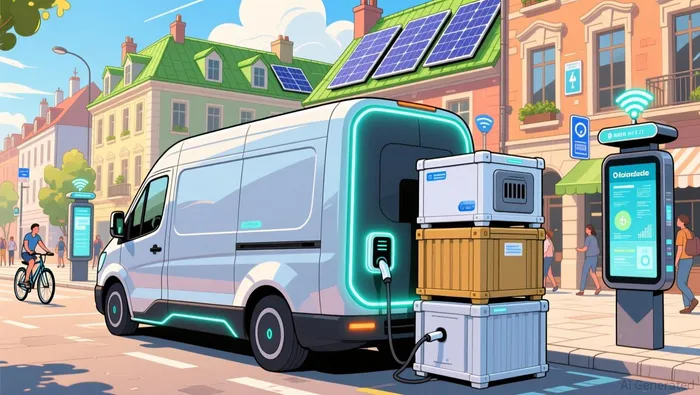 The PV5's recent accolades further validate its potential. It was named the 2026 International Van of the Year (IVOTY), a historic first for a Korean manufacturer and any Asian electric van according to industry reports. This award, judged by 26 industry experts, highlights the PV5's innovation in operational efficiency, safety, and environmental performance. Such recognition not only bolsters Kia's brand equity but also signals to investors that the PV5 is a market leader in a sector where differentiation is key.
The PBV Ecosystem: Beyond the Van, Beyond Mobility
The PV5 is the cornerstone of Kia's PBV ecosystem, a strategic initiative to transform mobility into a customizable, software-driven platform. By 2025, Kia plans to expand its PBV lineup with the PV7 (large van) and PV1 (small van), each designed for specific use cases such as ride-hailing, logistics, and personal lifestyle activities. These vehicles will leverage interchangeable upper bodies, enabling a single chassis to serve as a taxi, delivery van, or recreational vehicle. This modularity reduces costs for fleet operators and enhances asset utilization-a critical advantage in an industry where downtime is costly.
Kia's ecosystem is further strengthened by its software solutions. The In-Vehicle Infotainment (IVI) system personalizes user experiences and integrates business-specific apps, while the Fleet Management System optimizes operations through real-time data analytics and predictive maintenance. These tools are not just add-ons; they are foundational to Kia's vision of a "Total Energy Solution," which includes EV charging consulting and future V2X (Vehicle-to-Everything) infrastructure.
Partnerships are another pillar of the PBV strategy. Kia has aligned with global players like Uber, Coupang, and Dubai Taxi Corporation to tailor solutions for ride-hailing and logistics. Collaborations with Motional (for Robotaxi) and Boston Dynamics (for robotics in logistics) underscore Kia's ambition to integrate advanced technologies into its ecosystem. These alliances not only validate Kia's platform but also create a network effect, making the PBV ecosystem more attractive to investors seeking scalable, tech-driven opportunities.
Market Tailwinds: Policy, Infrastructure, and Investor Appetite
The ECV market is being propelled by a confluence of factors. Government policies such as the EU's Fit for 55 Plan, the U.S. Inflation Reduction Act, and India's FAME II are providing direct financial incentives and regulatory clarity according to market analysis for manufacturers and buyers. Meanwhile, falling battery prices and advancements in fast-charging technology are addressing range anxiety and operational efficiency concerns. The EV charging infrastructure market alone is projected to grow from $39.7 billion in 2024 to $350 billion by 2034, a trend that directly benefits Kia's PBV ecosystem.
Investor sentiment is also shifting. While Kia's Q3 2025 financials showed a 37% drop in net profits due to U.S. import tariffs, the company's EV sales surged by 32% year-on-year to 204,000 units according to financial reports. This resilience highlights the growing demand for electrified solutions, even amid macroeconomic headwinds. Moreover, Kia's plans to launch the EV5 and expand hybrid offerings in key markets like the U.S., Europe, and India according to market data suggest a diversified strategy to mitigate risks.
Why Now? Strategic Timing in a Booming Sector
The case for investing in Kia's PBV ecosystem is strongest today because the company is at the inflection point of its electrification journey. The PV5's market readiness, combined with the PBV's modular architecture and software capabilities, positions Kia to scale rapidly as demand for ECVs accelerates. While competitors like BYD and AB Volvo are also innovating, Kia's ecosystem approach-integrating hardware, software, and partnerships-offers a unique value proposition.
For investors, the risks are not negligible. Short-term financial pressures from tariffs and production transitions could persist. However, the long-term growth trajectory of the ECV market, coupled with Kia's strategic investments in robotics, AI, and smart city integration, suggests that the company is building a durable competitive advantage.
Conclusion
Kia's PV5 is more than an electric van-it is a gateway to a reimagined commercial mobility ecosystem. By leveraging modular design, software innovation, and strategic partnerships, Kia is positioning itself to dominate a market that is on the cusp of explosive growth. For investors, the question is not whether the ECV sector will thrive, but whether they can secure a stake in a company that is already leading the charge. The time to act is now.







Comentarios
Aún no hay comentarios