
Keppel's Bifrost Subsea Cable: A Strategic Bet on Trans-Pacific Connectivity and Digital Infrastructure Growth
In an era where data is the lifeblood of the global economy, infrastructure that enables its seamless flow has become a critical asset. Keppel's Bifrost subsea cable project, a $7.4 billion endeavor, epitomizes this shift. By directly linking Singapore to the U.S. West Coast via Indonesia, Bifrost not only addresses immediate demand for high-capacity connectivity but also positions itself at the intersection of two of the world's most dynamic digital economies. For investors, the project represents a compelling case study in strategic infrastructure positioning and long-term growth potential.
Strategic Positioning: Bridging Asia and North America
Bifrost's technical specifications underscore its significance. Spanning over 20,000 kilometers, the system offers a round-trip latency of just under 165 milliseconds and introduces 260 Tbps of additional capacity to the Asia-Pacific region, according to a Keppel press release. This is no small feat: the project, developed in collaboration with MetaMETA-- and Indonesia's Telekomunikasi IndonesiaTLK-- International (Telin), is the first direct subsea cable connecting Singapore to the U.S. in eight years, as reported by the Business Times. By bypassing the geopolitically sensitive South China Sea and leveraging Indonesia's archipelago as a transit point, Bifrost mitigates risks associated with route concentration while enhancing redundancy for data flows, as noted in a Carnegie Endowment paper.
The cable's landing stations further reinforce its strategic value. In Singapore, it connects to Keppel DC REIT's SGP 5 data center in Jurong, a hub for digital infrastructure, according to The Independent. On the U.S. side, Grover Beach, California, and Winema, Oregon, serve as key entry points, aligning with the U.S. Federal Communications Commission's (FCC) recent approval of the project as documented in the FCC landing license. This regulatory green light, coupled with Indefeasible Rights of Use (IRU) agreements for two of Keppel's five fiber pairs, signals strong demand from enterprise and cloud clients seeking reliable trans-Pacific connectivity, according to Light Reading.
Market Dynamics: A Booming Trans-Pacific Infrastructure Landscape
The Bifrost project is poised to capitalize on a rapidly expanding market. The Asia-Pacific subsea cable market, valued at $3.8 billion in 2024, is projected to reach $6.7 billion by 2033, growing at a compound annual rate of 6.5%, according to DataHorizzon Research. Singapore, with its 28 existing subsea cable landings and 13 more in development, is a linchpin in this growth; its liberalized telecom environment and National AI Strategy have attracted heavyweights like Google, Amazon, and Microsoft, which are investing in systems such as Bifrost to support AI training and cloud computing, as highlighted in a CSIS case study.
Meanwhile, the U.S. is experiencing a surge in demand for high-capacity data transmission. As global internet traffic grows-projected to reach 44.33 billion USD in subsea cable market value by 2030, per Grand View Research-the U.S. is increasingly reliant on trans-Pacific routes to meet the needs of its tech sector. Bifrost's 260 Tbps capacity, combined with its low-latency design, positions it to capture a significant share of this demand, particularly from hyperscalers and financial institutions requiring real-time data exchange, according to Yahoo Finance.
Competitive Edge: Singapore's Infrastructure Ecosystem
Singapore's dominance in subsea cable infrastructure is not accidental. Its pro-business regulatory framework, geopolitical neutrality, and investment in digital resilience have made it a magnet for global tech firms. For instance, the city-state's decision to reroute cables away from the South China Sea-due to security concerns-has spurred innovation in alternative pathways like Bifrost's Indonesia-based route, as discussed in a LinkedIn post.
Keppel's role in this ecosystem is pivotal. As a joint venture partner with 40% ownership of the cable's fiber pairs, the company is leveraging its expertise in power, green energy, and data center solutions to create a vertically integrated digital infrastructure portfolio. This aligns with broader trends: the global subsea cable market, valued at $31.7 billion in 2024, is expected to grow at a 5.6% CAGR through 2030, driven by offshore wind projects, 5G rollout, and cross-industry collaborations (Grand View Research).
Investment Implications: A Long-Term Play on Digital Resilience
For investors, Bifrost represents more than a physical asset-it's a bet on the future of digital infrastructure. With commercial service expected in H2 2025, the project is already securing long-term revenue streams through IRU agreements. The fact that three of Keppel's fiber pairs remain in negotiation suggests further upside potential as demand for trans-Pacific connectivity intensifies (Light Reading).
Moreover, Bifrost aligns with Keppel's broader strategy to expand its digital infrastructure ecosystem. By integrating subsea cables with power, cooling, and data center solutions, the company is creating a diversified portfolio that benefits from compounding growth drivers. This is particularly relevant in a world where AI and cloud computing are reshaping global data flows.
Conclusion: Infrastructure as a Cornerstone of Digital Leadership
Keppel's Bifrost project is a testament to the evolving role of subsea cables in the digital age. By addressing both immediate demand and long-term strategic needs, the cable reinforces Singapore's position as Asia's digital hub while catering to the U.S.'s insatiable appetite for high-speed connectivity. For investors, the project offers a rare combination of tangible infrastructure, regulatory tailwinds, and exposure to the AI-driven economy. As the world becomes increasingly interconnected, Bifrost stands as a bridge-not just between continents, but between today's digital needs and tomorrow's possibilities.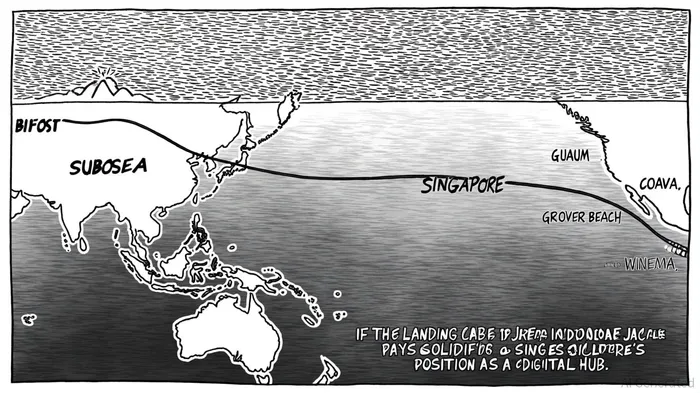





Comentarios
Aún no hay comentarios