
Kenya's Strategic Trade Dilemma: Balancing U.S. Pressure and China's Zero-Tariff Offer
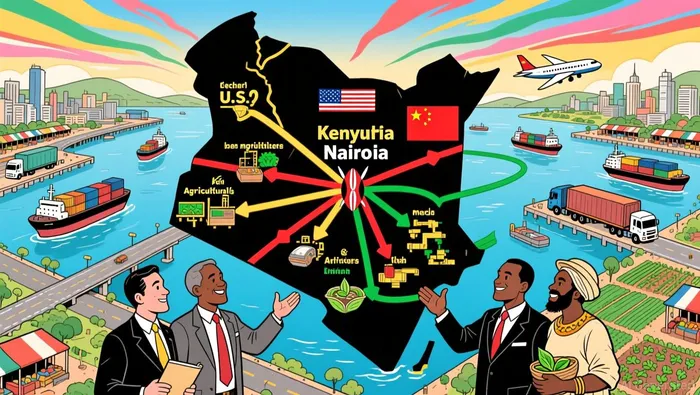
Kenya stands at a crossroads in its trade strategy, navigating the competing pressures of U.S. policy uncertainty and China's zero-tariff incentives while seeking to leverage regional integration under the African Continental Free Trade Area (AfCFTA). For African exporters, the country's balancing act offers critical lessons in risk diversification and market access in an era of shifting global trade dynamics.
U.S. Trade Dynamics: AGOA Uncertainty and Reciprocity Demands
Kenya's relationship with the United States has long been anchored by the African Growth and Opportunity Act (AGOA), which provided duty-free access to U.S. markets for key exports like tea, coffee, and avocados. However, AGOA expired on September 30, 2025, creating a vacuum in market access for Kenyan exporters. While a U.S. House committee approved a three-year renewal in December 2025, the Biden administration has signaled openness to a one-year extension, citing concerns over South Africa's trade policies. Kenya, under President William Ruto, has lobbied for a five-year extension to 2030, emphasizing the need for long-term stability in sectors like textiles and agriculture.
The U.S. is also pushing for a more reciprocal trade framework. Negotiations for a Strategic Trade and Investment Partnership (STIP) aim to replace AGOA with a bilateral agreement that includes U.S. commitments to reduce tariffs on Kenyan goods while encouraging Kenya to open its services sector to American firms. This shift reflects broader U.S. pressure for African nations to move beyond preferential trade programs and adopt more balanced, two-way trade relationships. For investors, the STIP represents both an opportunity-securing stable U.S. market access-and a risk: potential concessions that could undermine Kenya's export competitiveness.
China's Zero-Tariff Offer: A Double-Edged Sword
China's trade relationship with Kenya has grown rapidly, driven by its zero-tariff policy for 100% of tariff lines for African countries. In 2025, bilateral trade hit $2.25 billion, with China exporting machinery, telecommunications equipment, and infrastructure materials to Kenya while importing scrap copper and agricultural products. However, Kenya's exports to China remain modest, and in October 2025, they fell by 18.8% compared to the previous year, highlighting structural imbalances.
China's investments in Kenya's infrastructure-most notably the Mombasa-Nairobi Standard Gauge Railway-have improved trade logistics but also deepened dependency on Chinese capital. During President Ruto's April 2025 state visit to Beijing, over 20 agreements were signed, including $320 million for manufacturing and $430 million for agriculture. While these deals align with Kenya's Vision 2030 goals, they also raise concerns about overreliance on Chinese financing and technology. For African exporters, China's zero-tariff offer is a boon for market access but must be balanced against the risks of trade asymmetry and debt sustainability.
AfCFTA as a Diversification Strategy: Regional Integration and Resilience
Kenya's most promising avenue for risk diversification lies in the African Continental Free Trade Area (AfCFTA). In 2024, Kenya's intra-African trade surged to $5.14 billion, a 29% increase from the previous year, driven by its role as a regional logistics hub via the Port of Mombasa and the Northern Corridor. The AfCFTA Implementation Strategy (2022–2027) aims to further boost intra-African trade by 5% annually, with a focus on manufacturing, agriculture, and services.
Key initiatives include improving regional trade corridors, such as upgrading the Standard Gauge Railway to enhance transport efficiency, and harmonizing policies to reduce tariffs and regulatory barriers. For example, Kenya's collaboration with neighboring countries like Uganda and Rwanda has streamlined cross-border trade flows, reducing transit times and costs. These efforts are critical for African exporters seeking to reduce dependency on external markets while capitalizing on the continent's $1.5 trillion trade potential.
Risk Assessment and Investor Implications
Kenya's trade strategy exemplifies the challenges of balancing U.S. reciprocity demands, Chinese infrastructure investments, and regional integration. The expiration of AGOA and the STIP negotiations underscore the volatility of U.S. trade policy, while China's zero-tariff offer provides a stable but asymmetric trade relationship. AfCFTA, meanwhile, offers a long-term solution to diversify markets and reduce exposure to external shocks.
For investors, the key takeaway is the importance of hedging against geopolitical and economic risks. Kenya's push for a five-year AGOA extension and its AfCFTA-driven regional integration signal a strategic pivot toward self-reliance. However, challenges such as weak infrastructure and policy coordination across Africa remain hurdles. Investors in Kenyan agriculture, manufacturing, and logistics stand to benefit from the country's trade corridors and AfCFTA-driven growth, but must also monitor U.S.-China tensions and their ripple effects on African markets.
In the end, Kenya's ability to navigate this trade dilemma will hinge on its success in leveraging AfCFTA to create a resilient, diversified export base. For African exporters, the lesson is clear: regional integration is not just a policy goal-it's a survival strategy in an increasingly fragmented global economy.







Comentarios
Aún no hay comentarios