
Kenya's Crypto Regulatory Framework and Its Implications for African Tech Investment
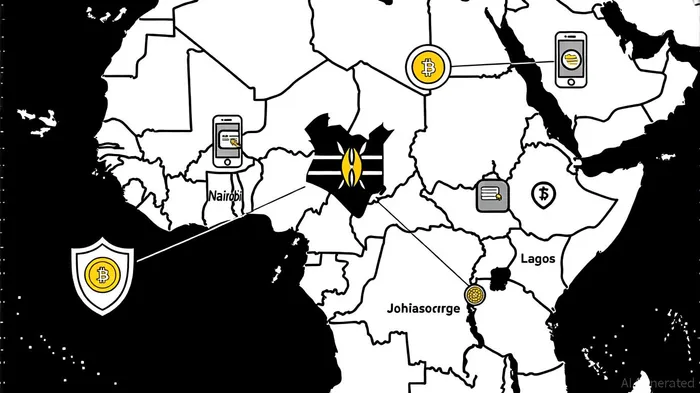
Kenya's passage of the Virtual Asset Service Providers (VASP) Bill in 2025 marks a pivotal moment in Africa's digital finance evolution. This landmark legislation, awaiting presidential assent, establishes a dual-regulatory framework where the Central Bank of Kenya (CBK) oversees stablecoin issuance and custodial services, while the Capital Markets Authority (CMA) regulates exchanges and trading platforms [1]. By aligning with global anti-money laundering (AML) and counter-terrorism financing (CTF) standards, Kenya has created a structured environment that balances innovation with investor protection, positioning itself as a potential leader in Africa's crypto-driven tech investment landscape [2].
Strategic Entry Points in Kenya's Crypto Market
The VASP Bill introduces several strategic opportunities for investors. First, the mandate for virtual asset service providers (VASPs) to maintain a registered office in Kenya and segregate client assets creates a clear pathway for foreign firms to establish local operations. This requirement, while potentially challenging for purely digital platforms, ensures a physical presence that can foster trust and collaboration with local institutions [3]. For instance, global crypto exchanges seeking to expand into Africa may partner with Kenyan fintech firms to navigate regulatory hurdles and tap into the country's existing mobile money infrastructure, such as M-Pesa, which already serves over 30 million users [4].
Second, the one-year transition period for compliance offers a window for investors to adapt to new requirements. During this phase, early movers can secure licensing advantages by engaging with the CBK and CMA to align operational models with the law's stipulations. For example, startups specializing in blockchain-based identity verification or decentralized finance (DeFi) protocols could leverage Kenya's youth-driven tech ecosystem-where 60% of the population is under 35-to pilot scalable solutions [5].
Comparative Regional Trends and Investor Opportunities
Kenya's approach contrasts sharply with regulatory stances in other African nations. Nigeria's 2023 banking ban on crypto services, for instance, pushed the market underground, stifling innovation and increasing fraud risks [6]. In contrast, Kenya's structured framework-reminiscent of South Africa's regulatory sandbox model-provides a blueprint for balancing oversight with growth. This differentiation is critical for investors seeking jurisdictions that prioritize long-term stability over short-term restrictions.
Moreover, Kenya's alignment with global standards like the Financial Action Task Force (FATF) Travel Rule and the EU's Markets in Crypto-Assets (MiCA) regulation enhances its appeal to international capital. As stated by a report from FurtherAfrica, the country's regulatory clarity could attract foreign direct investment (FDI) by reducing the perceived risks associated with emerging markets [7]. For example, institutional investors might channel capital into Kenyan-based blockchain infrastructure projects, such as cross-border payment platforms or tokenized real estate, which align with the country's goal of becoming a regional digital finance hub [8].
Challenges and Mitigation Strategies
While the VASP Bill presents opportunities, challenges remain. Smaller operators may struggle with compliance costs, such as annual audits and capital thresholds, which could consolidate the market in favor of larger players. To mitigate this, investors could focus on venture capital funding for early-stage startups or collaborate with local regulators to advocate for tiered compliance frameworks. Additionally, the requirement for physical offices might deter purely digital-first platforms, but partnerships with Nairobi-based co-working spaces or incubators could provide cost-effective solutions [9].
The Ripple Effect on African Tech Investment
Kenya's regulatory framework is likely to influence broader African tech investment trends. By demonstrating a balanced approach to crypto regulation, the country could catalyze regional harmonization efforts under frameworks like the African Continental Free Trade Area (AfCFTA). For instance, neighboring countries such as Ghana and Tanzania may adopt similar dual-regulatory models, creating a cohesive market for cross-border digital asset transactions [10]. Investors should also monitor Kenya's implementation of licensing rules, as these will shape the continent's ability to attract global fintech giants and scale local innovation.
Conclusion
Kenya's VASP Bill represents more than a domestic regulatory milestone-it is a catalyst for Africa's digital finance renaissance. By addressing gaps in consumer protection, aligning with global standards, and fostering a transparent environment, the country has created a fertile ground for strategic investment. For investors, the key lies in leveraging Kenya's regulatory clarity to access a market poised for exponential growth, while simultaneously contributing to the continent's broader tech ecosystem. As the law moves toward implementation, the next phase will test Kenya's ability to balance ambition with execution, but the potential rewards for early entrants are substantial.







Comentarios
Aún no hay comentarios