
Kenvue's Strategic Acquisition by Kimberly-Clark: A Catalyst for Value Realization?
Shareholder Value: Immediate Gains and Long-Term Prospects
The acquisition offers Kenvue shareholders $21.01 per share-a 33% premium over its pre-announcement stock price-through a combination of $3.50 in cash and 0.14625 shares of Kimberly-Clark per Kenvue share, according to Kimberly-Clark's announcement. This upfront value, coupled with $6.8 billion in cash consideration, has already been reflected in Kenvue's 12% stock surge following the announcement, as noted in a TikTok report. For Kimberly-Clark, the deal promises to expand its market capitalization and diversify revenue streams, potentially enhancing long-term shareholder returns.
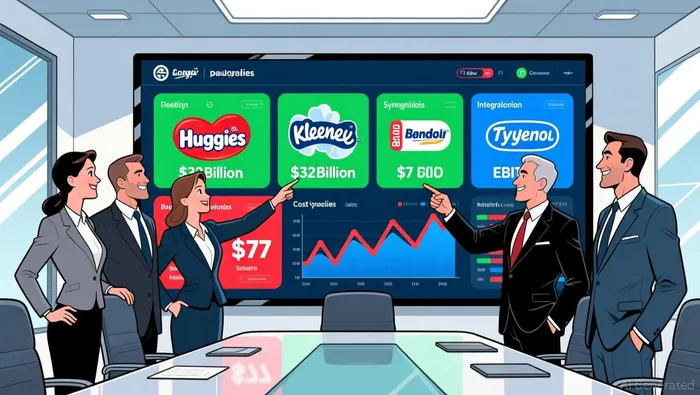
However, the success of this value proposition hinges on the realization of projected synergies. Management estimates $2.1 billion in annual cost and revenue synergies by 2028, including $1.9 billion in cost savings and $500 million in incremental revenue growth, according to Kimberly-Clark's announcement. These figures, if achieved, could significantly boost earnings per share (EPS) for combined shareholders. Yet, the path to synergy capture is not without risks. The merger will incur $2.5 billion in one-time integration costs over the first two years, which could pressure short-term profitability, as Kimberly-Clark's announcement notes.
Operational Efficiency: Synergy Realization and Integration Challenges
The merger's operational success depends on harmonizing two large, complex organizations. Kimberly-Clark's expertise in supply chain optimization and global manufacturing could complement Kenvue's strengths in over-the-counter healthcare innovation. Analysts note that Kenvue has already demonstrated resilience in navigating inflationary pressures and supply chain disruptions, achieving $32 billion in revenue in 2025 despite a 3.5% year-over-year sales decline in Q3 2025, according to a Yahoo Finance report.
Yet, integrating Kenvue's operations into Kimberly-Clark's framework will require meticulous execution. The combined entity must balance cost-cutting initiatives-such as consolidating facilities and streamlining procurement-with investments in R&D to maintain product innovation. Jefferies analyst Keith Devas emphasizes that "the ability to realize $1.9 billion in cost synergies will depend on avoiding operational friction during the transition," as the Yahoo report notes.
Long-Term Growth: Market Positioning and Strategic Fit
The acquisition strengthens Kimberly-Clark's leadership in personal care and health, aligning with growing consumer demand for integrated wellness solutions. The combined portfolio spans 150 countries, with brands addressing both daily essentials and acute healthcare needs. This diversification could insulate the company from sector-specific downturns, such as those seen in the Q3 2025 softness in Kenvue's consumer health segment, according to the Yahoo report.
Moreover, the merger positions the company to capitalize on trends like digital health and e-commerce. By leveraging Kimberly-Clark's retail partnerships and Kenvue's direct-to-consumer channels, the combined entity could enhance customer engagement and data-driven marketing. However, growth will also depend on navigating regulatory scrutiny. The deal requires approvals from antitrust authorities, particularly in markets where both companies hold overlapping brand dominance, as Stock Titan notes.
Risks and Regulatory Hurdles
While the strategic rationale is compelling, the merger faces significant risks. Regulatory bodies may demand divestitures of overlapping brands to address competition concerns, as seen in past consumer staples deals. Additionally, the $2.5 billion in one-time costs could strain cash flow, potentially limiting reinvestment in growth areas.
Analysts at Stock Titan caution that "the timeline for synergy realization is ambitious, and delays in integration could erode investor confidence," as Stock Titan notes. Furthermore, macroeconomic headwinds-such as rising interest rates and global inflation-could dampen consumer spending on non-essential goods, impacting the combined company's top-line growth.
Conclusion: A High-Stakes Bet on Synergy and Execution
The Kenvue acquisition represents a bold strategic bet by Kimberly-Clark to redefine its role in the consumer staples landscape. While the upfront value for shareholders and the scale of the combined entity are undeniably attractive, the deal's long-term success will depend on disciplined execution of synergies, regulatory navigation, and adaptability to market shifts. For investors, the key takeaway is that this merger is not a guaranteed win-it is a high-stakes opportunity that demands close monitoring of integration progress and financial performance over the next 12–24 months.





Comentarios
Aún no hay comentarios