
KBR's Strategic Positioning in U.S. Defense Logistics Amid Elevated Geopolitical Risk
The U.S. defense logistics sector has emerged as a critical battleground for companies capable of navigating geopolitical volatility while delivering mission-critical services. KBR Inc.KBR-- (KBR), a long-standing player in this arena, has positioned itself as a key beneficiary of rising defense budgets and the growing reliance on outsourced logistics solutions. With a robust backlog, strategic contracts, and a planned spin-off of its government-focused segment, KBR's long-term earnings potential appears well-anchored in a sector poised for sustained growth.
Financial Resilience and Strategic Contract Wins
KBR's third-quarter fiscal 2025 results underscore its financial resilience amid global uncertainties. The company reported $1.9 billion in revenue, with a book-to-bill ratio of 1.4x, driven by $4.2 billion in bookings and options. Its Mission Technology Solutions (MTS) segment, which accounts for 72% of total revenue, delivered $1.4 billion in Q3 revenue and $143 million in adjusted EBITDA, reflecting a 10.2% margin as reported. This segment's diversified customer base-60% of its EBITDA comes from non-U.S. government clients-provides stability during periods of government fiscal uncertainty, such as shutdowns or budget delays.
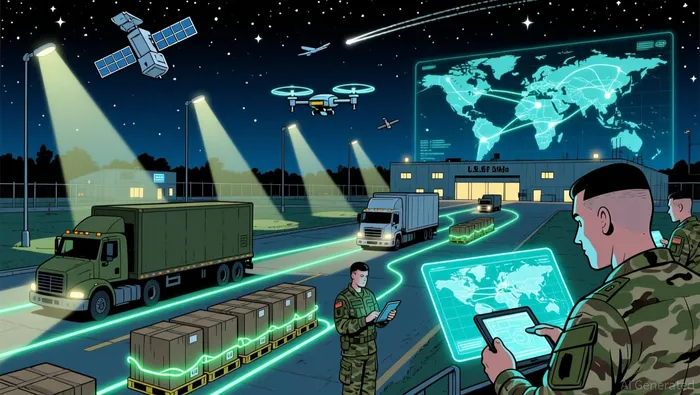 Recent contract wins further solidify KBR's market position. The company secured a $20 billion ceiling IDIQ contract (WEXMAC 2.1) with the U.S. Naval Supply Systems Command, spanning a decade and focused on continental defense readiness. Additionally, KBRKBR-- expanded its footprint in military mental health services through a subcontract with Strategic Resources and secured a $476 million base operations support contract in Djibouti. These contracts, combined with a $17.8 billion backlog in Q2 2025, highlight KBR's ability to lock in long-duration revenue streams.
Market Dynamics and Competitive Advantages
The defense logistics market is projected to grow from $182.5 billion in 2025 to $302.67 billion by 2032 at a 7.5% CAGR according to research, driven by U.S. defense spending nearing $900 billion in FY2025 as reported. KBR competes with industry giants like Lockheed Martin and Boeing but differentiates itself through specialized logistics capabilities, including digital visibility tools and security solutions for contested environments according to market analysis. Its expertise in outsourced base operations and sustainment services positions it as a critical partner for the Department of Defense, particularly as the U.S. prioritizes readiness amid global tensions.
A key competitive advantage lies in KBR's international diversification. While 58% of its 2023 revenue came from U.S. government contracts, its non-U.S. government exposure mitigates risks tied to domestic fiscal cycles. This balance is increasingly valuable as defense spending shifts toward multinational operations and allied nation support, as seen in KBR's recent $117 million Navy contract extension for allied services.
Strategic Spin-Off and Long-Term Earnings Potential
KBR's decision to spin off its MTS segment into a standalone public company by mid-to-late 2026 represents a transformative move. The spin-off, dubbed "SpinCo," will focus exclusively on national security and space priorities, while "New KBR" will concentrate on energy transition technologies. This separation is expected to unlock value by creating two pure-play entities with distinct capital allocation strategies and investor expectations.
The MTS segment's $23.35 billion backlog as of Q3 2025 provides SpinCo with a strong foundation for predictable cash flows. Meanwhile, New KBR's pivot to sustainable technologies aligns with decarbonization trends, broadening its revenue streams beyond defense. Analysts note that the spin-off could enhance KBR's operational flexibility, enabling both entities to pursue sector-specific growth opportunities without cross-subsidization constraints.
Geopolitical Tailwinds and Earnings Catalysts
Elevated geopolitical risks-ranging from conflicts in the Middle East to cyber threats-have accelerated demand for logistics and sustainment services. KBR's role in providing "contested logistics" solutions, which integrate physical and digital infrastructure to maintain operational readiness according to market analysis, positions it to capitalize on this trend. The company's recent NASA contract ($2.5 billion) and Air Force Research Laboratory partnerships as reported further diversify its revenue base into high-growth areas like space and advanced R&D.
Financially, KBR has demonstrated resilience. Despite energy sector headwinds, its adjusted EBITDA grew 10% year-over-year in Q3 2025, with adjusted EPS rising 21% according to financial reports. Strong cash conversion and a 5% net margin suggest the company is well-positioned to fund both organic growth and the spin-off's execution costs.
Conclusion
KBR's strategic positioning in the U.S. defense logistics sector is underpinned by a combination of financial discipline, contract durability, and forward-looking corporate strategy. As defense budgets remain elevated and global instability persists, the company's focus on mission-critical logistics and its impending spin-off create a compelling case for long-term earnings growth. For investors, KBR represents a rare blend of defensive qualities and growth potential-a stock that thrives in both calm and turbulent markets.





Comentarios
Aún no hay comentarios