
KB Home (KBH): Navigating the Breakout Opportunity Amid Consolidation
The housing market remains a focal point of economic uncertainty, yet within this volatility lies a compelling opportunity for investors attuned to technical dynamics. KB HomeKBH-- (KBH), a key player in U.S. residential construction, is positioned at a critical inflection point. With its shares hovering near a pivotal $56.64 resistance level, the stock presents a high-reward, medium-risk scenario for traders willing to act decisively. Let's dissect the technical setup and risk-reward calculus.
The Technical Setup: A Breakout on the Horizon?
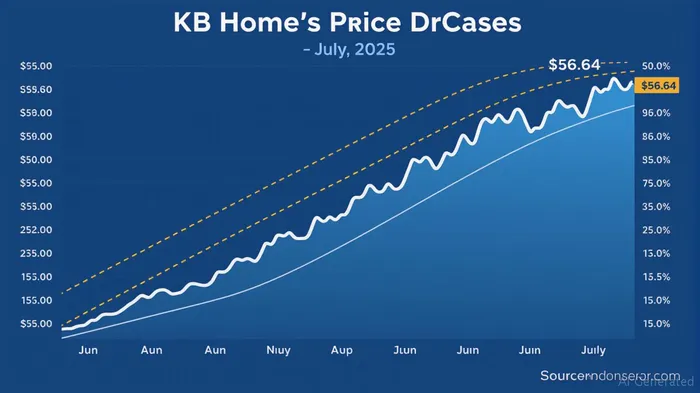
Recent price action suggests KBHKBH-- is grappling with a consolidation phase, but a breakout could soon redefine its trajectory. Here's the evidence:
Resistance at $56.64:
On July 9–10, 2025, KBH tested the $56.64 resistance level, reaching an intraday high of $57.38 before pulling back to close at $56.18 on July 10. While the resistance held in closing prices, the proximity to this level—combined with expanding trading ranges—hints at an impending breakout.Moving Average Convergence:
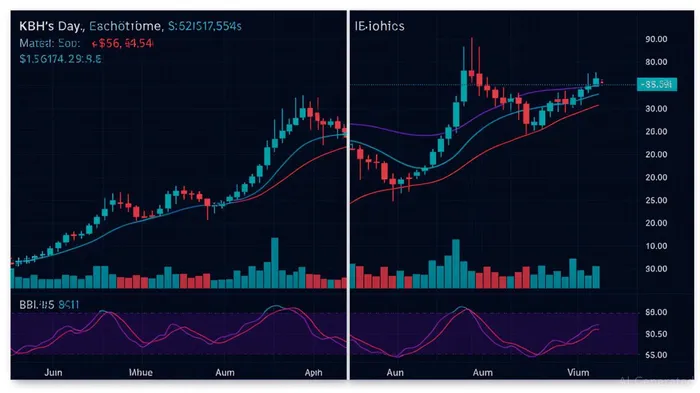
The 50-day SMA ($53.31) and EMA ($53.93) have acted as critical support, while the 5-day SMA ($54.75) and EMA ($55.52) signal short-term momentum. The shorter-term averages are now above the longer-term ones, a classic bullish crossover that aligns with the technical summary's “buy” rating for moving averages.MACD Buy Signals (Inferred):
Though explicit MACD values are unavailable, the moving average dynamics suggest a bullish MACD crossover is likely. The divergence between the 12-day and 26-day EMAs (the core of the MACD line) would align with the recent price surge toward $57.38. A confirmation of this crossover—paired with an upward turn in the MACD histogram—would reinforce the breakout thesis.
Risk Management: Anchoring Stop-Loss and Reward Potential
The $53.31 level (the 50-day SMA) is the logical stop-loss. Here's why:
- Support Role: This level has held firm over the past month, deflecting dips in mid-June and early July.
- Risk-Reward Ratio: Entering near $53.31 with a target above $56.64 offers a reward-to-risk ratio of ~2:1 (assuming a $57.50 target).
Scenario Analysis:
- Breakout Success: If KBH closes above $56.64, the next resistance could be $58.92 (August's forecast average), unlocking a potential 5.5% gain from current prices (~$55.60).
- Breakout Failure: A close below $53.31 would invalidate the bullish case, signaling a shift to bearish momentum.
Why Act Now? Timing and Volatility
The market's medium volatility (2.62%) and the Fear & Greed Index's “Fear” reading (39) suggest investors are hesitating—a window to capitalize on priced-in pessimism. Here are the catalysts to watch:
1. Volume Surge: A breakout above $56.64 must be accompanied by increased volume (above 1.5M shares) to validate conviction.
2. MACD Confirmation: A sustained MACD histogram expansion post-crossover will signal durable momentum.
3. Resistance Turned Support: Once $56.64 is cleared, it could pivot into support, reducing downside risks.
Investment Advice: A Balanced Approach
For traders with a short-term horizon:
- Entry Point: Accumulate positions between $53.31 and $55.97, with a target of $58.92.
- Stop-Loss: Set at $52.50 to account for slippage.
- Position Sizing: Allocate 2–3% of capital to balance reward potential with volatility.
For longer-term investors:
- Monitor the 200-day SMA ($65.25) for a sustained upward shift, which would signal a broader bullish trend.
Conclusion: Act Before the Tipping Point
KB Home's technicals paint a compelling picture: the $56.64 resistance is a make-or-break level. With moving averages aligned for a breakout and a favorable risk-reward profile, now is the time to position. However, discipline is key—exit if the $53.31 support fails, and prioritize the MACD signal's confirmation. In a market seeking clarity, KBH offers a rare blend of precision and opportunity.
Disclosure: This analysis is for informational purposes only. Always conduct your own research and consult a financial advisor before making investment decisions.





Comentarios
Aún no hay comentarios