
KB Home's EPS Growth at a Crossroads: Can Financial Engineering Offset Margin Pressures and Weakening Demand?
The housing market's slowdown has put KB HomeKBH-- (NYSE: KBH) in a precarious position. After lowering its full-year revenue guidance to $6.3–$6.5 billion—a 10% drop from 2024's results—the company faces mounting questions about the sustainability of its earnings growth. While share buybacks and disciplined capital allocation have propped up earnings per share (EPS), margin pressures and a fragile demand environment threaten to undermine these gains. Is KB Home's financial engineering enough to justify its valuation, or is the stock a value trap in a weakening housing cycle?
Backlog Dynamics: A Delicate Balancing Act
KB Home's backlog of 4,776 homes, valued at $2.3 billion as of May 2025, represents a critical lifeline for its 2025 delivery target of 13,200 homes. However, the company must sell an additional 2,500 homes by year-end to meet this goal—a hurdle complicated by weakening demand. Net orders fell to 4.5 homes per community in Q2, down from 5.5 a year earlier, as affordability constraints and high mortgage rates deter buyers.
Despite improved build times—now averaging 140 days company-wide and 132 days for built-to-order homes—management acknowledges that municipal delays and “a couple hundred sales” lost to community opening delays could further strain delivery timelines. 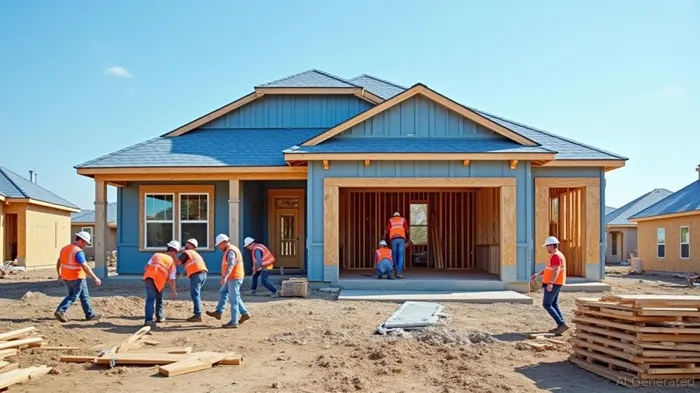
Margin Pressures: A Structural Challenge
The real test for KB Home lies in its margins. Adjusted housing gross profit margins dipped to 19.7% in Q2, a 150-basis-point decline year-over-year, driven by pricing pressure, rising land costs, and regional mix shifts. Even as construction costs fell 3.2% year-over-year through value engineering and supply chain efficiencies, these gains were insufficient to offset softer pricing.
Management expects margins to weaken further in Q3, guiding to 18.1%–18.7%, before stabilizing at 19.0%–19.4% for the full year. This trajectory raises concerns: Can KB Home sustain margins in a market where affordability issues are structural, not cyclical? Competitors' reliance on incentives—unlike KB's transparent pricing strategy—adds another layer of risk.
Financial Engineering: A Double-Edged Sword
KB Home's management has leaned heavily on financial engineering to boost EPS. In Q2 alone, the company spent $200 million on share repurchases, reducing diluted shares outstanding and lifting EPS to $1.50. With another $100–$200 million in buybacks planned for Q3, this strategy will continue to mask underlying revenue weakness.
Yet this approach carries risks. First, reduced shares amplify the impact of margin declines on EPS. Second, the company's land investments—$513 million in Q2 alone—reflect a bet on long-term growth, but H1 spending of $1.4 billion may prove excessive if demand stays tepid. While KB's debt-to-capital ratio of 32.2% remains manageable, the $1.2 billion in liquidity must be balanced against the need to pay down its revolver by year-end.
Valuation: A Contrarian Opportunity or a Mirage?
KB Home's stock trades at a forward P/E of 10.2x, below its five-year average of 12.5x and lower than peers like Lennar (LEN) at 11.8x. This discount reflects market skepticism about its ability to navigate margin and demand headwinds. However, if the company can stabilize margins near 19% and meet its delivery targets, the stock could offer upside.
Critically, the backlog's $2.3 billion valuation implies a 10% premium to current revenue multiples, suggesting some optimism about its future contribution. Yet this premium hinges on selling the remaining 2,500 homes at acceptable margins—a task made harder by a housing market where affordability and mortgage rates remain stubbornly elevated.
Risks and Considerations
- Affordability Crisis: With median home prices exceeding $450,000 and 30-year rates near 6%, demand risks further erosion.
- Execution Risks: Land cancellations (9,700 optioned lots scrapped) highlight management's efforts to stay disciplined, but delays in community openings could worsen sales shortfalls.
- Competitive Pressure: Rivals' incentive-heavy strategies could undercut KB's pricing discipline.
Investment Thesis: Proceed with Caution
KB Home's stock presents a compelling valuation at current levels, but investors must weigh the risks. The company's financial engineering has temporarily boosted EPS, but margin stability and sales execution are now the key variables. If management can navigate these challenges, the stock could rebound. However, with demand fundamentals deteriorating and margin pressures structural, the path to sustained growth remains narrow.
For now, KB Home is a hold. The valuation is attractive, but the risks of further margin contraction and missed delivery targets are too high to justify a buy. Investors should monitor Q3 gross margin results and sales trends closely before committing capital.
This analysis is for informational purposes only and does not constitute financial advice.





Comentarios
Aún no hay comentarios