
Kazakhstan's Tenge-Backed Stablecoin on Solana: A Macro-Fintech Investment Thesis in Emerging Markets
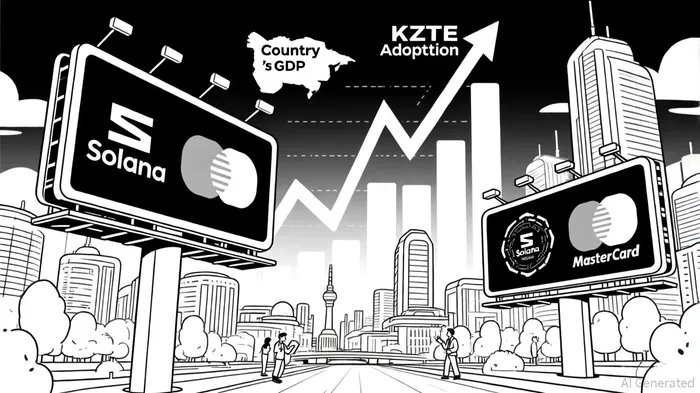
Kazakhstan's launch of Evo (KZTE), a tenge-pegged stablecoin on SolanaSOL--, marks a pivotal moment in the country's digital finance strategy. This initiative, spearheaded by the National Bank of Kazakhstan and supported by Intebix, Eurasian Bank, Solana, and MastercardMA--, is not just a technological experiment—it's a calculated move to position Kazakhstan as a regional leader in blockchain-driven financial innovation. For investors, the project represents a unique intersection of macroeconomic tailwinds, fintech acceleration, and strategic partnerships, all of which are reshaping the investment landscape in emerging markets.
Macroeconomic Tailwinds: Growth, Inflation, and Digital Resilience
Kazakhstan's economy is projected to grow by 4.5–5.0% in 2025, driven by oil production, fiscal stimulus, and structural reforms[1]. The country's GDP expanded by 6% in the first four months of 2025, with construction, trade, and transport sectors leading the charge[2]. However, inflation remains a challenge at 9.8% year-on-year, fueled by rising service prices and fiscal expansion[3]. In this context, KZTE's peg to the tenge offers a hedge against inflation while enabling seamless crypto-fiat conversions. By anchoring the stablecoin to a local currency, Kazakhstan addresses a critical pain point in emerging markets: the need for stable, low-cost digital assets that align with domestic economic conditions.
The National Bank's broader digital strategy—including a CBDC (digital tenge) launched in 2023 and a planned national crypto reserve—further underscores its commitment to financial modernization[4]. These initiatives are designed to reduce reliance on foreign assets, enhance cross-border transaction efficiency, and attract foreign investment. For investors, this signals a government that is not merely reacting to global trends but actively shaping them.
Fintech Acceleration: A Digital Infrastructure Play
Kazakhstan's fintech sector has quadrupled in five years, with 40% of venture capital financing in 2023 directed toward digital innovation[5]. The country now ranks first in the Commonwealth of Independent States (CIS) for e-government development, with 86% of transactions cashless and 81% of the population using mobile banking[6]. The National Bank's Open API and Open Banking projects, launched in 2023, process over 320,000 daily requests, laying the groundwork for KZTE's integration into existing financial systems[7].
The partnership with Solana—a blockchain known for its high throughput and low fees—amplifies this momentum. By leveraging Solana's infrastructure, KZTE can process transactions at a fraction of the cost of Ethereum-based stablecoins, making it attractive for both retail and institutional use cases. Mastercard's involvement adds another layer of credibility, as the stablecoin will soon support card-linked payments, bridging the gap between crypto and traditional finance[8].
KZTE in the Global Stablecoin Ecosystem: A Sovereign-Backed Differentiator
While USD-pegged stablecoins like USDTUSDT-- and USDCUSDC-- dominate global markets, KZTE's tenge peg offers a unique value proposition. Unlike fiat-backed stablecoins that rely on U.S. dollar reserves, KZTE is sovereign-backed, reducing exposure to foreign exchange volatility. This model aligns with trends in emerging markets, where local-currency stablecoins are increasingly used to mitigate inflation and facilitate cross-border trade[9].
Globally, stablecoin transaction volumes surged to $4.1 trillion in February 2025, with B2B transactions driving much of the growth[10]. Kazakhstan's KZTE, though in a pilot phase, is positioned to capture a slice of this market. The country's pilot zone, CryptoCity, where citizens can use crypto for everyday transactions, further tests real-world adoption[11]. If successful, this could catalyze broader use cases, from remittances to DeFi, mirroring the trajectories of stablecoins in Argentina and Nigeria[12].
Strategic Partnerships and Regulatory Innovation
The National Bank's regulatory sandbox approach is a key enabler. By testing KZTE in a controlled environment, regulators can address risks like money laundering and market stability while fostering innovation[13]. This contrasts with the fragmented regulatory landscapes in many emerging markets, where stablecoin adoption is often stifled by uncertainty. Kazakhstan's proactive stance—allowing AIFC firms to pay regulatory fees in stablecoins and exploring an investment stablecoin—demonstrates a willingness to experiment[14].
Mastercard's integration is equally significant. By enabling KZTE to be used for card payments, the stablecoin gains access to a global network of merchants, accelerating its utility beyond crypto-native users. This mirrors the success of USD Coin (USDC) in Latin America, where card-linked payments have driven adoption[15].
Risks and Considerations
Despite its promise, KZTE faces challenges. The pilot phase means adoption rates and transaction volumes are still unproven. Geopolitical risks, such as secondary sanctions and commodity price volatility, could also impact Kazakhstan's macroeconomic stability[16]. Additionally, the success of KZTE depends on the National Bank's ability to maintain the tenge's peg, which requires robust foreign exchange reserves and fiscal discipline.
Investment Thesis: A High-Growth, High-Impact Opportunity
For investors, KZTE represents a high-growth opportunity at the intersection of macroeconomic resilience, fintech innovation, and strategic partnerships. The stablecoin's alignment with Kazakhstan's digital tenge and crypto reserve ambitions positions it as a cornerstone of the country's financial modernization. With Solana's infrastructure and Mastercard's global reach, KZTE has the potential to scale rapidly, particularly in markets where local-currency stablecoins are in demand.
Moreover, Kazakhstan's broader fintech ecosystem—bolstered by government initiatives like the “Digital Kazakhstan” program and the Astana International Financial Centre—creates a fertile ground for KZTE's expansion. As emerging markets increasingly adopt digital assets, KZTE's sovereign-backed model could serve as a blueprint for other nations seeking to balance innovation with stability.
Conclusion
Kazakhstan's KZTE stablecoin is more than a technological experiment—it's a strategic lever for economic diversification and financial inclusion. By combining macroeconomic strength, fintech agility, and global partnerships, the project offers a compelling investment case for those seeking exposure to emerging markets' digital transformation. As the world watches, Kazakhstan may well emerge as a model for how nations can harness blockchain to build resilient, inclusive financial systems.





Comentarios
Aún no hay comentarios