
Kaspa's Stability and Snek's Rising Momentum in the Post-Volatility Crypto Market
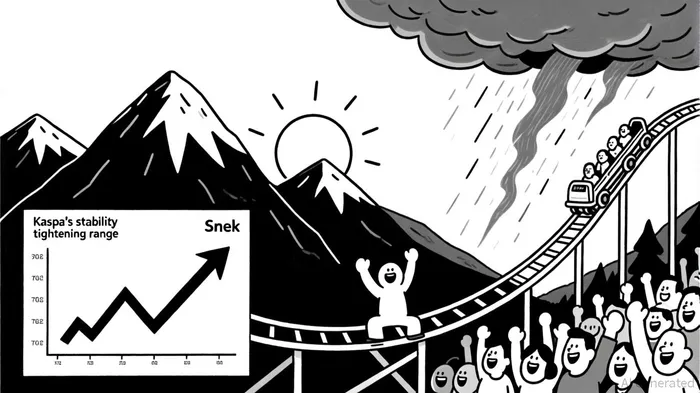
The crypto market in 2025 is no longer a wild west of speculative frenzy. Post-volatility, investors are increasingly prioritizing holder sentiment and on-chain demand as barometers of short-term investment potential. Two tokens—Kaspa (KAS) and Snek (SNEK)—stand out as contrasting case studies in this evolving landscape. While Kaspa embodies stability through its resilient holder base and impending technological upgrades, Snek's meteoric rise as a meme coin highlights the risks and rewards of momentum-driven speculation.
Kaspa: A Fortress of Stability in a Fragmented Market
Kaspa's on-chain data tells a story of conviction. 58% of its supply has remained unmoved for over six months, a metric that signals deep-rooted trust in the network's long-term value proposition[2]. This is rare in a market where short-term trading dominates. The token's price action further reinforces this narrative: after rebounding from a support level at $0.072, KAS has stabilized above $0.08, with a tightening trading range suggesting imminent breakout potential[1].
The August 31 smart contract upgrade is a critical catalyst[4]. Such upgrades often unlock new use cases (e.g., decentralized finance or NFTs), historically driving demand spikes. On-chain accumulation patterns—such as wallets holding KAS above its long-term holder realized price of $0.06—indicate that investors are buying the dip rather than selling into strength[3]. Even a recent 11.25% weekly correction has failed to dent long-term optimism, underscoring Kaspa's role as a “safe haven” in a volatile sector[5].
Snek: The Meme Coin's Double-Edged Sword
Snek's story is one of explosive momentum. Over the past month, SNEK has surged 636.85%, trading at $0.0046895 as of September 10[2]. Its rise mirrors that of Pepe and DogecoinDOGE--, fueled by Cardano's growing meme coin ecosystem and deflationary mechanics[1]. Technical indicators remain overwhelmingly bullish, with 21 out of 21 signals pointing upward as of August 14[4].
Yet, the data reveals cracks beneath the surface. Mixed price predictions abound: some models forecast a 25% drop to $0.003852 by September 12[4], while others project a 5% annual growth rate to $0.004961 by 2030[6]. This volatility is compounded by a lack of on-chain demand metrics—transaction volume, wallet activity, or blockchain analytics—to validate the token's fundamentals[6]. Without such data, Snek's momentum remains a “hot hand” bet, reliant on community hype rather than structural demand.
The Investor's Dilemma: Stability vs. Momentum
In a post-volatility market, the choice between Kaspa and Snek hinges on risk tolerance. Kaspa's holder sentiment and on-chain stability make it a defensive play, ideal for investors seeking exposure to a project with tangible upgrades and a resilient base. Snek, meanwhile, appeals to those chasing high-risk, high-reward scenarios—a token that could either cement its place in the meme coin pantheon or collapse under its own hype.
The absence of on-chain demand data for Snek is a red flag[6]. While holder sentiment is positive, it is not a substitute for metrics like transaction throughput or wallet growth. Kaspa, by contrast, offers a more transparent value proposition: its price action and holder behavior align with a network preparing for a pivotal upgrade.
Conclusion
The post-volatility crypto market demands a new lens for evaluating assets. Kaspa's stability and Snek's momentum are not mutually exclusive but represent divergent philosophies. For investors prioritizing holder conviction and on-chain fundamentals, Kaspa's fortress-like structureGPCR-- offers a compelling case. For those willing to ride the meme coin wave, Snek's meteoric rise is a reminder that momentum can be both a tailwind and a trap.
As always, the key lies in aligning one's risk profile with the data—whether it's Kaspa's unshakable holders or Snek's unpredictable price swings.






Comentarios
Aún no hay comentarios