
Kaspa's Quiet Revolution: How a High-Speed BlockDAG is Building the Infrastructure for Real-World Crypto Adoption
The blockchain industry has long been haunted by a paradox: while the technology promises to disrupt traditional finance, most projects remain trapped in speculative hype cycles with little tangible utility. Kaspa (KAS), however, is emerging as a rare exception. By combining a technically robust blockDAG architecture with aggressive merchant integration strategies, the project is quietly constructing a bridge between crypto's speculative past and its utility-driven future. For investors seeking to capitalize on the next phase of blockchain adoption, Kaspa's 2025 developments offer a compelling case study in how infrastructure innovation can catalyze real-world demand.
Technical Foundations: Speed, Scalability, and Security
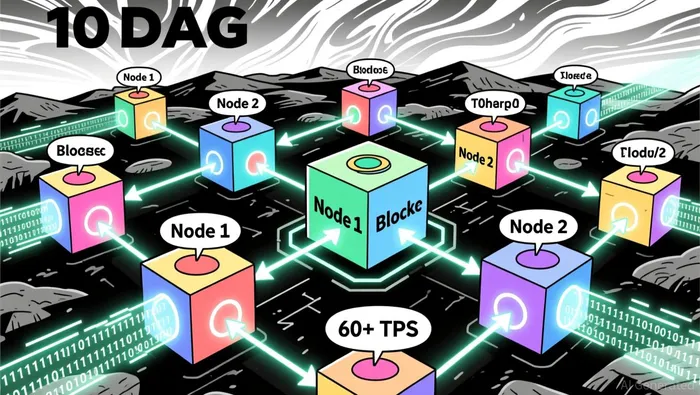
Kaspa's blockDAG (Directed Acyclic Graph) architecture has always been its differentiator, but 2025's Crescendo hard fork elevated its potential to a new level. By increasing throughput to 10 blocks per second-a rate that translates to over 60 transactions per second-the network now rivals centralized payment processors in speed while maintaining decentralized security according to technical reports. This is not just a technical achievement; it's a strategic enabler for real-world adoption. Merchants require low fees and near-instant confirmations to justify accepting crypto, and Kaspa's post-Crescendo performance meets those criteria.
The introduction of vProgs (verifiable programs) further solidifies this foundation. By allowing complex computations to occur off-chain while anchoring cryptographic proofs to Layer 1, Kaspa preserves its base layer's speed and security while enabling sophisticated applications. This separation of transaction ordering from computation mirrors Ethereum's Layer 2 strategies but is baked into Kaspa's architecture from the start, reducing friction for developers and users alike.
Merchant Integration: From Theory to Practice
Kaspa's technical prowess is only as valuable as its ability to attract merchants. In 2025, the project made significant strides in this area through initiatives like Kasway, a decentralized point-of-sale (PoS) system developed by Atomik Labs. Kasway's features-real-time fiat conversion, retry protection, and PDA-style address generation-address critical pain points for retail adoption. Merchants can now accept KAS without exposing themselves to price volatility or transaction failures, two major barriers to crypto adoption.
The Kaspa Store Directory program has also gained traction, incentivizing merchants to display "KASPA Accepted" branding and integrate cryptocurrency checkout systems. While specific case studies of large corporate partnerships remain undisclosed, the grassroots approach is paying dividends. Over 10,000 daily active users and a DApp ecosystem of more than 100 decentralized applications signal growing real-world utility. This is not just speculative activity; it's the infrastructure of a functional digital economy.
Ecosystem Momentum: DeFi and Enterprise Readiness
Kaspa's 2025 roadmap also prioritized DeFi and enterprise adoption. The launch of Kasplex, a zkEVM-compatible Layer 2, attracted early liquidity solutions and decentralized exchanges. This compatibility with EthereumETH-- tooling is a strategic masterstroke, allowing developers to port existing DeFi applications to Kaspa's high-speed network without rewriting code from scratch. Meanwhile, the Kaspa Industrial Initiative (KII) is targeting enterprise use cases in supply chain, healthcare, and logistics, leveraging the blockDAG's scalability for cross-border payments.
The network's performance in October 2025- processing 158 million transactions in a single day-underscores its capacity to handle high-volume, mission-critical applications. This is not the kind of activity seen in speculative altcoins; it's the footprint of a network being used for actual commerce.
Risks and Realities
No investment thesis is complete without acknowledging risks. Kaspa's recent 17% price decline in December 2025, triggered by the shutdown of a key infrastructure tool, highlights vulnerabilities in centralized control and funding sustainability. While the community has since stepped in to address these issues, they serve as a reminder that even the most technically sound projects can face governance challenges.
However, these risks are not unique to Kaspa and are often part of the maturation process for blockchain ecosystems. The project's deflationary tokenomics- fixed supply of 28.7 billion coins and a declining emission rate-provide a long-term tailwind for value retention. More importantly, Kaspa's focus on infrastructure over speculation positions it to weather market cycles better than projects reliant on hype.
The Investment Case: Timing the Inflection Point
For investors, the key question is whether Kaspa's developments represent a temporary spike or a sustainable inflection point. The evidence leans heavily toward the latter. The DAGKnight upgrade, scheduled for Q1 2026, promises to eliminate fixed latency parameters. This, combined with ongoing Layer 2 expansion and enterprise partnerships, creates a flywheel effect: faster transactions attract more merchants, which in turn attract more developers and users.
Kaspa's price forecasts for 2025–2030, ranging from $0.15 to $1.73, reflect growing confidence in its long-term potential. But price is secondary to utility. As the crypto market shifts from speculative trading to real-world adoption, projects like Kaspa-those with the infrastructure to support it-will outperform.
Conclusion: A Bridge to the Future
Kaspa's 2025 developments are more than incremental improvements; they represent a fundamental shift in how blockchain can serve as a backbone for global commerce. By combining high-speed blockDAG technology with merchant-friendly tools and enterprise-grade scalability, the project is building a bridge between crypto's speculative past and its utility-driven future. For investors, the opportunity lies in recognizing this transition early-before broader market awareness turns infrastructure innovation into a crowded investment race.






Comentarios
Aún no hay comentarios