
Kaspa (KAS) as a Structural Innovation in Proof-of-Work Blockchain
The blockchain trilemma-balancing scalability, security, and decentralization-has long been a thorny challenge for the crypto space. BitcoinBTC--, the original proof-of-work (PoW) blockchain, prioritized security and decentralization but sacrificed scalability, with its 10-minute block times and limited throughput. Enter Kaspa (KAS), a project that claims to redefine PoW by leveraging a blockDAG architecture to achieve unprecedented scalability without compromising decentralization. Let's break down why this matters for investors and how Kaspa's approach could reshape the future of value transfer and decentralized applications.
The BlockDAG Revolution: Scaling PoW Without Compromise
Kaspa's core innovation lies in its Directed Acyclic Graph (DAG) structure, which replaces Bitcoin's linear blockchain with a parallelized, multi-block validation system. Unlike Bitcoin, where each block must wait for the previous one to be confirmed, Kaspa's GHOSTDAG protocol allows multiple blocks to be validated simultaneously. This parallel processing enables Kaspa to process 10 blocks per second today, with plans to scale to 100 blocks per second in the future according to CoinMonks analysis.
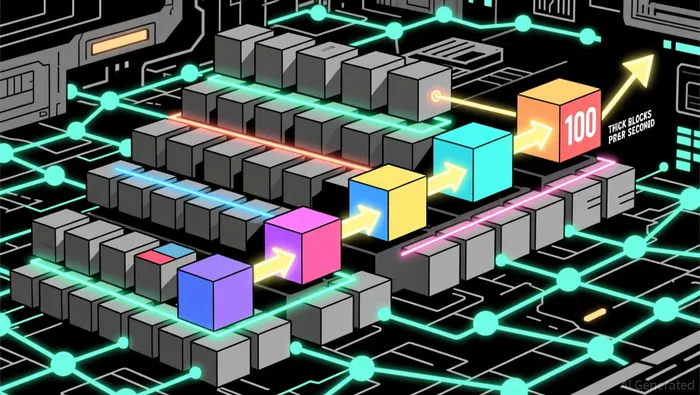
The implications are staggering. While Bitcoin struggles with a throughput of ~7 transactions per second (TPS), Kaspa's current network can handle 5,705 TPS according to CoinLaw data, a figure that dwarfs even the most optimistic estimates for Bitcoin's Lightning Network. This isn't just incremental improvement-it's a structural leap. By integrating all mined blocks into the consensus process (rather than orphaning conflicting ones), Kaspa eliminates the inefficiencies of traditional blockchains while maintaining a robust PoW model as reported by Kaspa.org.
PoW 2.0: Energy Efficiency and Decentralized Mining
Critics often argue that PoW is inherently energy-intensive and centralizing. Kaspa counters this with the kHeavyHash algorithm, an energy-efficient PoW mechanism designed to lower the barrier to entry for miners. This approach not only reduces environmental impact but also fosters broader participation, ensuring that mining remains decentralized. According to the Kaspa team, the algorithm's design allows for mining using consumer-grade hardware, a stark contrast to Bitcoin's reliance on specialized ASICs.
Moreover, Kaspa's blockDAG architecture inherently resists centralization. By allowing parallel block creation, the network avoids the "block race" dynamics that incentivize large mining pools in Bitcoin. This creates a more equitable mining ecosystem, where smaller participants can coexist with larger ones without being outcompeted as detailed in CoinMonks analysis.
Real-World Utility: K Social and the Dawn of On-Chain Social Media
Scalability is one thing; real-world adoption is another. Kaspa's K Social platform, launched in December 2025, demonstrates how blockDAG architecture can power decentralized social networks. K Social is a microblogging app where user posts are stored as on-chain transactions, leveraging Kaspa's high throughput to enable real-time interactions. Each post costs just 0.00002 KAS to publish, making it accessible for everyday users according to CoinMarketCap updates.
The platform's success is already evident. As of late 2025, K Social has attracted 10,000 daily active users and 500,000 social media followers across platforms like Twitter and Telegram as reported by Gate. More importantly, the network processed 158 million transactions in a single day in October 2025, a testament to its ability to handle high-volume use cases according to CoinLaw statistics. This isn't just a social experiment-it's a proof of concept for how blockDAG can support scalable, user-centric applications.
Market Adoption and Investment Rationale
Kaspa's market metrics further strengthen its investment case. As of late 2025, the project has a $1.18 billion market cap and a circulating supply of 27.06 billion KAS according to CoinLaw data. The network's active address count surged 150% year-over-year to 545,600, indicating robust participation as detailed in Gate analysis. Institutional interest is also growing, with Marathon Digital allocating resources to mine Kaspa and $35 million in whale accumulation reported in November 2025 as reported by Kaspa.org.
Looking ahead, Kaspa's roadmap is ambitious. The Crescendo hard fork in May 2025 increased block production from 1 to 10 per second, while the upcoming DagKnight upgrade in early 2026 promises faster finality and enhanced security according to Kaspa.org updates. These upgrades, coupled with initiatives like the Kaspathon hackathon (offering 200,000 KAS in prizes), signal a commitment to innovation and ecosystem growth as detailed in Kaspa.org milestones.
Contrasting Kaspa with Bitcoin: A New Paradigm
Bitcoin's limitations are well-documented. Its 10-minute block time and 7 TPS throughput make it ill-suited for modern use cases like microtransactions or real-time payments. While layer-2 solutions like the Lightning Network offer partial fixes, they introduce complexity and centralization risks. Kaspa, by contrast, tackles scalability at the protocol level, offering sub-ten-second finality and 5,705 TPS without relying on off-chain networks as analyzed on LinkedIn.
This isn't to dismiss Bitcoin's role as digital gold. However, for investors seeking exposure to a PoW blockchain that can scale to meet global demand, Kaspa presents a compelling alternative. Its blockDAG architecture and energy-efficient PoW model position it as a "Bitcoin 2.0" for value transfer, while its ecosystem initiatives (like K Social) demonstrate practical utility.
Conclusion: A Strategic Bet on the Future of PoW
Kaspa's blockDAG architecture represents a structural innovation in PoW blockchain, solving the scalability dilemma without compromising decentralization. With real-world applications like K Social already gaining traction and a roadmap that includes cutting-edge upgrades like DagKnight, the project is well-positioned to capture a significant share of the value transfer market. For investors, the combination of technical superiority, growing adoption, and institutional interest makes KAS a high-conviction play in 2025 and beyond.
As the crypto space evolves, projects that can scale without sacrificing decentralization will dominate. Kaspa isn't just keeping up-it's leading the charge.







Comentarios
Aún no hay comentarios