
Kaspa (KAS) Price Volatility Amid Growing Network Adoption: Is the Dumping a Buying Opportunity or a Red Flag?
The cryptocurrency market's latest volatility has cast a spotlight on Kaspa (KAS), a project that has simultaneously faced a sharp price correction and demonstrated robust network adoption. As of October 2025, KAS has dropped by -17.75% in just three days, with predictions suggesting further declines to $0.0663 by October 6 and $0.058032 by October 10, according to Changelly's forecast. This bearish technical picture contrasts with on-chain metrics showing record transaction volumes and ecosystem advancements. For investors, the question looms: Is this price drop a strategic entry point or a warning sign?
Technical Analysis: A Bearish Narrative
Kaspa's price action in October 2025 paints a clear bearish picture. The RSI and MACD indicators have both turned negative, with the RSI on daily charts hovering near oversold levels but failing to trigger a sustained rebound, according to a CoinCodex analysis. The asset is trading below critical moving averages-the 50DMA ($0.11766), 100DMA ($0.13263), and 200DMA ($0.14156)-reinforcing a downtrend, per a Kasmedia report. A head-and-shoulders pattern has also formed, suggesting a potential 70% decline to $0.040 if the neckline breaks, according to the CoinGecko chart.
Market sentiment, while mixed, leans heavily bearish. The Fear & Greed Index stands at 63 (greed), yet 84% of indicators signal a bearish outlook, according to the Changelly forecast. This paradox reflects a market caught between short-term panic selling and lingering optimism about Kaspa's fundamentals. However, the descending triangle pattern and weak volume suggest that sellers currently dominate.
Ecosystem Growth: A Foundation for Long-Term Value
Despite the price drop, Kaspa's ecosystem has made strides that could underpin future growth. The DAGKNIGHT 2.0 Protocol, launched in September 2025, improved finality speeds by 40% and reduced orphaned blocks, enhancing scalability for real-world applications, according to a CoinMarketCap update. Meanwhile, the Casplex Layer-2 solution activated in August 2025 enabled EVM-compatible smart contracts, unlocking DeFi and NFT use cases, per Coingape's forecast.
On-chain activity has surged, with daily transactions spiking to 1.92 million in September 2025-a 134% increase from the prior day-and daily active addresses surpassing 500,000, per a CryptoNews report. The KRC-20 token expansion further streamlined deployment, reducing costs by 15% and supporting projects like $ROCK and $KANDO, as CoinMarketCap notes. These developments suggest Kaspa is building a robust infrastructure, even as its price languishes.
On-Chain Metrics: Whale Accumulation vs. Exchange Outflows
On-chain data reveals a nuanced picture. Whale activity has been bullish, with large holders accumulating millions of KAS during the October dip, according to a Cryptois report. This contrasts with exchange outflows, which spiked during the November 2024 price drop, indicating panic selling, per a CaptainAltcoin analysis. However, late December 2024 saw inflows exceed $4 million, temporarily stabilizing the price, as CaptainAltcoin later noted.
The Network Value to Transactions (NVT) ratio, while not explicitly quantified in recent reports, likely reflects a disconnect between price and usage. With over 158 million transactions processed on October 5, 2025, and a price of $0.079, the NVT suggests the network's value is undervalued relative to its throughput, according to a BSC News report. This divergence often precedes price corrections in high-adoption projects.
Valuation Alignment: A Buying Opportunity or a Red Flag?
The key to assessing Kaspa lies in reconciling its technical bearishness with its fundamental strength. The MVRV Z-Score indicates significant undervaluation compared to historical norms, suggesting current levels could be attractive for long-term investors, per the Kasmedia report. However, the asset must first break above key resistances ($0.100–$0.105) to confirm a trend reversal, a point also raised by Kasmedia.
For risk-tolerant investors, the price drop offers an entry point to capitalize on Kaspa's ecosystem growth. The DAGKNIGHT 2.0 upgrade and Layer-2 adoption position KAS to benefit from broader DeFi and Web3 trends. Conversely, the bearish technical setup and weak macro conditions (e.g., regulatory uncertainty) pose risks. A strategic approach might involve dollar-cost averaging into dips while monitoring on-chain metrics for signs of sustained accumulation.
Conclusion: A Calculated Bet on Resilience
Kaspa's October 2025 price drop is a textbook example of market volatility clashing with foundational progress. While technical indicators scream caution, the project's ecosystem advancements and whale activity hint at a potential rebound. Investors must weigh the immediate risks of a 70% downside against the long-term potential of a blockchain with 10-block-per-second throughput and DeFi-ready infrastructure. For those who believe in Kaspa's vision, this may be a rare opportunity to buy into a project poised for growth-provided they're prepared to weather the storm.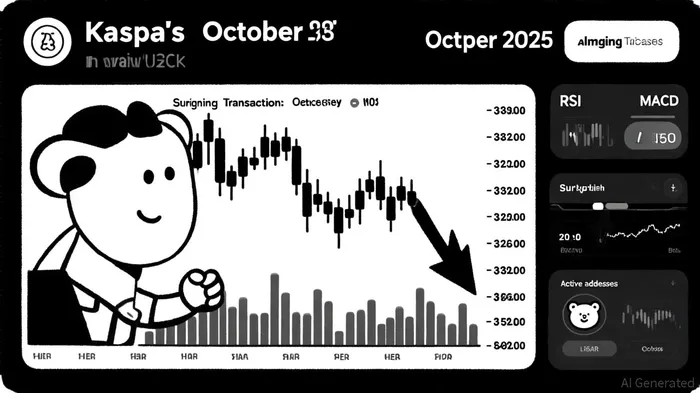







Comentarios
Aún no hay comentarios